
 All Courses


 5.0











Just finished college and wondering what to learn first? You’re not alone. Many freshers spend months on random tutorials, then find job posts asking for skills they never practised. We built this guide at 99Eedu Institute to fix that. It shows you the exact skills to learn in a Web Development Course in Kolkata, step by step, with a simple project for each one. Follow it, and you’ll know what to study, what to build, and what to ask before you pay any fee.
Is web dev still worth it in 2027?
Yes, learning web development will still be relevant in 2026. If a suitable web development course in Kolkata provides more than simply fundamental instruction, you may do this. Websites, apps, dashboards, and online shopfronts are all necessary for organisations. Thus, they require developers to build and maintain these.
The level of competition in the job market has increased. Hence, it becomes necessary for organisations to seek evidence of your learning. They want proof of the projects you have developed, neat coding skills, and the reasoning behind certain choices made by you. It is important to go for a Web Development Course in Kolkata that offers the complete package.
Why you should choose skills before you choose a course
Choose skills first, because a brochure promises topics while a portfolio proves ability. I have watched students compare three institutes by fee and timing alone. A Web Development Course in Kolkata deserves judgment by what you can build in week ten.
The city offers three kinds of openings. Service companies and agencies around Sector V and New Town hire freshers in volume. Startups hire fewer people but expect wider skills from each one. Freelance clients, often small businesses down the road from you, pay for a working site and don’t care about your marks.
HTML and CSS: the foundation most freshers rush
Semantic HTML5 and modern CSS come first, because every framework you learn later compiles down to them. Skip this stage and React will confuse you in week six.
What to learn:
- Semantic tags: header, nav, main, article, section, footer
- Forms, labels, and built-in input validation
- Flexbox and Grid. Both, not just one.
- Responsive layouts with media queries and relative units
- CSS custom properties for colours, spacing, and dark mode
- Basic accessibility: alt text, visible focus states, colour contrast
Why bother with accessibility and semantics? Screen readers read your structure. So do search engines and AI answer tools. A page with clean headings and labelled sections is easier to parse and quote than a pile of anonymous divs. Structure is not decoration. It has meaning.
Practice with a real brief. Build a mobile-first site for a Park Street cafe or a Gariahat boutique. No framework. No Bootstrap. You can add Bootstrap later, once you know what it hides from you.
A solid front-end development course in Kolkata spends two to three weeks here and makes you hand-code layouts. If a trainer jumps to a CSS library on day four, ask why. You will pay for that shortcut later, usually at an interview, when someone asks you to centre a div without a library.
JavaScript: where your study hours should go
JavaScript deserves the largest share of your hours, because it runs your front-end logic and, through Node.js, your server too. Weak JavaScript is the most common reason I see freshers fail technical rounds.
Core topics:
- Variables, scope, closures, hoisting
- Array methods: map, filter, reduce
- DOM manipulation and event delegation
- Promises, async/await, and the fetch API
- ES modules, destructuring, spread syntax
- Error handling with try/catch
- The event loop, at least conceptually
Interviewers love closures and async behaviour. Not because they enjoy trivia. Those two topics separate people who understand the language from people who memorised snippets.
Git, GitHub, and the terminal
Learn Git in your first week, because every team you join will assume you already know it. I mean it. Week one, not week twelve.
Minimum toolkit:
- git init, add, commit, push, pull
- Branching and merging
- Opening and reviewing a pull request
- Resolving a merge conflict without panic
- Writing commit messages a human can read
The terminal matters too. Moving through folders, running scripts, and reading error output are daily tasks, not advanced ones.
Your GitHub profile works as a second resume. Green squares prove nothing by themselves. A good README proves a lot. Write each README with a screenshot, the tech stack, setup steps, and a live link. A recruiter who opens your repo and finds that structure already trusts you more than the next candidate.
React: your first front-end framework
React is the safest first framework to learn, because many front-end openings still ask for it and its ideas carry over to Vue, Svelte, and Angular. I say safest, not best. Pick one and finish it.
One rule: don’t start React until you can build an interactive page without it. Students who skip this rule end up copying patterns they can’t debug.
What to cover:
- Components, props, and state
- useEffect and the rules of hooks
- Custom hooks and context
- Client-side routing
- Controlled forms and validation
- Fetching and caching data from an API
- A first look at Next.js for server rendering
Any front-end development course in Kolkata worth its fee ends with a React project that talks to a real API, handles loading and error states, and ships to a live URL. Loading and error states sound small. They are where junior code usually breaks.
Back-end development: pick one stack and go deep
Pick one back-end stack and go deep; Node.js with Express is the quickest route if you already know JavaScript. Spreading yourself across four languages gives you four shallow résumés.
A good back-end development course in Kolkata teaches routing, middleware, authentication, validation, error handling, and environment variables. Not just how to return Hello World from a route.
| Stack | Language | Good for | Trade-off |
|---|---|---|---|
| Node.js + Express | JavaScript | Startups, APIs, one language end to end | Few built-in rules, so you structure it yourself |
| Django | Python | Data-heavy apps, fast admin panels | Heavier framework to learn |
| Laravel | PHP | Agency and freelance client work | Smaller overlap with front-end skills |
| Spring Boot | Java | Large enterprise systems | Steeper learning curve for beginners |
Security belongs in week one of back-end work, not as an afterthought:
- Hash passwords with bcrypt. Never store plain text.
- Understand sessions versus JWTs, and when each fits.
- Validate every input on the server.
- Use parameterised queries to block SQL injection.
- Configure CORS on purpose, not by accident.
If your login form stores a raw password, you have not built a login. You have built a liability.
Databases: SQL first, then MongoDB
Learn SQL first and add MongoDB second, because relational thinking applies everywhere and shows up in nearly every interview. Pick PostgreSQL or MySQL. Either works.
SQL checklist:
- Tables, primary keys, foreign keys
- Joins (inner and left, at minimum)
- GROUP BY and aggregate functions
- Indexes and why they speed up reads
- Normalisation, in plain language
- Transactions
Then move to MongoDB: documents, collections, schema design, and basic aggregation. The real skill is choosing between them. Highly connected data with strict rules, like orders and payments, fits SQL. Flexible, nested data, like content blocks or activity logs, fits MongoDB.
Try this exercise. Design a schema for an online store with users, products, orders, and order items. Then write the query that returns the five best-selling products last month. If you can do that cold, you are ahead of many applicants.
APIs: how front end and back end actually talk
An API skill means you can build, document, test, and secure endpoints, and consume other people’s endpoints without panic. Most real projects spend more time on APIs than on pretty screens.
Learn REST properly:
- Resources and HTTP verbs: GET, POST, PUT, PATCH, DELETE
- Status codes: 200, 201, 400, 401, 403, 404, 500
- JSON request and response design
- Pagination, filtering, and sorting
- API keys, rate limiting, and CORS
- Testing with Postman or Thunder Client
- Documentation with OpenAPI (Swagger)
Use local, relatable integrations. Connect a payment gateway in test mode, such as Razorpay. Pull a map from a maps API. Send an email through a transactional email service. Each integration teaches you how to read someone else’s documentation, which is half the job.
One warning. Never hard-code a secret key in your front-end code. Anyone can read it in the browser. Keep secrets on the server, in environment variables.
Deployment: ship everything you build
Deploy every project, because a live URL tells a recruiter more than a screenshot ever will. A project that only runs on your laptop is a draft.
A beginner-friendly hosting path:
- Front end: Vercel or Netlify
- Back end: Render or Railway
- Database: MongoDB Atlas or a managed PostgreSQL service
Free tiers change often, so check current limits before you commit a project to one.
What to learn beyond clicking Deploy:
- How domains and DNS point to your app
- Why HTTPS matters and how certificates renew
- Environment variables across local and production
- Reading build logs when a deploy fails
- A basic CI pipeline with GitHub Actions
- Docker at an introductory level
You will break a deployment at least once. Good. Fixing that failure teaches more than a week of lectures.
Performance, SEO, and accessibility for developers
Developers who understand Core Web Vitals, structured data, and clean markup stand out in 2026, because speed and structure now decide how often a site gets found. Most freshers skip this. You shouldn’t.
Start with Google’s three Core Web Vitals: ‘Largest Contentful Paint (loading), Interaction to Next Paint (responsiveness), and Cumulative Layout Shift (visual stability). Interaction to Next Paint replaced First Input Delay in March 2024, so older tutorials may teach the outdated metric. Run Lighthouse and PageSpeed Insights on every project and fix what they flag.
Practical techniques:
- Serve images in WebP or AVIF, and lazy-load below-the-fold images
- Split large JavaScript bundles
- Cache static assets
- Set explicit width and height on images to prevent layout shifts
- Load fonts without blocking the first paint
Then learn the developer side of SEO:
- Unique title tags and meta descriptions
- Canonical URLs, sitemap.xml, robots.txt
- One H1 per page, logical H2 and H3 order
- Schema.org markup in JSON-LD for articles, organisations, and FAQs
Why this matters for GEO, or Generative Engine Optimisation: AI answer tools tend to pull from pages that state answers directly under clear headings and carry structured data. Content that appears only after heavy client-side scripts is harder for crawlers to read reliably, so server rendering helps.
One honest caveat: Google has narrowed FAQ rich results, so don’t promise client-side snippets. Structured markup still helps machines understand a page.
A developer who explains this to a marketing team becomes useful in week one.
AI-assisted coding: use it, but don’t hide behind it
Treat AI coding tools like a fast junior pair programmer: useful, often wrong, and never a substitute for understanding. We teach one rule. Explain every line before you commit it.
Good uses:
- Boilerplate and repetitive setup
Regular expressions and test data
Explaining an unfamiliar error message
Suggesting test cases you forgot
Bad uses:
- Authentication and payment code you never reviewed
- Whole projects you cannot explain
- Answers pasted into interviews
The skill that matters is review
Read the diff. Run the tests. Ask what breaks with empty input, a huge input, or a hostile one. Interviewers increasingly ask candidates to walk through their own code live, and copied work collapses in about two minutes.
Problem solving and communication
close calls between candidates. Technical skill gets you the interview. These get you the offer.
On the problem-solving side, practice:
- Arrays, strings, and hash maps
- Recursion and simple sorting
- Big-O thinking at a basic level
- Two or three easy problems a day, rather than twenty on Sunday
On the communication side:
- Write READMEs that a stranger can follow
- Explain a design decision in sixty seconds
- Ask a clear question when you’re stuck, with what you tried and what you saw
- Practice speaking in English for client calls and interviews, even if it feels awkward at first
I’ve seen average coders beat strong ones because they could explain their trade-offs.
The full stack path: a 16-week roadmap
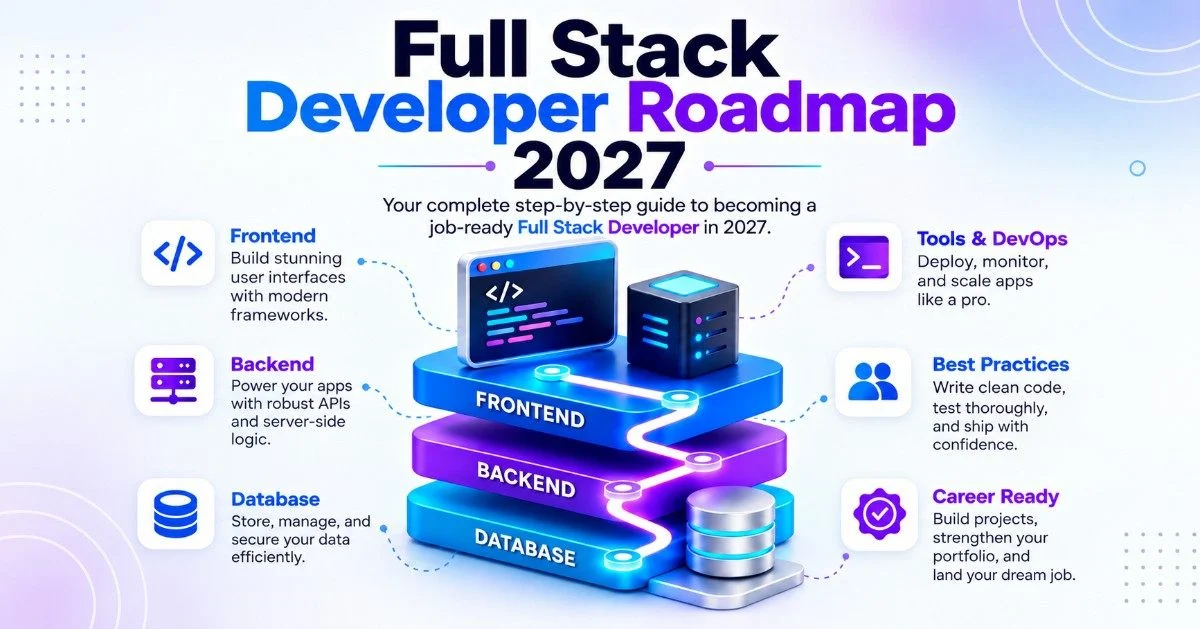
A full stack web development course in Kolkata should teach front end, back end, database, and deployment inside one connected project, not as four separate modules. Disconnected modules produce students who know pieces and can’t assemble them.
For a Website Development Training in Kolkata that begins at zero and requires three to four concentrated hours every day, sixteen weeks is a reasonable goal. Part-time college students should aim to double it.
| Weeks | Focus | What you finish |
|---|---|---|
| 1–3 | HTML, CSS, Git | Responsive portfolio site |
| 4–7 | JavaScript | Three small interactive apps |
| 8–10 | React | Dashboard with routing and API data |
| 11–13 | Node.js, Express, SQL, MongoDB | REST API with authentication |
| 14–15 | Integration and deployment | Live full-stack app |
| 16 | SEO, performance, interview prep | Polished portfolio and resume |
Weeks 11 to 13 are where a back-end development course in Kolkata earns its fee, since authentication and database design trip up most beginners. Slow down there. Nobody gets a prize for rushing.
Five portfolio projects that prove your skills
Build five projects, each proving a different skill, and deploy all of them. Five finished beats fifteen abandoned.
| Project | Skills it proves | Signal to employers |
|---|---|---|
| Local business website | HTML, CSS, responsive design | You can build what clients actually pay for |
| Expense tracker | JavaScript, DOM, local storage | You understand the language, not just a framework |
| Recipe or movie finder | React, API calls, error states | You handle real data and failure cases |
| Job board or mini store | Auth, CRUD, database, test payments | You can build a complete product |
| Capstone for a real user | Everything above, plus deployment | You solve problems, not exercises |
Project four is the one that makes a full-stack web development course in Kolkata worth finishing. Make the capstone personal. Build a booking system for a neighbourhood coaching centre or a clinic’s appointment page. Talk to the actual owner.
Real requirements are messier than tutorial requirements, and that mess is exactly what interviewers want to hear about. A job-oriented web development course in Kolkata should push you to finish these, review them, and polish them.
How to judge a course before you pay
Judge a course by the projects you will build, the trainers who review your code, the batch size, and honest placement support, not by the fee or the certificate. Use this checklist when you shortlist any Web Development Course in Kolkata:
- Is the full syllabus written down, week by week?
- Will a trainer review your code, or only play recorded videos?
- How many students sit in a batch?
- Can you attend a demo class first?
- Can you speak to former students, not just read testimonials?
- Does the course include Git, deployment, and API work, or stop at HTML and a framework?
- Are mock interviews and resume reviews part of the plan?
A few specifics on how the common search phrases translate into real expectations:
Red flags:
- A guaranteed job with no conditions
- No demo class
- A syllabus built mainly on jQuery and outdated tools
- Projects copied identically by every student in the batch
Mistakes freshers make and how to avoid them
The costliest mistake is tutorial hopping, where you watch endless videos and build nothing. I see it constantly. It feels like progress. It isn’t.
Other common traps:
- Learning five frameworks at once. Pick React or Vue, finish one project, then decide.
- Skipping JavaScript fundamentals. Frameworks hide the gaps only until the interview.
- Never deploying. An undeployed project doesn’t exist for a recruiter.
- Ignoring Git. Teams notice in the first pull request.
- Applying with no portfolio. A resume of course names competes with hundreds of identical ones.
- Waiting to feel ready. Nobody feels ready. Apply when your portfolio has three live projects.
Good web development training in Kolkata gives you structure and feedback. Structure alone won’t make you skilled, though. Hours of your own typing will. And choosing an affordable web development course in Kolkata is smart, but spending less money doesn’t excuse spending less effort.
Why Students Choose 99Eedu Institute for Web Development
Students choose 99Eedu Institute because we teach web development through real projects, honest feedback, and a clear path from beginner to job-ready. We don’t sell certificates. We help you build something you can show an employer.
Here is what students tell us they want, and how we answer it.
Beginner-friendly teaching
You can start with zero coding experience. We begin with HTML and CSS, then move to JavaScript, one step at a time. If you get stuck, we explain it again in plainer words.
Projects over theory
You learn by building. Every skill in the course connects to a project: a responsive website, an interactive JavaScript app, a React dashboard, and a full-stack capstone. You deploy each one, so you end up with live links, not screenshots.
Trainer code reviews
A trainer reviews your code and tells you what to fix. That feedback is what separates a student who finishes a course from one who can pass a technical round. We point out messy structure, weak naming, and security gaps early, while they’re cheap to fix.
Skills employers ask for
Our course follows what junior job posts actually list. That means:
- HTML5, CSS3, and JavaScript (ES6+)
- Git and GitHub
- React for the front end
- Node.js, Express, and databases for the back end
- REST APIs and deployment
- Performance and SEO basics
Interview and portfolio support
We prepare you for the hiring process, not just the classroom. You practice mock interviews, get resume feedback, and polish your GitHub profile so your work is easy to read.
Honest guidance
We tell you the truth about the job market. Getting hired takes consistent practice and a solid portfolio, and we won’t promise a job we can’t guarantee. What we promise is structure, feedback, and support until your projects are ready.
Try before you commit
Attend a demo class before you pay. Ask questions, meet the trainer, and see how we teach. If it fits your goals, join. If it doesn’t, you’ve lost nothing.
About the Author
Year Ali (Yeash) is a Senior SEO & PPC Specialist and Digital Marketing Trainer at 99Eedu Institute, with over 10 years of experience tracking how Google Search changes and what it means for students and job seekers.
He trains hundreds of 12th pass students, graduates, and freshers, and he teaches them to use AI tools without falling for wrong facts or copied answers. His rule is simple: AI can speed up your learning, but it cannot replace it.
Yeash wrote this guide to show freshers which web development skills matter, including the SEO and performance basics that help every website get found.
Source: Year Ali(LinkedIn Profile).
People Also Ask
Q1. How long does a Web Development Course in Kolkata take?
Most beginners need four to six months of steady practice to become job-ready. A focused full stack program runs about sixteen weeks, but your deployed portfolio, not the calendar, decides whether you are ready to apply.
Q2. Which language should I learn first for web development?
Learn HTML and CSS first, then JavaScript. JavaScript runs in every browser and, through Node.js, on servers too, so one language covers the front end and the back end while you build confidence.
Q3. Do I need a computer science degree to become a web developer?
No, a degree is not required. Many employers hire junior developers based on portfolio quality and interview performance. A degree helps with some companies, but deployed projects and clear explanations matter more for most entry-level roles.
Q4. Will web dev be replaced by AI?
No, AI will change web development, but it won’t replace the people who do it well. AI tools already write boilerplate, suggest fixes, and speed up routine work. They still get things wrong, and someone has to judge the output, test it, secure it, and talk to the client. The developers at risk are the ones who only copy and paste. Learn the fundamentals, then use AI as a fast assistant.
Q5. Which IT job is the highest paid?
Roles in AI/machine learning, cloud architecture, cybersecurity, and senior engineering management usually pay the most. Pay depends on experience, company, and country, so no single title always wins. Web development is a solid way in, and many people later move toward architecture, cloud, or AI work once they have a strong coding base.
Q6.Can I learn HTML in 3 days?
You can learn the basics of HTML in 3 days, but not become job-ready. In three days, you can pick up headings, paragraphs, links, images, lists, tables, and forms, and build a simple one-page site. Semantic structure and accessibility take longer, and HTML only works well alongside CSS and JavaScript. Treat day three as a start, not a finish line.
Final Thoughts
You don’t need to learn everything to get your first job; a good Web Development Course in Kolkata teaches the right skills in the right order and helps you prove them with real projects.
Start with HTML, CSS, and JavaScript. Add Git, one framework, one back-end stack, and a database. Then deploy everything you build. That path is enough to get shortlisted, and the rest you’ll pick up on the job.
I’ve seen freshers with average marks get hired because their portfolio showed three live projects and a clear explanation of each. I’ve also seen toppers struggle because they had nothing to show. Skills beat scores here.
Start Your Web Development Career with 99Eedu Institute
Master essential web development skills, including HTML, CSS, JavaScript, responsive web design, front-end and back-end development, database management, and version control. At 99Eedu Institute, gain practical knowledge and industry-relevant skills to prepare for exciting career opportunities in web development.
Ready to kick-start your web development career? Book a free demo class at 99Eedu Institute today and explore how you can learn in-demand skills and turn your passion for technology into a rewarding career!
Share on:

Quick Enquiry
Please fill up the form and we will get back to you in next 12 hours!
