
 All Courses

 5.0
5.0




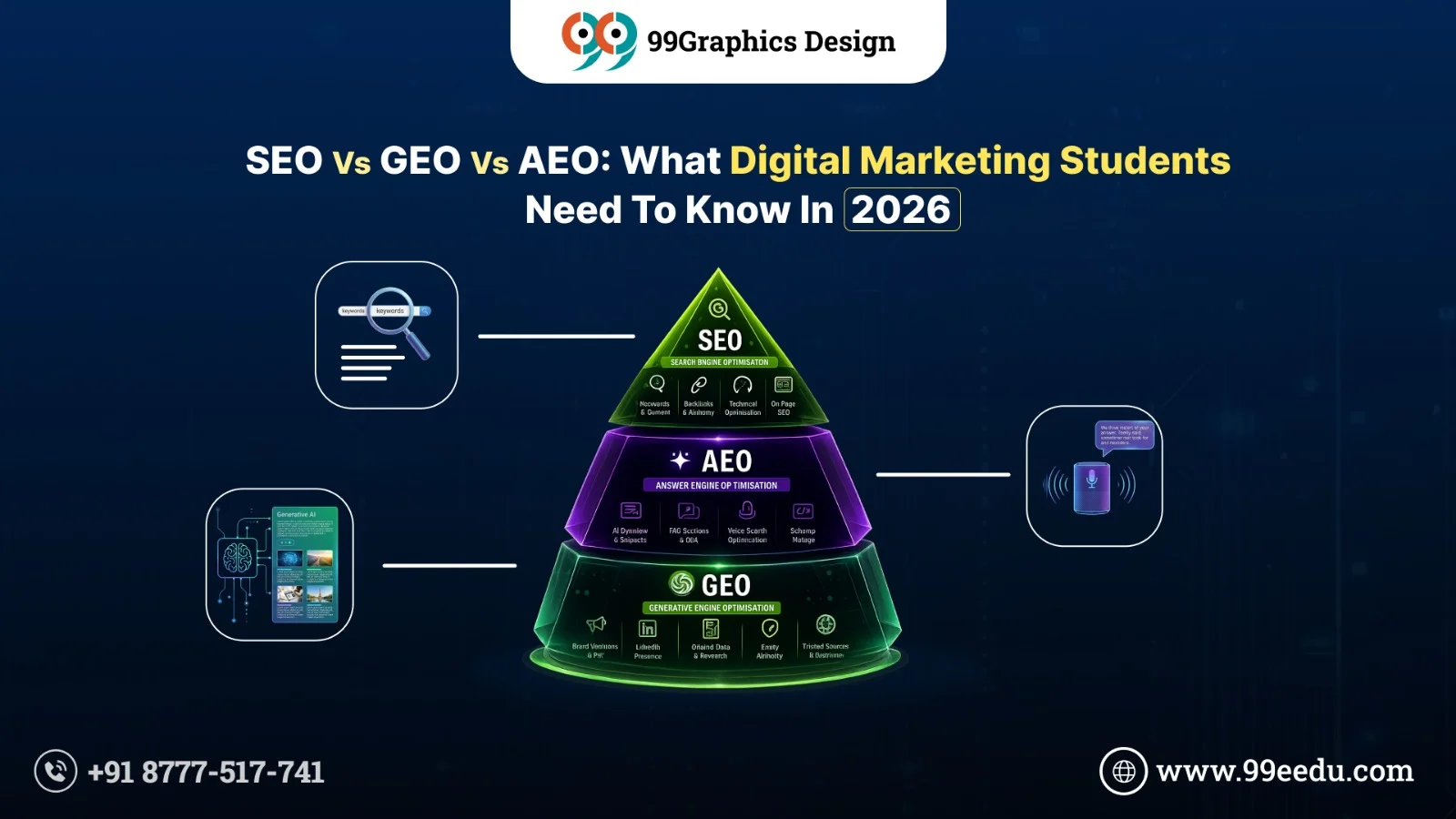
If you want to build a real career in digital marketing in 2026, you can’t skip SEO, GEO, and Answer Engine Optimization (AEO) anymore. The way people look for information has changed. Google Search is still there, but plenty of people now ask ChatGPT, scroll through Google AI Overview, search on Gemini, or just ask a voice assistant instead.
At 99Eedu Institute, we tell students the same thing: these three work as a team, not as competing strategies. SEO gets your website into traditional search results. To increase your chances of getting a direct response to someone’s question, you should use AEO. GEO makes sure your content shows up inside AI-generated responses across these newer search platforms.
Put SEO, AEO, and GEO together, and you’re not just writing for search engines anymore — you’re creating content that actually answers what people want to know, builds trust, and stays visible whether someone’s using Google or asking an AI.
Why is search changing in 2026?
Google’s core update cycles through 2026 have made one thing clear. AI Overviews now sit on top of a large share of search results. AI Mode handles longer conversational questions. And platforms like ChatGPT, Gemini, and Perplexity AI have become genuine research destinations for millions of people.
This has pushed marketers to think beyond classic SEO and start paying attention to how AI systems select, summarise, and cite content. Position on the page and citation inside an AI answer are now two separate battles, and a page can rank first in organic results while still being left out of the AI-generated summary.
Why Is It Important to Learn SEO, GEO, and AEO in 2026?
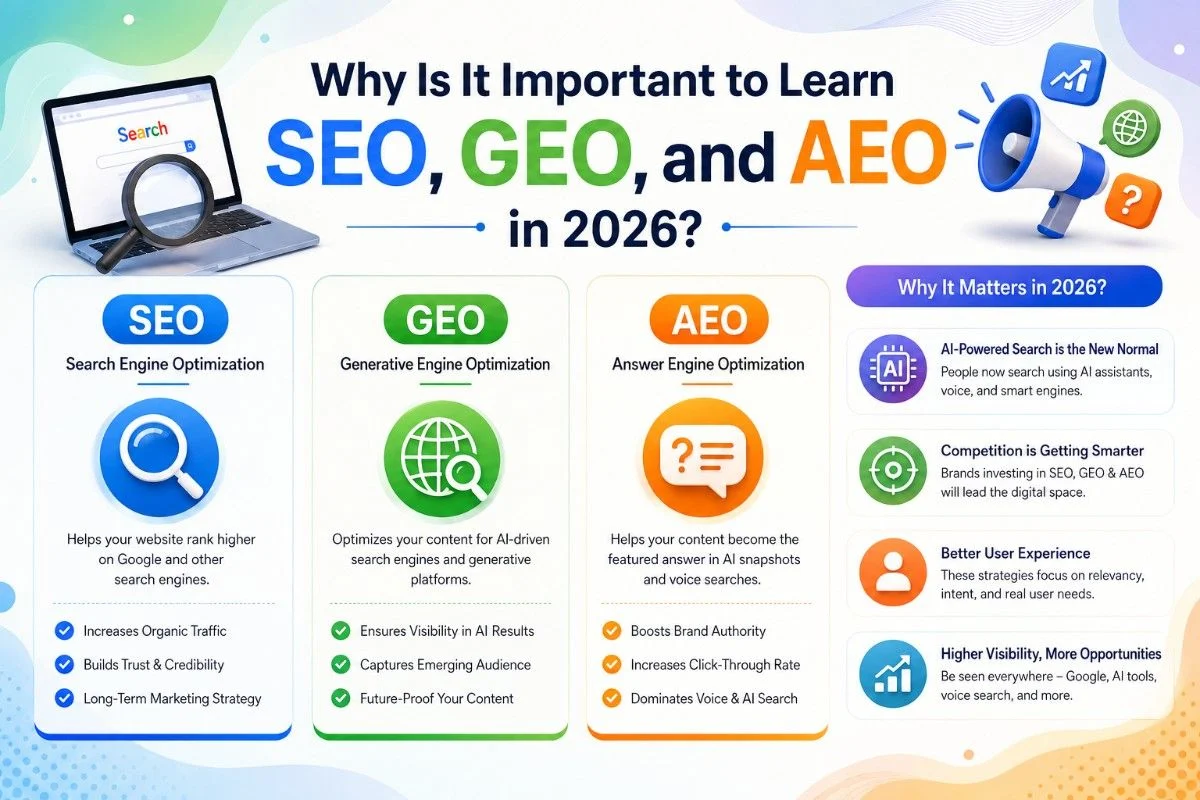
Digital marketing students need to understand SEO, GEO, and AEO because search has changed. People no longer rely on Google alone — they also ask questions directly to tools like ChatGPT, Perplexity, and Google’s AI Overviews
SEO ranks your content in traditional search results. GEO (Generative Engine Optimization) gets your content referenced inside AI-generated answers. AEO (Answer Engine Optimization) pulls your content into featured snippets and direct-answer boxes. A marketer who knows only one of these is only ready for part of the job.”
Here’s why this matters in practice:
- Search is changing: People now use both Google and AI tools like ChatGPT and Google AI Overview to find information.
- Employers expect modern skills: Companies want marketers who understand SEO, GEO, and AEO—not just traditional SEO.
- The skills work together: Clear, helpful, and well-structured content performs better across search engines and AI platforms.
- Brands want visibility everywhere: Businesses need content that can rank on Google and appear in AI-generated answers.
- It prepares you for the future: Learning SEO, GEO, and AEO helps you stay relevant as AI continues to reshape digital marketing.
What is SEO (Search Engine Optimization)?
SEO, or Search Engine Optimisation, is the practice of improving a website so it ranks higher in search results — mainly on Google, Bing, and Yahoo.
It involves technical fixes, content quality, keyword research, and link building. Together, these help search engines understand and trust a page enough to place it near the top.
How SEO Works
Search engines use automated crawlers to scan billions of web pages, index the content, and then rank pages for a given search query using hundreds of ranking factors. These include page speed, mobile usability, content relevance, backlinks from trusted sites, and increasingly, E-E-A-T signals — Experience, Expertise, Authoritativeness, and Trustworthiness.
When someone types in a query, Google’s algorithm looks at the intent behind that query and compares it to the content it has and presents what it thinks will best satisfy the user.
Key Components of SEO
- On-page SEO – title tags, headings, internal linking, keyword placement, and content depth
- Technical SEO – site speed, crawlability, indexing, mobile-friendliness, and structured data
- Off-page SEO – backlinks, brand mentions, and digital PR
- Local SEO – Google Business Profile optimisation, useful for a Best Digital Marketing Institute in Kolkata or any local service business trying to appear for nearby searches
- Content SEO – writing genuinely useful, well-researched pages built around real search intent
Benefits of Learning SEO
SEO remains one of the most in-demand skills in digital marketing because almost every business, whether local or global, depends on organic search traffic. Learning SEO teaches you how to research audience behaviour, structure content logically, and understand why some pages rank and others don’t. These fundamentals also form the base on which GEO and AEO are built, so skipping SEO basics makes the newer disciplines much harder to grasp.
Is SEO Still Relevant in 2026?
Even with AI Overviews and chatbots on the rise, Google Search still processes billions of queries every day. And most AI systems pull a large share of their information from well-ranked, well-structured web pages.
What is GEO (Generative Engine Optimization)?
GEO, short for Generative Engine Optimisation, is the practice of optimising content so AI tools like ChatGPT, Google Gemini, and Perplexity AI pull it into, reference it in, or cite it within their generated answers.
Instead of optimising purely for a ranked list of links, GEO focuses on one thing: becoming a source a generative AI model actually trusts enough to quote or summarise.
How GEO Works
AI search tools and large language models pull information from different websites and blend it into one clear answer. GEO (Generative Engine Optimization) is about making your content something these AI systems can actually understand, trust, and pull from — through clear writing, accurate information, original insights, and reliable sources. Unlike traditional SEO, where ranking at the top matters, GEO is about increasing the chances of your brand being included in AI-generated answers.
Why GEO Matters for AI Search
More people are turning to ChatGPT, Google AI Overview, Gemini, and similar tools to get answers instead of clicking through a bunch of websites. Generative Engine Optimization (GEO) is about making your content something these AI systems can actually understand, trust, and pull into their responses.
With traditional SEO, the goal is ranking higher in search results. GEO is different. As more people search this way, GEO has become a must-have skill for building visibility and brand trust online.
Best Practices for GEO
- Write in clear, direct sentences that are easy for an AI model to lift and summarise
- Back claims with original data, statistics, or first-hand experience
- Use descriptive subheadings that mirror natural questions
- Keep author bios and credentials visible, since AI systems weigh source credibility
- Publish consistently on a narrow set of topics to build topical authority
What is AEO (Answer Engine Optimization)?
Answer Engine Optimization is about structuring your content so answer engines can lift it out and use it as a short, precise answer — think Google featured snippets, voice assistants like Alexa and Siri, and the answer boxes inside AI Overviews. With AEO, ranking your page isn’t the only goal anymore — it’s about giving your content a real shot at being the direct answer when someone asks a question.
How Answer Engine Optimization Works
Answer engines scan content for direct, self-contained responses to specific questions. When a page answers a question clearly in the opening lines, using plain language and a logical flow, it’s much easier for answer engines to pull out and reuse. AEO relies heavily on question-based headings, concise definitions, and formats like numbered steps, bullet points, and tables that answer engines can parse quickly.
Why Answer Engine Optimization is Important
Voice search and zero-click search behaviour have grown steadily, meaning many users never scroll past the first answer they see or hear. If your content is not structured for extraction, you simply won’t appear in that moment, even if your page ranks reasonably well. As AI search continues to evolve, Answer Engine Optimization has become a core topic in any practical AI Digital Marketing Course. Instead of treating it as an advanced concept, it should be introduced early alongside SEO and GEO.
How to Optimise Content for Answer Engines
- Answer the core question in the first one to two sentences under each heading
- Use FAQ sections with direct, plain-language answers
- Apply FAQPage, HowTo, and Article schema markup
- Keep sentences short and avoid unnecessary jargon
- Structure content with clear H2 and H3 headings that match real search questions
SEO vs GEO vs AEO: What’s the Difference?
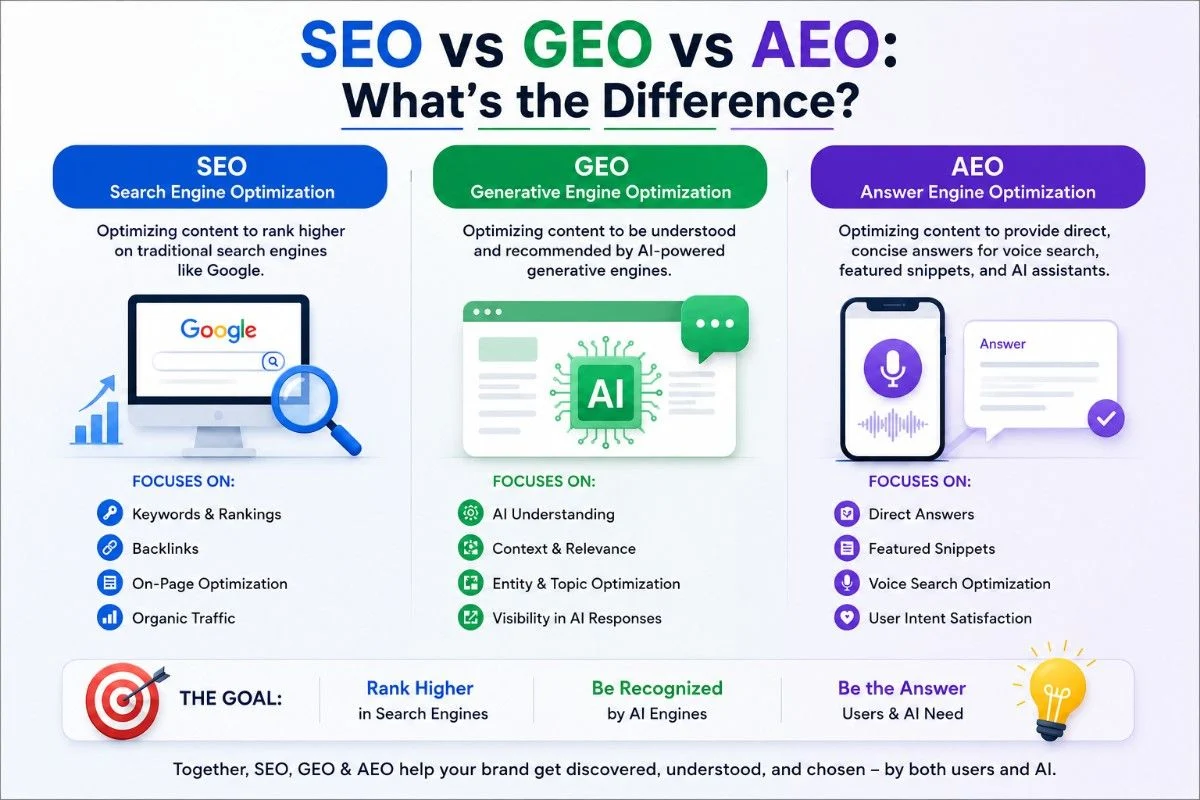
Although SEO, GEO, and AEO share the same goal — being visible when someone searches for information — they operate differently in practice. The table below breaks down how they compare.
| Factor | SEO (Search Engine Optimisation) | GEO (Generative Engine Optimisation) | AEO (Answer Engine Optimization) |
|---|---|---|---|
| Primary Goal | Rank pages high in traditional search results | Get cited inside AI-generated answers | Become the direct, extractable answer |
| Target Platform | Google, Bing, Yahoo | ChatGPT, Gemini, Perplexity AI | Featured snippets, AI Overviews, voice assistants |
| Content Type | In-depth articles, landing pages, blogs | Original, data-backed, well-attributed content | Short, direct, question-and-answer style content |
| Ranking Method | Algorithmic ranking factors and backlinks | AI model selection based on trust and clarity | Extraction based on structure and directness |
| Best Optimisation Techniques | Keyword research, technical SEO, link building | Original data, clear structure, authorship signals | FAQ schema, concise answers, question headings |
| User Intent | Broad informational, navigational, transactional intent | Research and comparison intent | Quick-fact, immediate-answer intent |
| Key Metrics | Rankings, organic traffic, backlinks | AI citation share, brand mentions in AI answers | Featured snippet wins, voice search appearances |
In practice, these three approaches overlap far more than they compete. A page built with strong SEO fundamentals, structured for AEO, and written with the originality that GEO principles reward has the best chance of performing everywhere at once.
Why Every Digital Marketing Student Should Learn SEO, GEO, and AEO
Digital marketing keeps changing, and so does the way people search. Ranking on Google isn’t the whole game anymore — your content also needs to show up in AI search tools and answer people’s questions directly. Learn SEO, GEO, and AEO together, and you’re covered for both traditional search and where search is headed next.
Career Opportunities
Agencies and in-house marketing teams are actively hiring for roles that blend SEO with AI search strategy. Job titles like “AI Search Specialist,” “GEO Analyst,” and “Content Visibility Strategist” barely existed three years ago, and now appear regularly on hiring platforms. Students who complete a well-rounded AI Digital Marketing Course or a hands-on Digital Marketing Course with an AI component enter the job market with a genuine advantage over candidates who only know traditional SEO.
Skills Employers
Employers now want more than keyword research skills. They expect you to understand structured data, how AI evaluates content, prompt-based research tools, and how to track visibility inside AI Overviews and chatbot answers. A good SEO Certification Course covers all of this — not outdated tricks like keyword stuffing, which just don’t work anymore. Choosing the right SEO Training Institute matters too. Look for one that offers real client projects and hands-on practice, not just slides, so you’re ready to handle SEO, GEO, and AEO from day one.
Future-Proof Your Digital Marketing Career
The marketers who will thrive over the next five years are the ones who treat SEO, GEO, and AEO as one connected discipline rather than three separate silos. Choosing a Best SEO course in Kolkata 2026 that teaches this integrated approach, rather than a decade-old syllabus, is one of the smartest early decisions a student can make.
Whether it’s labelled an SEO Certification Course, a Best AI marketing course, or simply a Best SEO course in 2026, the syllabus content matters far more than the title on the certificate — look for AI search, structured data, and hands-on projects, not just theory slides.
How Google AI Overview Has Changed SEO
Google AI Overview flipped a lot of what marketers thought they knew about ranking. You can be sitting in position one and still watch your traffic drop, because a lot of users get their answer straight from the summary at the top of the page and never scroll down to click anything. Ranking well is still part of the game, but it’s no longer the whole game — now your content also has to be good enough for Google’s AI to want to pull from it and quote it directly.
Traditional Search vs AI Search
Traditional search returns a ranked list of links, and the user decides which one to click. AI search, by contrast, gathers information from multiple sources and hands the user a single synthesised answer, often before any links appear at all.
Zero-Click Searches
A growing share of searches now end without a single click, because the AI-generated summary already satisfies the user’s question. This makes visibility inside that summary far more valuable than a standard ranking position, since a page that never gets read still earns no traffic, no matter how high it ranks.
AI-Generated Answers
Google’s AI Overview pulls from a mix of top-ranking pages, but ranking alone doesn’t guarantee inclusion. Content needs clear structure, verifiable facts, and credible authorship to be selected. This is precisely where SEO, GEO, and AEO intersect, and why students learning digital marketing today need all three working together, not one in isolation.
How to Optimise Your Content for SEO, GEO, and AEO
You don’t need three separate content strategies for this. The difference is just where you put the emphasis: SEO wants your page findable and well-ranked, Answer Engine Optimization wants your answer extractable, and GEO wants your content trustworthy enough for an AI to cite. Build with all three in mind, and you’re covering your bases no matter how someone’s searching.
Write for User Intent
Start every piece of content by asking what the reader actually wants to know, then answer that question directly before adding supporting detail. Search engines, generative engines, and answer engines all reward content that satisfies real intent rather than content built purely around a keyword.
Build Topical Authority
Publishing consistently within a focused subject area, rather than covering unrelated topics at random, signals expertise to both Google’s algorithm and AI models. Over time, this topical depth is what earns a site consistent citations across search and AI answers alike.
Use Structured Data
Schema markup such as FAQPage, HowTo, and Article schema helps search engines and AI crawlers understand exactly what a page contains, which improves both traditional rankings and AI citation chances.
Add FAQs
FAQ sections written in plain, direct language are one of the simplest ways to support Answer Engine Optimization, since they mirror exactly how people phrase questions to voice assistants and AI chatbots.
Improve Content Experience
Fast page speed, clean formatting, short paragraphs, and mobile-friendly design all continue to matter. A page that is hard to read is also hard for an algorithm or an AI model to trust.
Optimise for AI Citations
Include original research, first-hand experience, clear author credentials, and up-to-date facts. These are the exact signals that GEO rewards, and they are also the signals Google’s E-E-A-T guidelines have been emphasising across every core update in 2026.
One well-structured, genuinely useful piece of content can work for SEO, Answer Engine Optimization, and GEO at the same time — you just have to write it with all three in mind from the start, not bolt them on afterwards.
What Are the Most Common SEO, GEO, and AEO Mistakes?
Beginners often focus on rankings and miss how search has changed. Skipping real answers, messy structure, low-quality content, and ignoring AI search are the biggest mistakes. Fix them, and your content shows up better — in both search engines and AI results.
Focusing Only on Keywords
Keyword research still matters, but treating it as the entire strategy is outdated. Modern search rewards content that genuinely answers a question, not content built around repeating a phrase as many times as possible.
Ignoring AI Search
Some students still study SEO as if AI Overviews, ChatGPT, and Perplexity AI don’t exist. That approach leaves a major, fast-growing part of search visibility completely uncovered.
Writing Thin Content
Short, generic pages that repeat what already exists elsewhere online rarely rank well and are even less likely to be cited by an AI system looking for original, useful information.
Forgetting E-E-A-T Principles
Experience, Expertise, Authoritativeness, and Trustworthiness are not optional extras anymore. Google’s 2026 core update guidelines have made it clear that content without real experience behind it, and without a credible, named author struggles to rank or get cited, regardless of how well it’s written.
Which AI Tools Should You Use for SEO, GEO, and AEO in 2026?
Learning the theory behind SEO, GEO, and AEO is only half the picture — students also need hands-on comfort with the tools professionals actually use every day. A good Practical SEO Training program, whether delivered as a standalone AI SEO Course or bundled inside a broader Digital Marketing Course with AI, should include real-world time on each of these:
- ChatGPT – research, content structuring, and testing how content gets summarised
- Google Gemini – understanding Google’s own generative answer behaviour
- Perplexity AI – studying citation patterns in real-time AI search
- Google Search Console – tracking rankings, clicks, and indexing issues
- Google Analytics – measuring traffic quality and user behaviour
- Ahrefs – backlink analysis and keyword research
- Semrush – competitive analysis and content gap research
- Screaming Frog – technical SEO audits and crawl analysis
- Surfer SEO – on-page content optimisation and structure scoring
Modern SEO works best when you use a combination of tools. SEO platforms help monitor rankings and technical performance, while AI-focused tools provide insights into how your content appears in AI-driven search experiences.
How Can You Optimise One Blog for SEO, GEO, and AEO?
You don’t need three different blog posts. Start with a clear question-based structure, answer it directly near the top, back it up with credible facts and sources, and add clean formatting like FAQs and headers. Do that, and the same post can rank on Google, get pulled into AI Overviews, and get cited by chatbots — all at once.
Google Search
The page needs strong SEO basics — a clear title tag, useful subheadings, internal links to related guides, and enough depth to outrank thin competitor pages, exactly the kind of on-page discipline taught step by step in a practical Digital Marketing Course in Kolkata.
Google AI Overview
The content needs a short, direct summary near the top, backed by credible facts and a visible author with relevant experience, so Google’s AI system can confidently extract and cite it.
ChatGPT
The page benefits most from original data points, such as real registration costs or timelines, since generative models favour specific, verifiable information over generic advice when selecting sources through GEO signals.
Perplexity AI
Because visible citations are displayed by Perplexity, the chances of being included as a cited source are increased when clear author credentials and a consistent publishing history in your niche are maintained.
One well-researched article, structured correctly, can genuinely serve all four destinations at once — which is exactly the mindset a good Digital Marketing Institute Kolkata should be teaching students to apply from day one.
Who Can Benefit from Learning SEO, GEO, and Answer Engine Optimization?
More people than just SEO specialists. Students, content writers, business owners, freelancers, and marketing teams all have a stake in online visibility — and each of them gains something from understanding how search and AI answers actually work today.
Digital marketing students
This is quickly becoming baseline knowledge, not a specialisation, so learning it early puts you ahead rather than catching up later.
Content writers and bloggers
If you write online, your work is competing with AI Overviews and chatbot answers, whether you like it or not. Knowing how to structure content for both readers and AI keeps your writing visible.
Small business owners
You don’t need to become an SEO expert, but understanding the basics helps you make smarter calls when hiring an agency or freelancer, and keeps you from paying for outdated tactics.
Freelancers and consultants
Clients are starting to ask about AI visibility, not just Google rankings. Being able to answer that puts you ahead of freelancers still only pitching traditional SEO.
Career switchers
if you’re moving into marketing from another field, this is a genuinely good entry point, since AI search skills are new enough that experience gaps matter less than usual.
In-house marketing teams
Even people who aren’t SEO specialists (social media, PR, product) benefit from understanding how content gets picked up by AI, since it affects brand visibility across the board.
If your work involves creating content, running a business online, or advising people who do — this isn’t a “nice to have” anymore.
Why Choose 99Eedu Institute for Practical SEO, GEO, and AEO Training?
99Eedu Institute’s AI-Powered Digital Marketing Course is a 96-hour classroom programme built for people who want practical skills, not just theory. CEO Avijit Rath shapes how the training runs, drawing on his 15+ years of industry experience. Instead of sitting through hours of presentations, students get hands-on with real projects, live campaigns, and assignments that actually mirror how digital marketing works on the job.
Learn the basics from people who still do this work
The AI-Powered Digital Marketing Course runs as a 96-hour classroom programme, shaped under the guidance of CEO Avijit Rath, who brings 15 years of industry experience to how the course is structured. You’re not learning from someone who read about SEO once and built a syllabus around it — the training is led by people currently working in the field, including a senior digital marketing specialist with 8 years’ experience handling SEO, Google Ads, and Meta Ads, and a dedicated SEO/PPC specialist focused on real lead generation. That matters more than it sounds like it should, because search changes fast, and only people actively working in it notice those changes early enough to teach them.
You learn GEO and AEO alongside SEO
A lot of older institutes still treat AI search as a bonus module tacked onto a traditional SEO syllabus. At 99Eedu, AI, AEO, and GEO are already built into the core curriculum — so instead of learning outdated keyword tactics first and AI concepts as an afterthought, you learn how they connect from day one. You see, in real time, why a page can rank well on Google and still get skipped by an AI Overview, and what actually needs to change to fix that.
Practice on real, live projects — not made-up examples
Learning SEO is important, but you truly understand it when you start applying it to real projects. That’s why the course puts you on live projects instead of fictional case studies — you’ll work on real websites, run actual SEO audits, optimise real content, and see how these strategies play out in real business situations. Along with classroom and online sessions, you’ll also take part in mock interviews that prepare you for real interviews.
Real results, not just promises
Many institutes say their training is practical and designed for the industry, but what really matters is the results students achieve. Over the years, 99Eedu has helped more than 4,000 students start their careers, with placement support through a network of 300+ IT companies and MNCs.
The institute has also been recognised with the ICSTA 2023 Award. Employers who have hired 99Eedu graduates often appreciate their practical knowledge, confidence, and readiness for the workplace. Feedback like this reflects real hiring experiences and carries more value than marketing claims alone.
Want to learn the skills that really count in search right now? At 99Eedu Institute, everything is hands-on — SEO, GEO, AEO, live projects, real AI tools, real case studies, and expert guidance every step of the way.
What Our Students Say
Joining 99Eedu Institute was honestly one of the best decisions I’ve made for my career. I learned Graphic Design and Advanced Digital Marketing, and it wasn’t just theory — we worked on real live projects, which taught me a lot. The trainers were really supportive and explained everything in a simple way, always pushing us to do better.
Now I feel much more confident, and I actually feel ready to take up real client projects. I’m really thankful for everything I learned and the support I got during the course.
Arpita Das — (https://www.youtube.com/shorts/FW-t9HiFFOI)
About the Authour
This content was written by Year Ali (YEASH), who has spent over 5 years in the trenches of SEO, Google Ads, and Meta Ads – and now brings that experience into the classroom as a digital marketing trainer at 99Eedu Institute.
Before teaching, he worked directly on live client campaigns at 99Graphics, handling search and paid advertising for real businesses with real budgets on the line. That same hands-on, project-first approach is exactly how he trains students today — he doesn’t just teach digital marketing; he teaches it the way he’s actually lived it.
LinkedIn: https://www.linkedin.com/in/year-ali-91631a285/
Frequently Asked Questions
Q1. Which is the best AI digital marketing course in Kolkata?
The best course covers SEO, GEO, AEO, AI tools, content strategy, analytics, and live campaign management — all through practical, hands-on training. Look for something like 99Eedu Institute, where you get real projects, mentors with actual industry experience, and a curriculum built around what employers are hiring for.
Q2. Can AI replace traditional SEO?
No. AI is changing how people search, but traditional SEO is still essential. The best results come from combining SEO, GEO, and AEO so your content performs well in both Google Search and AI-powered search.
Q3. Is GEO replacing SEO?
No. GEO is not a replacement for SEO—it’s an extension of it. SEO helps your content rank in search results, while GEO increases the chances of your content being referenced in AI-generated answers.
Q4. How do I write AI-friendly content?
Write content that is clear, accurate, well-structured, and genuinely helpful. Use descriptive headings, answer user questions directly, support your points with reliable information, and keep your content easy for both people and AI systems to understand.
Q5. What is the future of SEO in the AI era?
SEO is evolving, not disappearing. As AI-powered search grows, successful content will combine SEO, GEO, and AEO to improve visibility across traditional search engines and AI platforms like Google AI Overview and ChatGPT.
Q6. How do AI search engines rank content?
AI search engines evaluate content for clarity, factual accuracy, original data, and credible authorship, then select the sources most likely to answer the user’s question directly and confidently.
Q7. Which is better for beginners: SEO, GEO and AEO?
Beginners should start with SEO fundamentals first, since concepts like keyword intent, content structure, and technical basics form the groundwork needed to understand GEO and AEO properly.
Final Thoughts
SEO, GEO, and Answer Engine Optimization (AEO) should not be viewed as separate skills. Together, they form a complete approach to improving online visibility. While traditional Google Search remains important, visibility in Google AI Overviews, ChatGPT, Gemini, and other AI-powered search platforms has also become essential. Learning SEO, GEO, and AEO together makes it easier to create content that’s clear, trustworthy, well-structured, and genuinely helpful.
Ready to Learn SEO, GEO, and AEO with Practical Training?
Build the skills needed for today’s search landscape with hands-on training at 99Eedu Institute. Get ready for today’s search landscape with hands-on training at 99Eedu Institute. You’ll learn how SEO, GEO, and Answer Engine Optimization work together through live projects, real AI tools, actual case studies, and guidance from people who do this work every day — so you walk out ready for both traditional search and AI-powered search.
🌟 Start Your Learning Journey
📈 Master SEO, GEO & AEO
Share on:

Quick Enquiry
Please fill up the form and we will get back to you in next 12 hours!
