
 All Courses

 5.0
5.0





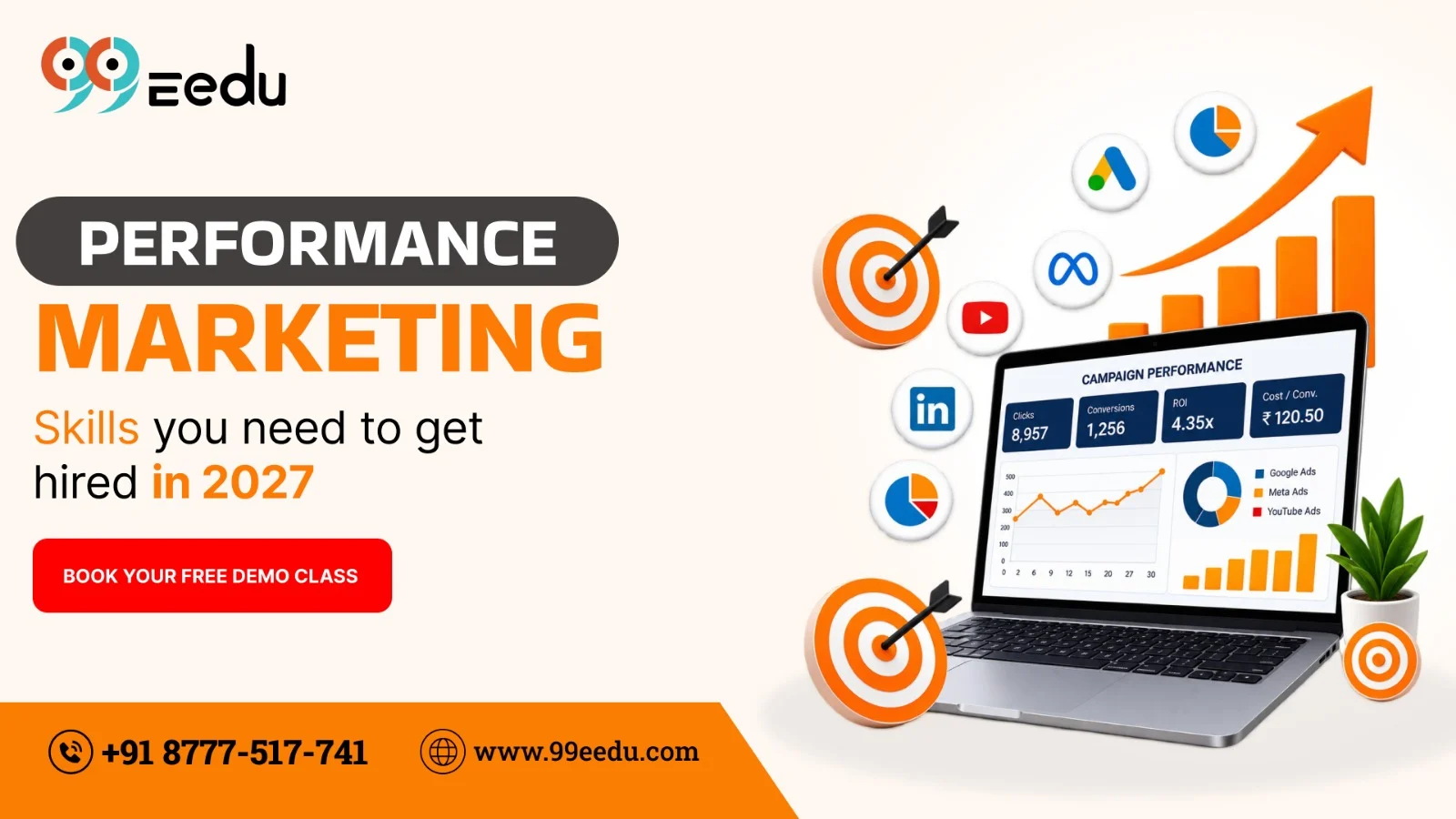
Most freshers apply to 45-50 digital marketing jobs and hear nothing back — not because they lack passion, but because they’re missing the exact performance marketing skills recruiters screen for in the first ten seconds of a resume scan. At 99Eedu Institute, I see this gap constantly, and it almost always comes down to one thing: performance marketing skills that are talked about in class but never actually practiced.
The skills that actually get you hired in 2027 are Google Ads and Meta Ads execution, GA4 analytics reading, and campaign strategy — proven through a real portfolio, not just listed on a resume. I’ve hired, trained, and rejected candidates for performance marketing roles for over a decade, and at 99Eedu Institute, I now run the exact training that closes that gap for 12th-pass students, graduates, and freshers.
What Is Performance Marketing, and Why Does It Matter for Your Career in 2027?

Performance marketing is a results-driven form of digital marketing where you only pay for measurable actions — clicks, leads, sign-ups, or sales — instead of paying for generic ad space. Think Google Ads, Meta Ads, affiliate campaigns, and programmatic buying. Every rupee spent gets tracked back to a number.
This matters for your career because companies are shifting entire marketing budgets from brand advertising to performance channels. Brand marketing tells a story. Performance marketing pays the bills. That’s why hiring managers now want people who can run a campaign, read the dashboard, and explain why the numbers moved.
A quick reality check: in 2024, digital ad spend crossed traditional media spend in most markets. By 2027, most entry-level marketing roles will expect at least basic performance marketing exposure — even for brand or content positions.
What Are the Key Differences Between Digital Marketing and Performance Marketing?
Digital marketing is the broad umbrella covering every online marketing activity, while performance marketing is one specific, results-only branch of it that you pay for based on measurable outcomes. A lot of freshers use these terms interchangeably, and that mix-up shows up fast in interviews.
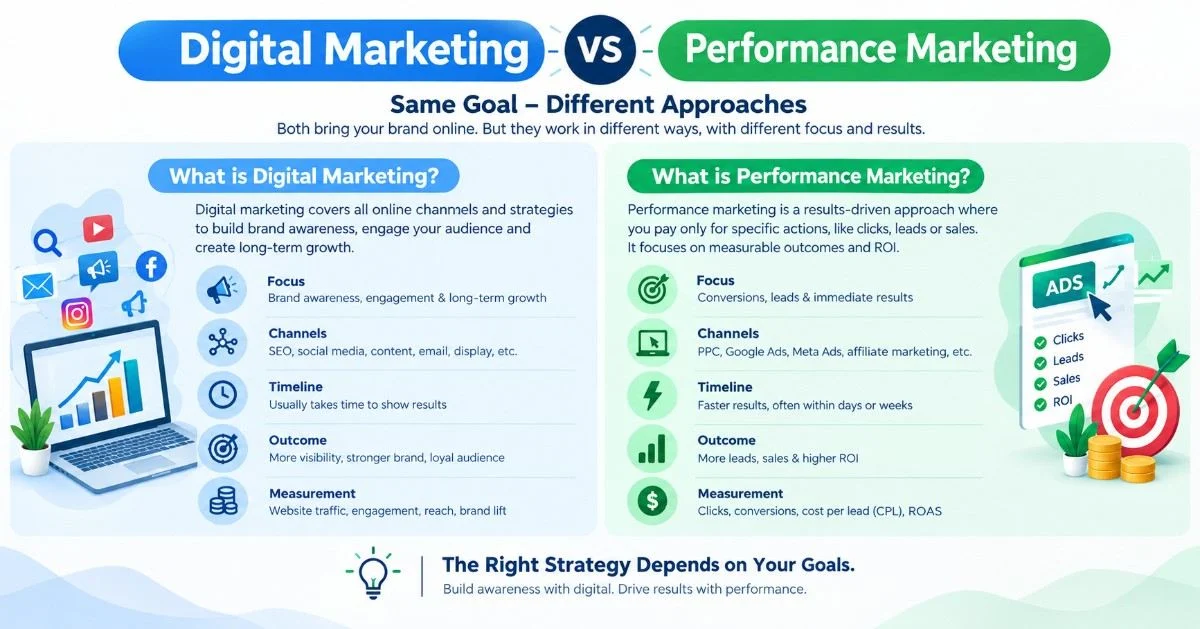
Here’s the simplest way I explain it to students: digital marketing includes SEO, content, email, social media, branding, and paid ads — anything that happens online. Performance marketing sits inside that umbrella, but it only cares about one thing: did the money spent produce a trackable result?
| actor | Digital Marketing | Performance Marketing |
|---|---|---|
| Scope | Broad — covers SEO, content, email, social, branding, ads | Narrow — focused on paid, trackable campaigns |
| Payment model | Often flat fee or salary-based work | Pay-per-click, pay-per-lead, pay-per-sale |
| Goal | Awareness, engagement, long-term brand building | Immediate, measurable action — clicks, leads, sales |
| Timeline for results | Weeks to months (especially SEO, content) | Days to weeks — dashboards update in real time |
| Core tools | CMS, social schedulers, email platforms, SEO tools | Google Ads, Meta Ads Manager, GA4, attribution tools |
| Skill focus | Creativity, content strategy, consistency | Data analysis, budget optimization, rapid testing |
| Conversion tracking | Optional, often measured loosely (traffic, engagement, followers) | Essential — pixels, UTM tags, and attribution set up before launch |
Every performance marketer is a digital marketer, but not every digital marketer is a performance marketer. If your career goal is fast, measurable results — and faster hiring, since performance roles are in higher demand right now — build performance marketing skills first, then expand into the broader digital marketing skills 2027set once you’re already employed.
The Core Performance Marketing Skills Every Fresher Must Master
You need six core skill areas to be job-ready: paid ads platforms, analytics, strategy, copywriting, SEO basics, and reporting. Miss even one, and interviewers notice immediately.
Let’s break each one down.
1. Google Ads and Meta Ads Expertise
Google Ads and Meta Ads expertise is non-negotiable — these two platforms run roughly 60% of global digital ad spend. You don’t need to be an agency-level expert on day one. You need working knowledge of:
- Campaign structure (campaigns, ad groups, ad sets)
- Keyword match types and audience targeting
- Budget allocation and bid strategies
- Basic pixel and conversion tracking setup
I tell every student the same thing: open a free Google Ads account, run a small test campaign with your own ₹500, and watch what happens. Reading about bidding strategies teaches you nothing compared to watching your own budget burn on the wrong keyword.
2. Marketing Analytics and Data Skills
Marketing analytics and data skills mean you can look at a dashboard and explain what happened, why it happened, and what to do next. This is where most freshers fall short. They can run a campaign but can’t read the results.
Minimum toolkit to learn:
| Tool | What It’s For |
|---|---|
| Google Analytics 4 | Website traffic and conversion tracking |
| Google Looker Studio | Building simple performance dashboards |
| Excel / Google Sheets | Pivot tables, ROAS calculations, trend analysis |
| Meta Ads Manager | Campaign-level breakdowns |
You don’t need to code. You need to be comfortable enough that a spreadsheet doesn’t intimidate you.
3. Paid Media Strategy Skills
Paid media strategy skills are about deciding where the budget goes before you even touch a platform. A campaign manager who just “boosts posts” gets replaced by automation. A strategist who understands audience stages, funnel logic, and channel mix does not.
Here’s the funnel logic every fresher should internalize:
- Top of funnel: Awareness campaigns, broad targeting, video and display ads
- Middle of funnel: Retargeting, comparison content, lead magnets
- Bottom of funnel: Conversion-focused ads, cart abandonment, direct offers
Once you can map a client’s problem to the right funnel stage, you stop looking like a fresher.
4. Copywriting and Conversion Skills
Copywriting and conversion skills decide whether your perfectly targeted ad actually gets clicked. You can have flawless targeting and still fail if your headline is boring. Practice writing five headline variations for the same product. Study what competitors run using Meta’s Ad Library — it’s free and shows you exactly what’s live in the market right now.
5. SEO and Content Fundamentals
SEO and content fundamentals help you understand organic traffic, which every performance marketer eventually has to work alongside. Paid and organic aren’t separate worlds anymore. Knowing basic keyword research, on-page SEO, and how AEO and GEO are reshaping search results makes you far more valuable than someone who only understands paid ads.
6. Reporting and Client Communication
Reporting and client communication skills mean you can explain a campaign’s performance to someone who doesn’t understand marketing jargon. A client or manager doesn’t care about your CTR unless you connect it to revenue or leads. Practice translating numbers into plain business language — this single skill fast-tracks freshers into team lead roles within two years.
Soft Skills That Separate Hired Candidates From Rejected Ones
The soft skills that get freshers hired are curiosity, comfort with ambiguity, and the ability to test ideas fast. Technical skills get you shortlisted. Soft skills get you the offer.
Hiring managers consistently look for:
- Curiosity — Do you ask “why did this happen?” or just report the number?
- Speed of learning — Platforms change monthly. Can you adapt without hand-holding?
- Ownership — Will you flag a problem early, or wait for someone to catch it?
- Communication clarity — Can you explain a campaign result in two sentences, not two paragraphs?
I’ve hired candidates with weaker technical skills over stronger ones purely because they asked better questions in the interview. Skills can be taught in three weeks.
Should You Take a Digital Marketing Course or a Performance Marketing Course?
Should you go for performance marketing or a broader digital marketing course? Honestly, it depends on where you’re starting from. If you already get the basics and want to go deep into paid ads and analytics, performance marketing is the move. If you’re starting from zero, go broad first.
A general digital marketing foundation covers SEO, social media, email, content — the whole picture, and honestly, it’s one of the best skills to learn for digital marketing jobs right now. That’s where most 12th-pass students and freshers with no background should start.
Performance marketing skips all that. It jumps straight into campaign optimization, attribution modeling, bidding strategies — the advanced stuff. And honestly, none of it clicks unless you’ve already got the fundamentals sitting in your head.
My advice, for what it’s worth: start broad, then specialize. Do a few months of foundational training first, and focus on the best skills to learn for digital marketing jobs — SEO, analytics, and content strategy — before jumping into anything advanced. Then move into a focused performance marketing course once you actually have context for the advanced concepts.
Performance Marketing Certification: Is It Worth It in 2027?

A performance marketing certification is worth it only if it comes from the platform itself — Google, Meta, or HubSpot — not a random third-party course claiming “certified expert” status. Recruiters recognize official certifications instantly. They ignore the rest.
Free certifications worth your time:
- Google Ads Search Certification
- Google Analytics Certification (GA4)
- Meta Certified Digital Marketing Associate
- HubSpot Content Marketing Certification
None of these cost money. All of them take under two weeks each. Put them on your resume and LinkedIn immediately after passing — they’re one of the few things an ATS (applicant tracking system) actually scans for by name.
How to Land Entry-Level Digital Marketing Jobs With Zero Experience
Landing entry-level digital marketing jobs with zero experience comes down to building proof before you apply, not after. Nobody hires “potential” anymore — they hire evidence.
Here’s how I coach students through their first job hunt:
- Run a real campaign, even a tiny one. Boost a friend’s small business post with your own ₹1,000. Document the results.
- Build one case study. Even a personal project counts — a blog you grew, an Instagram page you scaled, an ad you tested.
- Get platform certifications. Google Ads and Meta certifications cost nothing and signal seriousness.
- Apply for internships before full-time roles. A three-month internship on your resume beats a blank experience section every time.
- Network inside communities, not just job portals. Marketing Slack groups, LinkedIn creator comments, and local meetups surface unlisted openings.
Entry-level digital marketing jobs rarely go to the most qualified candidate. They go to the candidate who removed the most doubt from the hiring manager’s mind.
Performance Marketing Interview Questions You Should Prepare For
Performance marketing interview questions almost always test three things: your understanding of metrics, your ability to problem-solve on the spot, and whether you can explain campaign logic simply.
Expect questions like:
- “How would you improve a campaign with high clicks but low conversions?”
- “Walk me through how you’d allocate a ₹50,000 monthly ad budget.”
- “What’s the difference between CPC, CPA, and ROAS, and when does each matter most?”
Don’t memorize textbook answers. Practice thinking out loud. Interviewers care more about how you reason through a problem than whether you land on the textbook-perfect answer.
A 90-Day Roadmap to Build Job-Ready Performance Marketing Skills
A 90-day roadmap works because it forces you to learn by doing, not by watching endless YouTube tutorials. Here’s the exact structure I give students:
Day 1–30: Foundations
- Complete one digital marketing course covering SEO, paid ads, and analytics basics
- Set up Google Ads and Meta Ads test accounts
- Learn Google Analytics 4 navigation
Days 31–60: Hands-On Practice
- Run one small real or simulated campaign
- Get your first platform certification
- Build a basic reporting dashboard in Looker Studio
Days 61–90: Proof and Applications
- Write one detailed case study from your campaign
- Apply to 15–20 internships or entry-level digital marketing jobs
- Practice performance marketing interview questions out loud with a friend or mentor
Students who follow this roadmap consistently outperform those who “study” for six months without ever touching a live campaign.
Common Mistakes Freshers Make When Learning Performance Marketing
The biggest mistake freshers make is collecting certificates without ever touching a live campaign. I see this pattern constantly. A student finishes four courses, holds three certifications, and still can’t explain why a campaign’s cost-per-click spiked overnight. Certificates prove you watched videos. Campaigns prove you can think.
Other patterns I flag during mentorship sessions:
- Chasing every new platform instead of mastering two. TikTok Ads, LinkedIn Ads, Pinterest Ads — all useful eventually. But a fresher who’s mediocre at five platforms loses to one who’s genuinely strong at Google Ads and Meta Ads.
- Ignoring the “why” behind a metric. Knowing that ROAS stands for return on ad spend isn’t enough. You need to explain why a 2x ROAS might still be unprofitable once you factor in product margin and operational costs.
- Treating analytics as someone else’s job. Freshers who say “I’m more of a creative person; I don’t do numbers” eliminate themselves from most performance marketing roles before the interview even starts.
- Skipping the boring parts of the platform. UTM tagging, conversion tracking setup, pixel verification — none of this is glamorous. All of it is what separates someone who “ran ads” from someone who can be trusted with a real budget.
Fix these four habits early, and you’ll already be ahead of most people applying alongside you.
Free Resources to Build Performance Marketing Skills Without Spending Money
You don’t need an expensive bootcamp to build strong performance marketing skills — most of what matters is available for free directly from the platforms. Paid courses can accelerate structure and mentorship, but they aren’t required to start.
Here’s where I point every student first:
| Resource | What You’ll Learn |
|---|---|
| Google Skillshop | Google Ads, Analytics, and Display certifications |
| Meta Blueprint | Meta Ads Manager and campaign structure |
| HubSpot Academy | Content marketing, inbound strategy, CRM basics |
| YouTube case study channels | Real campaign breakdowns from working marketers |
| Meta Ad Library | Live competitor ads across every industry |
| Google’s Think with Google | Consumer trend data and campaign benchmarks |
A paid digital marketing course or performance marketing course adds real value through structured mentorship, peer accountability, and placement support — not because the raw information is otherwise unavailable. If the budget is tight, use the free resources above for six weeks before deciding whether a paid course is worth it for you.
What Salary Can You Expect With These Skills in 2027?
Freshers with performance marketing skills can expect ₹2.5–4.5 LPA in their first role, rising to ₹6–10 LPA within 2–3 years once they have proven campaign results. Here’s the realistic breakdown by experience level.
| Experience Level | Typical Salary (India, Annual) | What Gets You There |
|---|---|---|
| Fresher / 0–1 year | ₹2.5–4.5 LPA | Google Ads/Meta certification, 1 documented campaign or internship |
| 1–3 years | ₹4.5–7 LPA | Independent campaign management, GA4 reporting fluency |
| 3–5 years | ₹7–12 LPA | Multi-channel budget ownership, proven ROAS improvements |
| 5+ years / Team Lead | ₹12–20+ LPA | Strategy across paid channels, team management |
Numbers shift by city — Bengaluru, Mumbai, and Delhi NCR typically pay 15–25% above tier-2 cities for the same role. Agency roles often start lower than in-house brand roles but move faster once you have 2–3 client results to show.
A few factors that move your starting salary up fast:
- A documented case study showing real campaign results, even from a personal project
- At least one platform certification listed on your resume
- Comfort discussing metrics like CPC, CPA, and ROAS without hesitation in an interview
- Any internship experience, even unpaid, at a marketing agency or in-house team
Don’t chase the highest number in your first role. Chase the role that gives you real campaign ownership within the first six months. That experience compounds into much stronger salary leverage at your second job.
Building a Portfolio That Gets You Shortlisted
A performance marketing portfolio doesn’t need client work — it needs proof that you can think through a real problem. Most freshers assume they need agency experience before they can build a portfolio. That’s backwards. Build the portfolio first, and the agency experience follows.
Three portfolio projects any student can create this month:
- A mock campaign brief and execution plan. Pick a real brand you admire, imagine you’re running their next ₹1 lakh campaign, and write out your targeting, budget split, and expected KPIs.
- A small real campaign with your own money. Even ₹500–1,000 spent on boosting a post for a friend’s small business generates real data you can analyze and present.
- A teardown of a competitor’s ad strategy. Use the Meta Ad Library or Google’s transparency tools to reverse-engineer what a brand is running and why it likely works.
Package these into a simple one-page PDF or a Notion page. Link it directly in your resume and LinkedIn profile. Recruiters remember candidates who show work far more than candidates who list skills.
Why AEO and GEO Skills Matter for Your Job Search Too
AEO and GEO aren’t just buzzwords for content teams — they’re changing how recruiters and clients find marketers online. Answer Engine Optimization and Generative Engine Optimization refer to how AI tools like ChatGPT, Perplexity, and Google’s AI Overviews pull direct answers from web content instead of just listing links. If you’re job hunting or freelancing, this shift affects you in two direct ways.
First, when a hiring manager searches “best performance marketing skills for freshers” or “how to hire a performance marketer,” AI search tools now surface direct, structured answers — often pulled from blogs exactly like this one. Understanding how this content gets picked up gives you an edge if you ever write for a company blog or manage content strategy alongside paid ads.
Second, your own online presence gets evaluated the same way. A LinkedIn profile or portfolio page written with clear, direct, scannable answers — not unclear buzzwords — performs better both for human recruiters skimming quickly and for any AI tool a recruiter might use to summarize your profile. Write your “About” section the way this blog is structured: a direct answer first, proof second, no filler.
Why Learn Performance Marketing With 99Eedu Institute?
99Eedu Institute trains 12th-pass students, graduates, and freshers to become job-ready performance marketers through live campaigns, not just recorded lectures. I built this program around one belief: you don’t learn to swim by watching swimming videos.
Here’s what sets the training apart:
- Live campaign practice — students run real (or realistic simulated) Google Ads and Meta Ads campaigns, not just theory slides
- Portfolio-first approach — every student leaves with a documented case study recruiters can actually evaluate
- Certification support — guided prep for Google Ads and Meta Blueprint certifications, at no extra cost
- Interview readiness — mock interviews built around real performance marketing interview questions, run by people who’ve actually hired for these roles
- Built for beginners — no prior marketing background needed; the course starts from zero and moves at a pace 12th-pass students and freshers can actually keep up with
Most institutes teach you what performance marketing is. We train you to actually do it — and walk into an interview with proof, not just a certificate.
Want to Learn Performance Marketing Live? Join 99Eedu Institute’s Free Masterclass
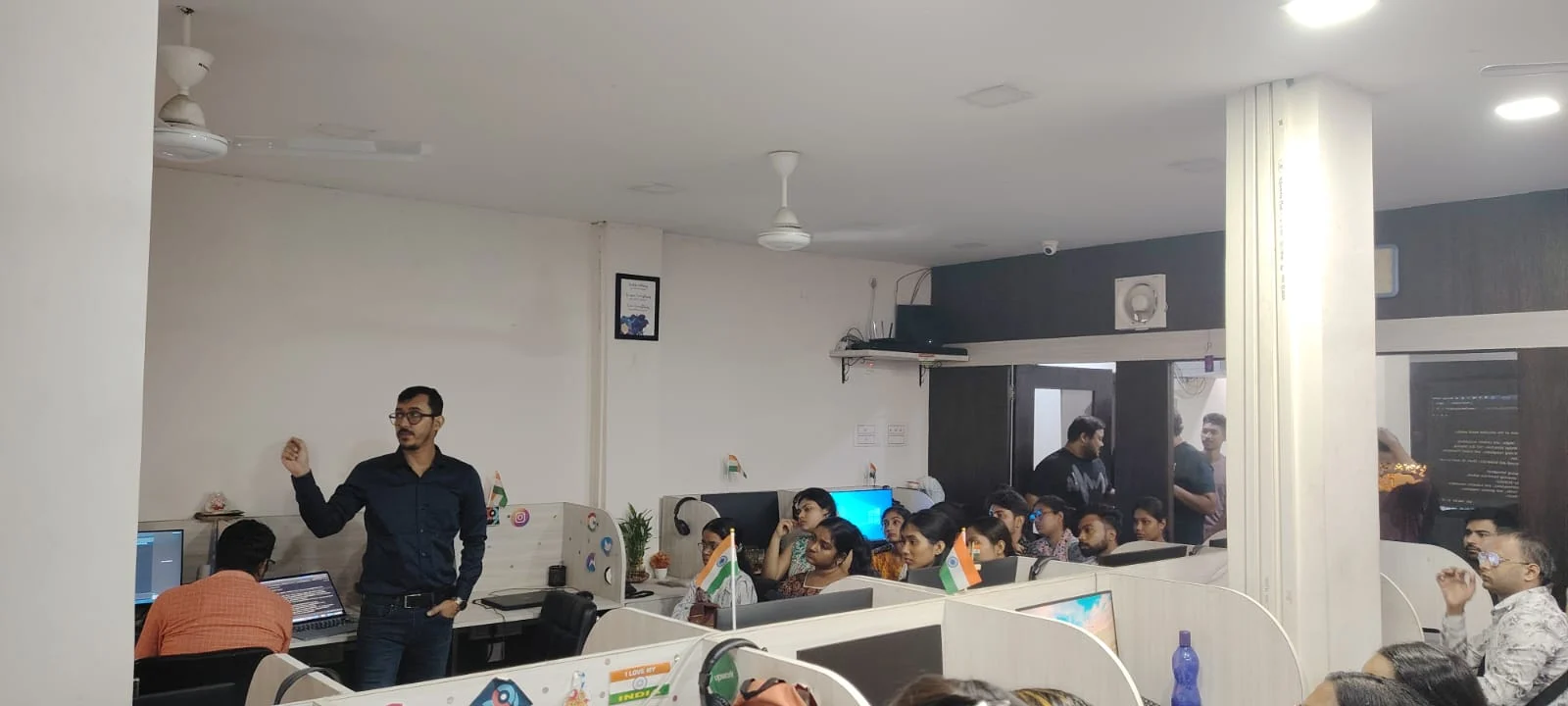
99Eedu Institute organizes a free Performance Marketing Masterclass for students who want to learn directly from practitioners, not just read about the field. Reading a guide like this one gets you started. Sitting in a live session where you can ask real questions, watch an actual campaign get built, and get your doubts cleared on the spot — that’s what actually speeds up the learning curve.
The masterclass covers exactly what recruiters look for: Google Ads and Meta Ads walkthroughs, live GA4 dashboard reading, and an open Q&A on career paths for 12th-pass students, graduates, and freshers. No fluff, no sales pitch dressed up as training — just a real look at what the job actually involves before you commit to a full course.
The session is personally conducted by Avijit Rath, CEO of 99Graphics Design — someone who’s built and scaled performance marketing strategy at an institutional level, not just taught it from slides. Learning directly from someone who runs the business gives students a perspective most training programs simply can’t offer.
Source: CEO Avijit Rath (LinkedIn Profile).
About the Author
Year Ali(Yeash) is a Senior SEO & PPC Specialist and Digital Marketing Trainer at 99Eedu Institute, with over 10 years of hands-on experience running paid media campaigns, building organic search strategy, and hiring for performance marketing roles. He has trained hundreds of 12th-pass students, graduates, and freshers, taking them from zero marketing background to job-ready with real Google Ads and Meta Ads campaign experience.
Yeash’s approach is simple: theory without practice doesn’t get anyone hired. Every course he builds at 99Eedu Institute is structured around live campaigns, real dashboards, and portfolio-first learning — because that’s what actually gets candidates shortlisted in interviews.
When he’s not training students or optimizing ad accounts, Yeash writes practitioner-first guides like this one, breaking down what recruiters genuinely look for in 2027’s performance marketing hiring cycle.
Source: Year Ali(LinkedIn Profile).
Frequently Asked Question
Q1: What are the most important performance marketing skills for freshers?
Google Ads and Meta Ads management, analytics reading, and campaign reporting matter most. Freshers who master these three get shortlisted faster than those focused only on theory.
Q2: Is a performance marketing certification necessary to get hired?
Not strictly necessary, but it strongly helps. Free certifications from Google and Meta signal job-readiness to recruiters and often get flagged by resume-scanning software.
Q3: Can a 12th-pass student learn performance marketing without a degree?
Yes. Platforms like Google Ads and Meta don’t require a degree — only demonstrated skill. A solid digital marketing course plus one real campaign case study is often enough to get an entry-level interview.
Q4: What is performance marketing?
Performance marketing is a digital advertising approach where you pay only for measurable actions — clicks, leads, or sales — instead of paying for ad space upfront. Google Ads and Meta Ads are the most common platforms used.
Q5: What is another name for performance marketing?
It’s also called “pay-for-performance marketing” or “ROI-based marketing.” Some professionals use “paid media marketing” loosely, though that term technically covers a wider range of paid advertising activities.
Q6: What is the salary of a performance marketer?
Entry-level performance marketers in India typically earn ₹2.5–4.5 LPA, rising to ₹6–10 LPA with 2–3 years of proven campaign results. Salaries scale fast with a strong portfolio and certifications.
Q7: Which is better, SEO or performance marketing?
Neither is “better” — they solve different problems. SEO builds long-term, free organic traffic slowly. Performance marketing delivers fast, paid, trackable results. Most strong marketers eventually learn both.
Q8: What is an example of performance marketing?
A Google Ads Search campaign where you pay only when someone clicks your ad and lands on your website is a classic example. Affiliate marketing, where you pay a commission only after a sale, is another.
Want to Become a Job-Ready Performance Marketer?
Join 99Eedu Institute’s Performance Marketing Course to gain hands-on experience, build a job-ready portfolio, earn a recognised certification, and develop the practical skills employers look for. Book a free demo class today and take the first step toward your career in performance marketing.
Share on:

Quick Enquiry
Please fill up the form and we will get back to you in next 12 hours!
