
 All Courses

 5.0






Your degree gets you the interview. Your portfolio gets you the job. Most freshers in Kolkata have the first and a thin version of the second. I wrote this guide at 99Eedu Institute to fix that. Below, I explain what an Advanced graphic design course in Kolkata should teach in 2027, how AI-driven search changes the way employers find designers, and how to build a portfolio that passes a 90-second recruiter scan.
Will AI replace graphic designers in 2027?
No, but it will replace designers who only operate tools. AI produces options fast. Somebody needs to select, fine-tune, and argue for them to the client. We teach students to lead the AI and not rely on it.
What Should You Expect From a Graphic Design Course in 2027?
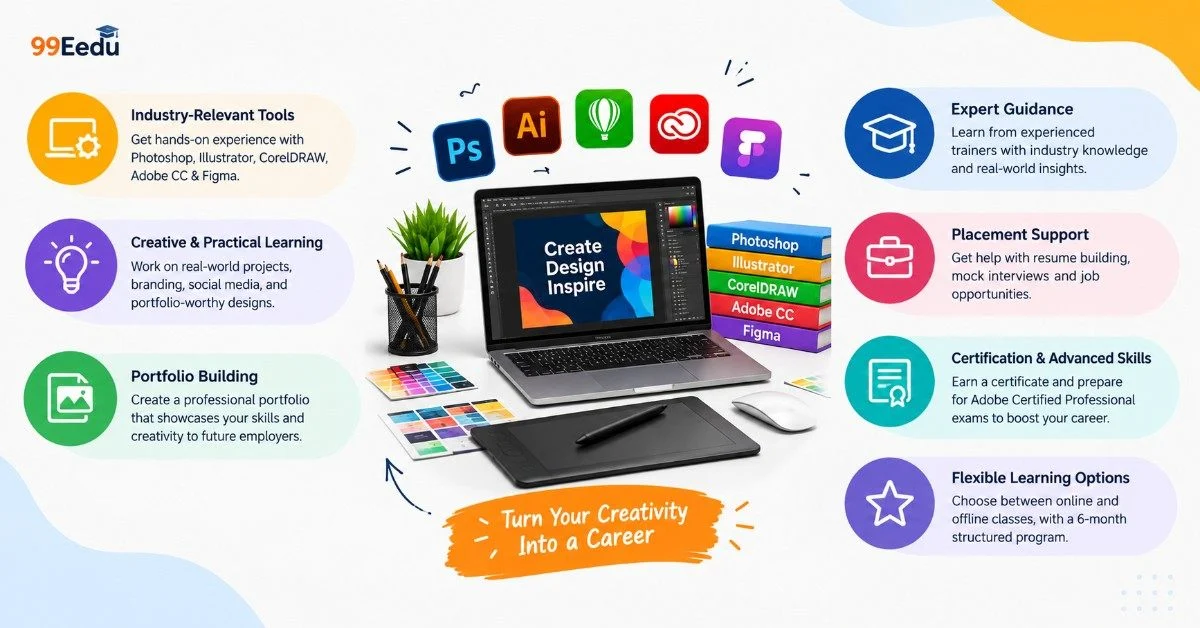
In 2027, a good advanced graphic design course in Kolkata teaches design thinking first, AI-assisted workflows second, and ends with six to eight published case studies. Tools matter less each year. Taste, strategy, and clear explanation matter more.
Here is the short version:
- You should finish with six to eight case studies, each showing the brief, your process, and the result.
- AI should speed up your work, not do your thinking. If a trainer can’t explain how they use it, that’s a red flag.
- Feedback should come weekly, against a real brief, from someone who has worked with clients.
- Job assistance should mean practical help: portfolio reviews, mock interviews, introductions. Never a guaranteed job.
- Your portfolio should be public and written so Google and AI search tools can quote it.
Book a demo class at 99Eedu Institute, bring whatever work you have, and ask to see portfolios from last year’s students. Then decide.
How is a professional graphic design course different from a basic one
A basic course teaches software. A professional course teaches decisions. Basic class says, “Click here to apply a gradient.” A professional Graphic Design Course in Kolkata asks, “Why does this gradient help the reader find the price?” You learn to defend choices. Clients pay for that skill.
Signs you’re in a professional programme:
- You get briefs with constraints, not free-for-all assignments.
- Mentors critique your work in rounds, the way an art director would.
- You present your work out loud at least once a month.
- You redo projects. Good designers revise.
Plenty of Graphic Design Classes in Kolkata stop at tool training. Ask what happens after week six.
What does a 2027-ready design portfolio look like?
A 2027-ready design portfolio has six to eight deep case studies, each showing the brief, your process, and the result, published online where Google and AI search can read it. Quality beats quantity. Every project must prove you can think, not just click.
Here is what we tell students at 99Eedu Institute to include:
| Portfolio element | What it should show |
|---|---|
| Case studies | Six to eight projects, each with a clear story |
| Variety | Branding, packaging, social campaign, editorial, UI screens, one motion piece |
| Process | Sketches, rejected ideas, and why you chose the final one |
| AI use | A short note on where you used AI and where you made the call yourself |
| Results | A real or realistic outcome: more sign-ups, cleaner layout, better recall |
| About page | Your photo, your name, “graphic designer in Kolkata,” and contact details |
What makes it stand out?
- Show your thinking, not just the final image. A logo alone is a picture. A logo with the problem, the sketches, and the reasoning is proof.
- Be honest about AI. Recruiters in 2027 expect you to use it. They want to know you can direct it and fix its mistakes.
- Write the first sentence like an answer. “I redesigned a local bakery’s packaging to make it easier to spot on shelves.” Short. Clear. Easy for AI tools to quote.
- Name everything properly. Use descriptive file names and alt text, not “final_v3.jpg.”
- Put your best project first. Recruiters scan for seconds, not minutes.
What should you leave out?
- Tutorial files and stock mockups with no original thinking
- Fifteen thin projects when five strong ones would do
- Trendy styles you can’t explain
- Anything you wouldn’t defend in an interview
Quick check before you publish
Ask yourself three questions:
- Can a stranger understand each project in ten seconds?
- Does every project show the problem, not just the solution?
- Could I explain every design choice out loud?
If you answer yes three times, your portfolio is ready.
A 2027-ready portfolio is not bigger or flashier. It is clearer, more honest, and easier to find. Build that, and you give recruiters a reason to call.
How do AI search engines find and rank your design portfolio?
Search engines based on AI technology will find your portfolio after scanning the pages that say everything in a clear manner, and then select those that appear reliable, specific, and quotable. These search engines do not “see” your design as would the recruiter. They scan your text, headings, image captions, and context of your name.
Let me be frank with you: no one except the search firms themselves knows the precise algorithm for ranking, and it is continually evolving. The following recommendations are drawn from their publicly available information about how they operate and my practical observations.
How do they locate your pages?
- Crawling. Robots look for links to your pages and crawl through them, reading the text on them. If you created a portfolio with only images and no text at all, there is nothing for bots to read.
- Indexing. The pages should be publicly available and load quickly. They shouldn’t be hidden behind logins and scripting.
- Retrieval. When people ask the question “Who is a good brand designer in Kolkata?”, it retrieves relevant pages, then summarizes their content.
What do they look for when ranking?
| Signal | What it means for your portfolio |
|---|---|
| Clear answers | A one-sentence summary at the top of each case study |
| Structure | Headings like “The Brief,” “My Process,” “The Result” |
| First-hand proof | Real process, sketches, and your own reasoning |
| Identity | Your name, photo, city, and a consistent bio across sites |
| Image context | Descriptive file names and alt text |
| Trust signals | Links from Behance, LinkedIn, your institute, or client pages |
| Freshness | Updated projects, with dates |
This week, what can you do?
- Give every project its own page. One URL per case study, not one page for everything.
- Open with the answer. Example: “I designed a packaging system for a Kolkata sweet shop to make gift boxes easier to spot.” Then explain.
- Use real headings. Not just bold text. Proper H2 and H3 tags help machines read the structure.
- Write alt text that describes. “Matte black tea box with gold logo on a wooden shelf,” not “image1.”
- Keep your identity consistent. Same name, same photo, same one-line bio on your site, Behance, and LinkedIn.
- Link your profiles to each other. This helps machines connect them as one person.
- Add a short AI note. Say where you used AI and where you decided yourself. It builds trust with humans and adds honest, original context.
What is ineffective?
- Stuffing keywords like “best designer Kolkata” into every line
- Pasting AI-written descriptions that say nothing specific
- Publishing images only, with no text
- Hiding your work behind a password or a slow, script-heavy gallery
AI search rewards the same thing recruiters reward: clear, specific, honest work with a person behind it. Write plainly. Show your process. Make it easy to find. At 99Eedu Institute, we teach students to publish this way from the first project, so by the end of the course their portfolio is already live and readable.
Should Graphic Design Students Use AI Tools in 2027?
Yes. Use AI tools, but use them to speed up your work, never to replace your thinking. Recruiters in 2027 expect you to know them. They also expect you to catch their mistakes.
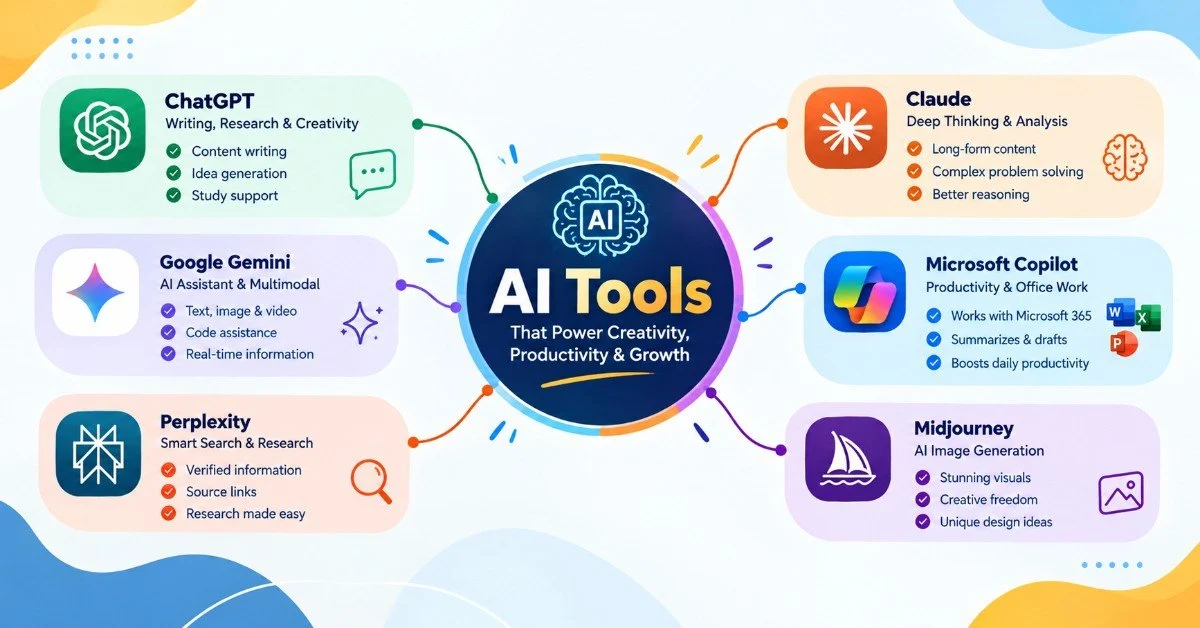
At 99Eedu Institute, we tell students the same thing every batch: AI is a fast assistant, not a designer. It gives you options in seconds. You still choose, fix, and defend the final one.
Where does AI help?
- Early ideas. Generate ten mood directions in minutes, then pick one worth sketching.
- Mockups and variations. Test a logo on a bag, a poster, and a screen without building each by hand.
- Boring tasks. Remove backgrounds, resize files, and clean up images faster.
- Copy drafts. Get rough headline options, then rewrite them in your own voice.
- Research. Summarise a client’s market or collect reference styles quickly.
Where does AI hurt?
- Final logos. AI marks are often generic, hard to scale, and impossible to trademark with confidence.
- Typography. AI text inside images is often broken or oddly spaced. You still need trained eyes.
- Original style. If you copy AI output, your portfolio looks like everyone else’s.
- Client trust. A client who finds out you pasted raw AI work will question everything else.
- Learning. Skip the basics, and you won’t know when the output is wrong.
A simple rule we use
| Stage | AI role | Your role |
|---|---|---|
| Research | Collect and summarise | Check facts, pick direction |
| Ideas | Generate options | Choose and sketch |
| Design | Speed up repetitive work | Make every key decision |
| Final delivery | Minor assists only | Full ownership |
Learn the fundamentals first. Then add AI. Students who start with AI and skip typography, layout, and colour usually can’t tell good output from bad.
Which Design Skills Do Recruiters Check First in a Fresher’s Portfolio?
Recruiters check typography, layout, and visual hierarchy first, usually within ten to fifteen seconds of opening your portfolio. Software skills come second. Hiring teams differ, so treat this as a pattern we see, not a rule.
They scan in roughly this order:
| Order | Skill | What they look for |
|---|---|---|
| 1 | Typography and layout | Readable fonts, clean spacing, clear hierarchy |
| 2 | Visual hierarchy | Does the eye know where to go first? |
| 3 | Brand thinking | Does one project feel like a system, not a single image? |
| 4 | Tool skills | Illustrator, Photoshop, InDesign, Figma used with control |
| 5 | Process and reasoning | The brief, the sketches, the why |
| 6 | AI judgment | Can you direct AI and fix its mistakes? |
| 7 | Communication | A clear write-up and a tidy, easy-to-read portfolio |
Why typography comes first
Weak type is the fastest way to look like a beginner. Recruiters spot it instantly: cramped lines, mismatched fonts, text that fights the image. Good type tells them you have trained eyes. Fix this before anything else.
What recruiters skip
- A long list of software logos on your resume
- Projects with no explanation
- Tutorial work they have seen a hundred times
What you can do this week
- Audit your top three projects for type. Limit yourself to two fonts per project.
- Squint test. Blur your eyes at each layout. If you can’t tell what matters most, the hierarchy needs work.
- Add a three-line write-up to each project: the brief, your process, the result.
- Put your strongest project first. Recruiters rarely scroll to project number six.
An advanced graphic design course in Kolkata should train these skills in this order, because they decide whether your portfolio gets a second look. At 99Eedu Institute, we review every student’s typography and layout before we move on to branding and motion.
What Should You Check Before You Join a Graphic Design Institute in Kolkata?
Check five things before you pay: past student portfolios, trainer experience, batch size, feedback frequency, and how current the syllabus is. A brochure can promise anything. Student work can’t fake it.
I’d rather you walk away from us after asking hard questions than join us on a guess. Here is the checklist we’d use ourselves.
Why student work matters most
Ask to see portfolios from recent students, not just the best one on the wall. One star student proves nothing. Look at the average. Is the typography clean? Does each project show a process? If the work looks like tutorials, your work will too.
Sit in a demo class
A demo class tells you more than any website. Watch how the trainer gives feedback. Do they explain why something works, or just say “make it bigger”? You are buying that teaching style for the next few months.
Ask about certificates and job help
A certificate helps with paper screening, and job assistance should mean practical support. That means portfolio reviews, mock interviews, and introductions. If any institute guarantees a job, I’d walk away. Nobody can promise that honestly.
Questions to ask before you pay
- Can I see last year’s student portfolios?
- Who will teach me, and what client work have they done?
- How many students sit in one batch?
- How often do I get feedback on my own work?
- How do you teach AI tools without replacing the basics?
- What exactly does the fee cover?
What you can do this week
- Shortlist two or three institutes.
- Book a demo class at each one.
- Take notes on the same six questions.
- Pick the one whose student work you’d be proud to match.
Whichever place you choose, make sure its advanced graphic design course in Kolkata ends with a portfolio you can publish, not just a certificate you can frame. At 99Eedu Institute, we’re happy to show you student work and let you sit in a class before you decide.
Is This Advanced Graphic Design Program Right for You?
This course is designed for those who desire a portfolio and a career rather than just a certificate. You do not need a background in design; you need curiosity and persistence in completing what you started.
This course is for you if you are:
- A college student. You build a portfolio before placements start.
- A fresh graduate. You get real projects to show, not just a degree.
- A fresher job seeker. You get feedback, mock interviews, and job support.
- A self-taught designer. You get structure, critique, and finished case studies.
- A career switcher. You get a clear path into design from day one.
What you need to start
A laptop that runs design software
Two to three hours of practice each week
Willingness to take feedback
Skip it if
You want a certificate without the work
You expect a guaranteed job (nobody can honestly promise that).
After the Course: Which Jobs Can You Get, and What Can You Earn?
Students who have gone through an advanced graphic design class mostly begin their careers as junior designers, visual designers, or design trainees, and the salary is more determined by your portfolio than your certification. The salaries of two students in the same batch can vary greatly.
I won’t quote exact salary numbers here, because pay in Kolkata changes with agency size, role, and skill level. Check live listings on job portals and ask us for our recent placement records.
Which jobs can you apply for?
- Junior Graphic Designer. You create posts, brochures, banners, and print layouts under a senior’s guidance.
- Visual Designer. You build campaign visuals, ads, and brand assets.
- Social Media Designer. You design daily posts, reel covers, and carousels for brands.
- Brand Design Assistant. You work on logos, color systems, and guidelines for client projects.
- UI Design Trainee. You design app and website screens in Figma.
- Motion Graphics Trainee. You make short animations for ads and social media.
- Freelance Designer. You find your own clients and set your own pricing and schedule.
Where will you work?
- Design and ad agencies. The pace is fast, you meet many clients, and you learn quickly.
- In-house teams. You work on one brand, with steady projects and deeper brand knowledge.
- Startups. You take wider responsibility, and the variety is often higher early on.
- Freelance. You get more freedom, but you must find clients and manage your own money.
Most freshers in Kolkata start at about ₹1.2 lakh to ₹3 lakh a year, and pay can pass ₹9 lakh as you gain experience. These numbers come from salary sites, not from 99Eedu Institute records. Use them as a guide, not a promise.
What can you earn, and how does pay grow?
- Fresher (0 to 1 year): ₹1.2 lakh to ₹3 lakh per year. That is roughly ₹10,000 to ₹25,000 a month. Payscale lists the average early-career pay in Kolkata at ₹2.75 lakh.
- Your skills change your pay. Designers with InDesign skills average about ₹3.22 lakh. Those listing only CorelDraw average about ₹1.38 lakh. Modern tools pay more.
- Mid-level (about 2 to 5 years): ₹4.2 lakh to ₹9 lakh per year. Pay grows when you show brand thinking, speed, and client handling.
- Senior (5+ years): ₹9 lakh to ₹12.3 lakh per year. Strategy and team leadership drive this pay.
- Freelance: no fixed range. Your income depends on your pricing and your clients. The first year is usually uneven, so keep some savings as a cushion.
Want to earn more, faster? Add a second skill, such as UI, motion, or AI-assisted workflows. A strong portfolio matters more than your certificate.
How do you get hired faster?
- Apply with a live portfolio link, not just a resume.
- Lead with your two strongest case studies.
- Apply for three role types, such as junior designer, social media designer, and brand assistant.
- Practice explaining your design choices out loud for interviews.
- Take small freelance projects while you search, so your portfolio keeps growing.
What does placement support look like?
Real placement support means portfolio reviews, mock interviews, and introductions, not a promised job. At 99Eedu Institute, we help you get ready and get seen. Your work does the rest. If any institute guarantees a job, ask for proof.
If you are choosing an advanced graphic design course in Kolkata, ask one direct question: “Where did last year’s students start working?” A clear answer tells you more than any brochure.
Note: Add your real placement numbers, hiring partners, and salary range from 99Eedu Institute records. One verified figure will make this section far stronger than any general claim.
Why Do Students Choose 99Eedu Institute in Kolkata?
Students choose 99Eedu Institute because we focus on one result: a portfolio you can show to employers. We don’t sell a long software list. We build the course around real briefs, weekly feedback, and finished case studies.
Here is what you can expect from us:
- Real project briefs. You work on client-style problems, not tutorial files.
- Weekly feedback. Your trainer reviews your work every week, so you fix mistakes early.
- Six to eight finished case studies. Each one shows the brief, your process, and the result.
- Honest job support. We help with portfolio reviews, mock interviews, and introductions. We never promise a guaranteed job.
- AI used the right way. You learn to direct AI tools, not depend on them.
Book a demo class, ask to see past student work, and judge us by what you see. Add your real batch size, trainer background, and student results here. Specific facts will make this section stronger than any claim I can write for you.
About the Author
Year Ali (Yeash) is a digital marketing professional and SEO specialist with 8+ years of hands-on experience in local SEO, search visibility, content optimisation, and lead-focused digital strategy. He has worked with businesses across different industries to improve rankings, strengthen their local presence, and build steady online growth.
Yeash focuses on practical SEO methods, real user intent, and long-term performance that fits modern search standards. He wrote this guide to help students and freshers in Kolkata understand how to build a portfolio that people can find, trust, and hire. The advice on publishing case studies, writing clear headings, and showing honest process comes from that search-first experience.
Contact with Yeash: (LinkedIn Profile).
People Also Ask
1. Is an advanced graphic design course worth it in 2027?
Yes, if it leaves you with a published portfolio and teaches you to use AI with judgment. A certificate alone won’t get you hired. Six to eight strong case studies will. Check student work before you pay.
2. Will AI take over graphic design jobs in 2027?
AI will replace repetitive tasks, not designers who think. Clients still need someone to choose ideas, fix errors, and explain decisions. Learn the fundamentals first, then use AI to work faster.
3. How long does an advanced graphic design course take?
Most courses run three to six months, depending on batch timing and depth. You can build a hireable portfolio in about 90 days of focused project work. Ask your institute for the exact schedule.
4. What is the fee for a graphic design course in Kolkata?
Fees vary widely by institute, duration, and software included. Ask for the total cost in writing. Check for hidden charges like exams, mockups, or software licenses. Compare two or three institutes before deciding.
5. Can I get a design job after the course without experience?
Yes, if your portfolio shows real process and strong typography. Freshers get hired on proof of skill, not years of work. A good course gives you portfolio reviews, mock interviews, and job support, but never a guarantee.
6. Which software should I learn first as a beginner?
Start with Adobe Illustrator and Photoshop. Add InDesign for layouts and Figma for screens. Learn two tools well before adding more. Employers care about what you make, not how many tools you list.
7. Can I learn graphic design while studying in college?
Yes, a few hours of practice each week is enough. Many students join weekend or evening batches. Finish one project every two to three weeks, and you’ll have a portfolio before placements begin.
Final Thoughts
An advanced Graphic Design Course at 99Eedu Institute, Kolkata, is based on only one outcome: the portfolio that you will be able to present to the recruiters. Here, you will learn through hands-on experience by working on briefs similar to those of a professional environment, receiving feedback from your trainer every week and completing six-eight projects till the end.
In this training, we begin by training you on typology and layout design and then move onto teaching you the use of artificial intelligence software without losing your identity.
Ready to Build a Portfolio That Gets You Hired?
Join us for book a free demo class of our Advanced Graphic Design Course at 99Eedu Institute, Kolkata. Explore the course, bring your work, ask questions, and take a look at our students’ portfolios. Get a feel for the learning experience before you decide—no pressure, just a chance to see if it’s right for you!
Share on:
Quick Enquiry
Please fill up the form and we will get back to you in next 12 hours!
