
 All Courses

 5.0
5.0











Quick Answer: AI writing tools use machine learning trained on billions of web pages to predict and generate human-like text. They are most effective when used as a drafting and optimisation assistant — not as a replacement for human editorial judgment.
How AI Writing Tools Work
At their core, AI writing tools send your instructions (called “prompts”) to a language model through an API. The model processes the context and generates statistically likely text continuations based on its training data. Modern tools layer on top of this with:
- Real-time SERP analysis — scanning top-ranking pages for keyword density and structure
- Brand voice training — fine-tuning outputs based on your existing content
- Plagiarism detection — cross-checking outputs against indexed web content
- SEO scoring — grading drafts for keyword optimisation in real time
Benefits of Using AI for Content Creation

- 10x – Faster first draft creation
- 60%– Reduction in content costs
- 3x– More content output per month
- 47%– Marketers using AI tools in 2026
Why Use AI Tools for Content Writing in 2026
The content marketing landscape in 2026 is more competitive than ever. Google’s Search Generative Experience (SGE) has raised the bar for E-E-A-T (Experience, Expertise, Authoritativeness, Trustworthiness) content. AI tools help you produce more content — faster — while keeping quality high enough to rank.
Speed & Efficiency
A skilled human writer can produce a 1,500-word blog post in 3–5 hours. An AI-assisted writer can complete the same task in 45–90 minutes by using AI to generate an outline, draft sections, and suggest headers — then editing for accuracy and brand voice. That’s 2–4x more output from the same writer.
SEO Optimisation Capabilities
Tools like Surfer SEO, Frase, and Clearscope don’t just write — they actively analyse competitor pages and tell you exactly which keywords, entities, and structures your content needs to outrank existing results. This is a significant competitive advantage in 2026’s AI-saturated search landscape.
Cost vs Hiring Writers
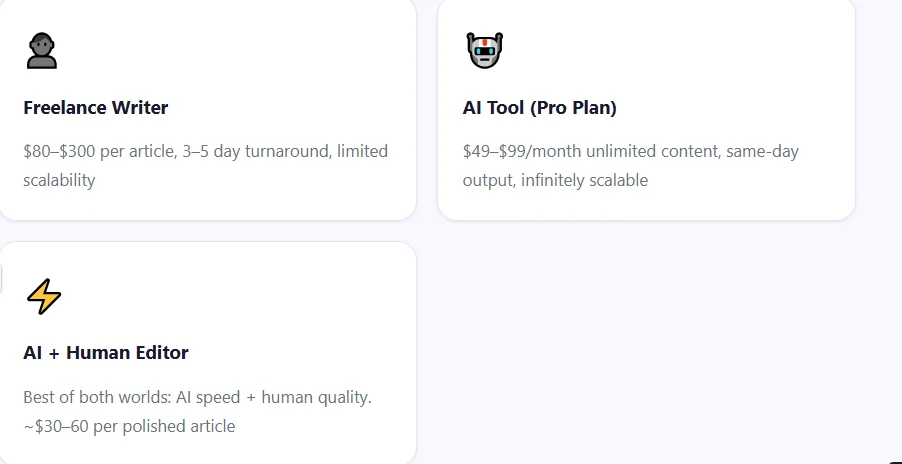
Freelance Writer
$80–$300 per article, 3–5 day turnaround, limited scalability.
AI Tool (Pro Plan)
AI + Human Editor
Best of both worlds: AI speed + human quality. ~$30–60 per polished article
Top 10 Best AI Tools for Content Writing
We tested each tool over a 30-day period, generating blog posts, product descriptions, social media copy, and SEO articles. Here’s what we found:
1. ChatGPT (GPT-4o)
Best Overall Most Versatile
ChatGPT with GPT-4o remains the most capable and versatile AI writing tool in 2026. Its ability to follow complex instructions, maintain context across long documents, and handle virtually any content type makes it the Swiss Army knife of AI writing. The new Canvas mode lets you edit long-form content directly in the interface, a game-changer for blog writers.
Key features: Long-form writing, code generation, image analysis, browsing/web search, custom GPTs for niche writing tasks, multilingual support in 50+ languages.
✅ Pros
- Extremely capable across all content types
- Strong instruction-following
- Web browsing for up-to-date content
- Huge ecosystem of custom GPTs
- Free tier available
❌ Cons
- No native SEO scoring
- Can hallucinate statistics
- Outputs need fact-checking
- No built-in brand voice training
2. Jasper AI
Best for Marketing Teams
Jasper AI is built specifically for marketing content at scale. Its “Brand Voice” feature lets you train the AI on your existing content so every output sounds like your brand. In 2026, Jasper added a Campaign mode that lets you generate an entire multi-channel content campaign (blog + email + social) from a single brief.
Key features: Brand voice training, Surfer SEO integration, 50+ content templates, team collaboration, Campaign Mode, Chrome extension.
✅ Pros
- Best-in-class brand voice consistency
- Native Surfer SEO integration
- Excellent marketing templates
- Team collaboration features
❌ Cons
- Expensive for solo users
- Outputs still need editing
- Learning curve for full features
Best for SEO Content
Surfer SEO is the gold standard for data-driven SEO content creation. Its AI writing capabilities are built directly into a real-time content editor that scores your article as you write, showing keyword coverage, heading structure, word count, and NLP entity gaps — all benchmarked against top-ranking competitors.
Key features: Real-time Content Score (0–100), SERP analyser, NLP keyword suggestions, auto-optimise, internal linking suggestions, and content audit tool.
✅ Pros
- Best SEO optimisation engine
- Real-time competitor analysis
- Actionable Content Score
- Excellent for ranking improvement
❌ Cons
- Not great for non-SEO writing
- Higher price point
- Can over-optimise content
Copy.ai has evolved from a simple copywriting tool into a full GTM (Go-To-Market) AI platform. For content writers, its Workflows feature allows you to automate repetitive content tasks — like generating 50 product descriptions from a spreadsheet or creating weekly blog outlines from a topic list.
Key features: GTM Workflows, 90+ writing templates, free plan with unlimited words, multi-language support, and CRM integrations.
✅ Pros
- Generous free tier
- Powerful workflow automation
- Easy for beginners
- Great for short-form copy
❌ Cons
- Long-form content needs heavy editing
- No native SEO integration
- Outputs can be repetitive
5. Writesonic
Best for Blog Writing
Writesonic’s AI Article Writer 6.0 can generate a fully SEO-optimised, 2,500-word article in under 2 minutes — complete with an AI-generated featured image, fact-checked statistics, and a Surfer SEO score. It’s one of the most turnkey solutions for high-volume blog content in 2026.
Key features: One-click 2,500-word articles, real-time fact-checking, Surfer SEO integration, AI image generation, WordPress auto-publish, Chatsonic (web-connected chatbot).
✅ Pros
- Fastest long-form article generation
- Built-in fact-checking
- WordPress integration
- Affordable starter plan
❌ Cons
- Quality is inconsistent at scale
- Fact-checking is not always reliable
- Outputs lack deep expertise signals
6. Frase.io
Best for Research + SEO
Frase combines AI writing with powerful content research. It automatically summarises the top 20 Google results for your keyword and helps you build content that comprehensively covers the topic. Particularly valuable for writers who need to understand why competitors rank, not just how to mimic them.
✅ Pros
- Deep SERP research is built in
- Topic modelling & entity coverage
- Excellent for content audits
- Competitive pricing
❌ Cons
- Writing quality below Jasper/GPT-4
- Limited templates
- Steeper learning curve
7. Rytr
Best Budget Pick
Rytr is the most affordable full-featured AI writing tool on the market in 2026. At $9/month for the Saver plan, you get access to 40+ use cases, 30+ languages, and a clean interface. It’s ideal for freelancers and small business owners who need AI writing help without breaking the budget.
✅ Pros
- Most affordable paid plan ($9/mo)
- 30+ language support
- 40+ content use cases
- Simple, beginner-friendly UI
❌ Cons
- Limited for long-form content
- No SEO integration
- Not suitable for enterprise
8. Claude (Anthropic)
Best for Long-Form & Analysis
Claude by Anthropic stands out in 2026 for its exceptional ability to handle extremely long documents, nuanced writing instructions, and research-heavy content. Its 200K token context window means it can write, edit, and improve an entire book chapter or comprehensive guide in a single session — something no other tool matches.
✅ Pros
- 200K token context window
- Excellent at following complex briefs
- More nuanced, less robotic output
- Strong safety and accuracy
❌ Cons
- No native SEO tools
- Less marketing-template variety
- Fewer third-party integrations
9. Hypotenuse AI
Best for E-commerce
Hypotenuse AI is purpose-built for e-commerce content. It can generate hundreds of product descriptions in bulk from a simple spreadsheet, maintain category-level brand voice consistency, and output content directly to Shopify or WooCommerce. A specialist tool for a specialist job.
✅ Pros
- Bulk product description generation
- Shopify & WooCommerce integration
- Excellent for catalogue content
- Category voice training
❌ Cons
- Too niche for general blogging
- Limited non-ecommerce templates
10. Notion AI
Best for Teams Already Using Notion
Notion AI integrates AI writing assistance directly into Notion workspaces — making it the best choice for teams that already use Notion for documentation, project management, or content calendars. It can summarise meeting notes, draft blog posts, translate pages, and explain technical jargon without ever leaving your workspace.
✅ Pros
- Seamless Notion integration
- Summarise, translate, and explain features
- Great for internal content
- Affordable add-on pricing
❌ Cons
- Requires a Notion subscription
- Not for standalone content use
- Limited SEO or marketing features
Comparison Table of AI Writing Tools
Here’s a quick-reference comparison of all 10 tools across the features that matter most for content writers in 2026:
| Tool | Starting Price | SEO Tools | Long-Form | Templates | Free Plan | Best For | Rating |
|---|---|---|---|---|---|---|---|
| ChatGPT (GPT-4o) | Free / $20/mo | ✗ | ✓ | ✗ | ✓ | All-purpose writing | 9.5 |
| Jasper AI | $49/mo | ✓ Surfer | ✓ | ✓ 50+ | ✗ | Marketing teams | 9.2 |
| Surfer SEO + AI | $89/mo | ✓ Native | ✓ | Limited | ✗ | SEO professionals | 9.0 |
| Copy.ai | Free / $49/mo | ✗ | Limited | ✓ 90+ | ✓ | Short-form & copy | 8.7 |
| Writesonic | Free / $16/mo | ✓ Surfer | ✓ | ✓ | ✓ | Blog writing | 8.5 |
| Claude (Anthropic) | Free / $20/mo | ✗ | ✓ 200K | Limited | ✓ | Long-form & analysis | 8.8 |
| Frase.io | $14.99/mo | ✓ Native | ✓ | Limited | ✗ | SEO content research | 8.3 |
| Rytr | Free / $9/mo | ✗ | Limited | ✓ 40+ | ✓ | Budget users | 8.0 |
| Hypotenuse AI | $29/mo | Limited | Limited | ✓ | ✗ | Ecommerce | 7.9 |
| Notion AI | $10/mo add-on | ✗ | ✓ | Limited | ✗ | Notion teams | 7.7 |
How to Choose the Right AI Writing Tool
The best AI writing tool for you depends on three key factors: your budget, your content type, and your skill level. Here’s a decision framework:
Based on the budget
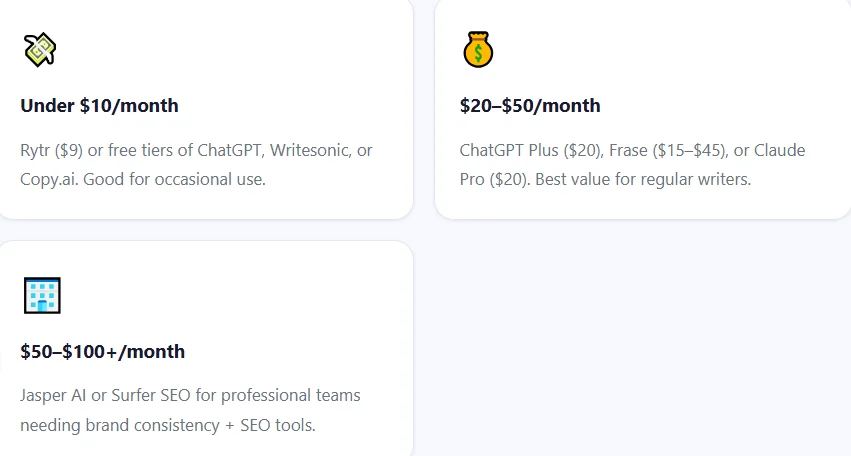
Under $10/month
Rytr ($9) or free tiers of ChatGPT, Writesonic, or Copy.ai. Good for occasional use.
$20–$50/month
ChatGPT Plus ($20), Frase ($15–$45) o Claude Pro ($20). Best value for regular writers.
$50–$100+/month
Jasper AI or Surfer SEO for professional teams needing brand consistency + SEO tools.
Based on Content Type (Blogs, Ads, SEO)
- Blog articles & long-form content: ChatGPT, Claude, Writesonic, Jasper
- SEO-optimised content: Surfer SEO + AI, Frase, Jasper (with Surfer integration)
- Social media & ad copy: Copy.ai, Jasper, Rytr
- E-commerce product descriptions: Hypotenuse AI, Copy.ai
- Technical documentation: Claude, ChatGPT
- Email marketing: Copy.ai, Jasper, Writesonic
Based on Skill Level
- Beginner: Start with Rytr or Copy.ai — both have simple UIs and guided templates
- Intermediate: ChatGPT or Claude gives you more control with prompt-based customisation
- Advanced/Professional: Jasper + Surfer SEO for a complete SEO-optimised content workflow
Best Practices for Using AI in Content Writing
Human Editing Is Still Essential
Always edit AI output before publishing: AI drafts are starting points, not finished products. Review for accuracy, tone, and factual correctness. Google’s E-E-A-T guidelines reward content that demonstrates real-world experience — add your own examples and insights.
Fact-check statistics and claims: AI models can “hallucinate” plausible-sounding but false statistics. Always verify numbers and citations through primary sources before publishing.
Use AI for structure, humans for insight: AI excels at generating outlines, filling in standard sections, and covering breadth. Human writers add depth, unique perspective, and the experience-based insight that AI cannot replicate.
Avoiding AI Detection Issues
With the rise of AI detection tools (Originality.ai, GPTZero, etc.), pure AI-generated content is increasingly identifiable. To maintain credibility:
- Mix AI-drafted paragraphs with human-written sections
- Add personal anecdotes, original research, or first-person insights
- Use tools like Humaniser or QuillBot to vary sentence structures
- Customise AI outputs with your unique data, quotes, or case studies
💡 Pro Tip: Google’s stance is not about penalising AI content — it’s about penalising low-quality content. High-quality, helpful AI-assisted content ranks just fine. Focus on value, not on hiding AI involvement.
Maintaining Brand Voice
AI tools default to generic, neutral writing styles. To maintain your brand voice consistently:
- Create a detailed brand voice prompt template with tone descriptors, example sentences, and words to avoid
- Use Jasper’s Brand Voice feature or fine-tune prompts with 3–5 examples of your best existing content
- Build a “style guide” document and paste relevant sections into your AI prompts
Common Mistakes to Avoid
1. Over-reliance on AI without editing
2. Ignoring SEO strategy
3. Publishing without fact-checking
4. Using one tool for every task
5. Vague prompts = vague output
Future of AI in Content Writing
Trends in AI + SEO
In 2026, the intersection of AI and SEO is evolving rapidly. Google’s AI Overviews (formerly SGE) have changed how people consume search results — readers now get AI-summarised answers before they even see blue links. This means:
- Content must be structured for featured snippets and zero-click answers
- E-E-A-T signals (author credentials, first-hand experience, citations) are more important than ever
- Long-tail conversational queries are growing — AI content tools need to target these
- Multimodal content (text + video + images) will be AI-generated in integrated pipelines by 2027
Role of Human Writers
Despite fears of replacement, human content writers are more valuable in 2026, not less. The role has shifted from writing everything from scratch to strategic editing, brand differentiation, and subject matter expertise. Writers who learn to use AI as a collaborator (not a replacement) are among the highest-paid in the field. The skills that matter now: prompt engineering, editorial judgment, SEO strategy, and niche expertise that AI cannot replicate.
Insight: According to industry surveys, content writers who adopted AI tools in 2024–2025 reported a 40–60% increase in client capacity without increasing working hours. AI is an amplifier, not a replacement.
Related Topics & Semantic Keywords
This guide covers the following related topics and semantic keywords that content writers search for:
Frequently Asked Questions
Q1. What is the best AI tool for content writing?
The best AI tool for content writing in 2026 is ChatGPT (GPT-4o) for general use, Jasper AI for marketing teams, and Surfer SEO + AI for SEO-focused content. The right choice depends on your goal — blogging, ad copy, or search rankings.
Q2. Are AI writing tools good for SEO?
Yes, AI writing tools are good for SEO — especially tools like Surfer SEO, Frase, and Clearscope that analyse top-ranking pages in real time. They suggest the right keywords, heading structure, and content length to help your article rank higher on Google.
Q3. Can AI replace human content writers?
No, AI cannot fully replace human content writers. AI can write fast drafts and optimise for SEO, but humans are still needed for fact-checking, storytelling, brand voice, and E-E-A-T signals that Google uses to rank trustworthy content. The best results come from AI + human collaboration.
Q4. Which AI tool is best for blog writing?
The best AI tools for blog writing are:
Writesonic — fastest full article generation
Jasper AI — best for brand-consistent blogs
ChatGPT — best for custom, flexible writing
Frase — best for SEO-researched blog posts
Q5. Are AI-generated articles plagiarism-free?
AI-generated articles are generally plagiarism-free because the content is newly generated, not copied. However, similar phrasing can occasionally appear. Always run your content through a plagiarism checker like Copyscape or Grammarly before publishing to be safe.
Q6. How much do AI writing tools cost?
AI writing tools cost anywhere from free to $100+/month, depending on features:
Free — ChatGPT Free, Copy.ai, Rytr Free
Budget — Rytr ($9/mo), Frase ($14.99/mo)
Mid-range — ChatGPT Plus ($20/mo), Claude Pro ($20/mo)
Professional — Jasper ($49/mo), Surfer SEO ($89/mo)
Most tools offer a free trial before you commit.
Conclusion
AI tools for content writing have matured significantly in 2026. Whether you’re a solo blogger, a content agency, or an ecommerce brand, there’s a tool that fits your workflow, budget, and goals.
Here’s our final shortlist based on use case:
- Best overall: ChatGPT (GPT-4o) — versatile, powerful, affordable
- Best for marketing teams: Jasper AI — brand voice + SEO integration
- Best for SEO: Surfer SEO + AI — data-driven ranking optimisation
- Best free option: Copy.ai or ChatGPT Free
- Best for long-form: Claude by Anthropic — 200K context, nuanced writing
- Best for e-commerce: Hypotenuse AI — bulk product descriptions
The most important thing to remember: AI is a force multiplier, not a shortcut. The writers who use these tools to think faster, outline smarter, and edit better will consistently produce content that ranks and converts — not just content that exists.
Ready to Start Writing Smarter?
Try at least two tools from this list using their free trials. The right AI writing tool will 10x your output — without sacrificing quality.
Share on:

Quick Enquiry
Please fill up the form and we will get back to you in next 12 hours!
