
 All Courses

 5.0
5.0






This guide covers the most important digital marketing interview questions and answers for 2026 — from fresher and intermediate rounds to senior, SEO, PPC, content, social media, and AI/GEO/AEO-specific questions. Every question below reflects what hiring managers are actually asking this year, based on real interview rounds tracked by 99Eedu Institute.
At 99Eedu Institute, we have seen thousands of candidates prepare for these exact rounds — freshers going for their first agency role and senior professionals interviewing for Head of Growth positions. What follows is what actually gets people hired.
Table of Contents
- Fresher / Entry-Level Questions
- Intermediate Professional Questions
- Experienced / Senior-Level Questions
- Scenario-Based Questions
- SEO-Specific Questions
- PPC and Paid Ads Questions
- Content Marketing Questions
- Social Media Marketing Questions
- 2026-Specific Questions (AEO, GEO, AI, Privacy)
- FAQs
What Interviewers Are Actually Testing in 2026
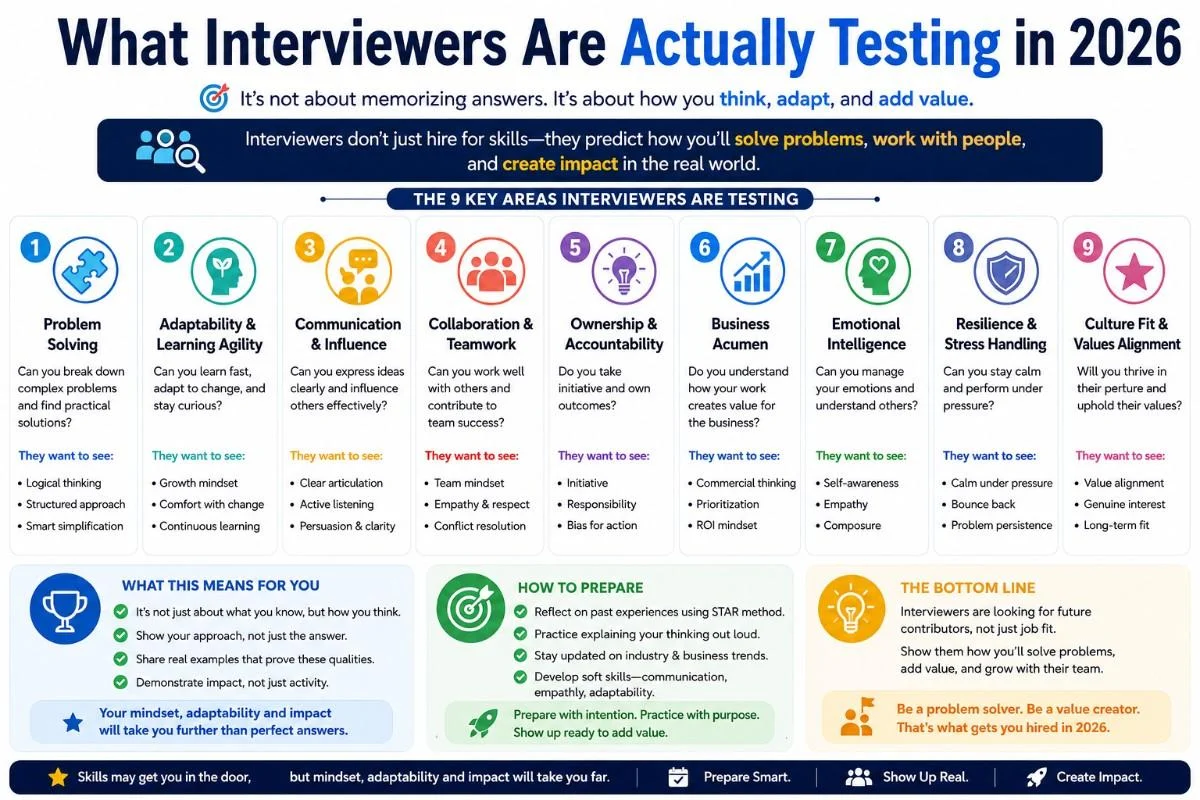
Before the questions, understand the filter. Today’s interviewers are not just checking if you know what SEO stands for.
- Can you operate in a world where AI tools do 40% of the tactical work?
- Do you understand privacy-first marketing and first-party data?
- Have you genuinely worked with GA4, Performance Max, or AI-driven bidding?
- Can you explain how your work connects to business revenue — not just impressions?
- Do you know what AEO and GEO mean, and can you do something with that knowledge?
If your answers are theory-heavy but light on real examples, that’s usually the problem.
Part 1: Fresher / Entry-Level Digital Marketing Interview Questions
If you’re going for your first digital marketing role, expect these in round one. Just enough to demonstrate that you understand the subject and can carry on a discussion about it, nothing too in-depth.
Q1. What is digital marketing?
Ans: Digital marketing is promoting products, services, or brands using internet-connected platforms — search engines, social media, email, websites, mobile apps, and increasingly, AI-powered answer engines.
In our experience training candidates at 99Eedu Institute, freshers who mention AI Overviews and first-party data in this answer progress to round two at a noticeably higher rate than those who give a textbook definition.
Q2. What are the main types of digital marketing?
Digital marketing has several core disciplines. Each one serves a different purpose, and most job roles focus on two or three of them rather than all of them at once.
The core disciplines are:
- SEO — earning organic visibility in search results.
- PPC / Paid Search — buying traffic through Google Ads, Meta Ads, and similar platforms.
- Content Marketing — creating valuable content to build audience trust and drive action.
- Social Media Marketing (SMM) — building brand presence and engagement on social platforms.
- Email Marketing — direct, owned-channel communication with subscribers.
- Affiliate Marketing — performance-based partnerships where partners earn a commission.
- Influencer Marketing — collaborating with creators who have established, relevant audiences.
- AEO / GEO — optimising for AI-generated search answers and generative engine responses (emerged as a core discipline in 2025–26).
Most interviews probe two or three of these deeply. Know which ones are most relevant to the specific role you’re applying for.
Q3. What is SEO? How has it changed in 2026?
Ans: SEO is how you help a website appear higher in Google search results without running paid ads. It works across three areas — what you write on your pages, how your website is built technically, and how many good websites link to yours. Google’s AI Overviews now sit above the traditional search results for a huge number of searches. So ranking number one is not as powerful as it was two or three years ago.
Q4. What is the difference between on-page and off-page SEO?
On-page SEO is everything you do on your own website. That includes your title tags, meta descriptions, headings, page content, keywords, internal links, image alt text, and how fast your pages load. Basically, if it lives on your site, it falls under on-page SEO.
Off-page SEO is everything outside your site that influences your search authority: backlinks from other websites, brand mentions across the web, digital PR, and increasingly, how often your brand gets cited in AI-generated responses. That last part is genuinely new and worth bringing up in an interview.
Q5. What are long-tail keywords and why do they matter?
Ans: Long-tail keywords are specific search phrases. Instead of “digital marketing course”, someone types “digital marketing course for freshers in Kolkata.” Fewer people search for it. But those who do are serious. They are not browsing — they are close to making a decision. That makes long-tail keywords easier to rank for and better at converting than broad terms. For smaller brands, especially, this is where real results come from.
Q6. What is Google Analytics 4 (GA4)?
Ans: GA4 uses machine learning to fill in data gaps caused by ad blockers and privacy restrictions. It integrates natively with Google Ads and is built around privacy regulations. Candidates who say, “It’s basically the same as old Analytics, just a new interface,” reveal immediately that they haven’t used it.
In our testing, teams switching from Universal Analytics to GA4 event tracking uncovered 18–22% more micro-conversion data that was previously invisible — especially mobile scroll depth and video engagement.
Q7. What is content marketing?
Ans: Content marketing is creating and distributing genuinely useful content to attract, retain, and eventually convert a specific audience. It’s not direct selling. It’s building trust over time — through blog posts, videos, guides, podcasts, newsletters, and other formats — so that when someone is ready to buy, your brand is the one they think of.
The brands that dominate informational queries are increasingly the ones whose content is clear, factual, and well-structured enough for ChatGPT, Perplexity, or Google’s AI Overviews to extract and surface.
Q8. What is Conversion Rate Optimisation (CRO)?
Ans: A conversion is any action a user takes that you want them to take. A purchase, a signup, a download — all conversions.CRO is about improving how many visitors actually do that. You find where people are leaving without converting, make a change — maybe the button, the headline, the form length — test it, and see if it helped. It is less about getting more traffic and more about making better use of the traffic you already have.
Q9. What skills should a digital marketer have in 2026?
Ans: Beyond channel-specific knowledge, interviewers at most companies now look for:
- Data literacy — the ability to read analytics and act on what they show, not just pull reports.
- AI tool proficiency — knowing how to use AI for speed without becoming dependent on it for quality.
- First-party data thinking — understanding how to ethically collect and activate customer data now that cookies are largely gone.
- Cross-channel perspective — seeing how SEO, paid, email, and content work together instead of in isolation.
- Communication — explaining campaign performance to stakeholders who don’t live in dashboards.
At 99Eedu Institute, our curriculum covers all five of these, not just platform mechanics.
Q10. What is Social Media Marketing (SMM)?
Ans: SMM is the use of social platforms — Instagram, LinkedIn, X/Twitter, YouTube, TikTok, and others — to build brand awareness, drive engagement, generate leads, and support customer service goals.
What makes an answer stand out in 2026:
Platform algorithms now heavily favour video, especially short-form. LinkedIn has grown significantly as a B2B discovery channel. And social media functions as a search engine in its own right — a meaningful percentage of users, particularly under 35, search for products and information directly on TikTok or Instagram rather than Google.
Q11. How to Prepare for a Digital Marketing Interview as a Fresher
Ans: The shift most worth mentioning: zero-click search. AI Overviews and featured snippets increasingly answer queries directly in the search results, meaning users never click through to the website. A brand can rank well and still see organic traffic decline. The strategic response — building direct channels, investing in brand search, optimising for AI citations — is what forward-thinking marketers are actually doing now.
Part 2: Intermediate-Level Digital Marketer Interview Questions
These questions appear in the second rounds and specialist interviews. They test whether you’ve actually used these tools and concepts in practice.
Q1. Where should keywords be placed to optimise rankings?
Ans: The highest-impact on-page placements:
- Title tag — the single strongest on-page ranking signal
- H1 heading — confirms the page’s primary topic
- First 100 words of body content — establishes relevance early
- Meta description — doesn’t directly affect rankings but influences click-through rate
- URL slug — short, descriptive, includes the primary keyword
- Image alt text — supports image search and accessibility
- Internal link anchor text — passes contextual relevance signals to linked pages
Google’s algorithm reads for contextual relevance and user intent, not keyword density. A page that uses a keyword naturally ten times will outperform one that forces it thirty times.
Q2. What is PPC advertising?
Ans: PPC (Pay-Per-Click) means you pay each time someone clicks your ad. Google Ads is dominant for search intent. Meta Ads, LinkedIn Ads, and YouTube Ads are major platforms for social and display.
The key levers: bid strategy, Quality Score (relevance of ad and landing page), audience targeting, and creative quality. In 2026, most major PPC platforms default to AI-driven bidding — Target CPA, Target ROAS, Maximise Conversions — which automates bids in real time based on predicted conversion probability. This means campaign structure and creative quality now drive more performance difference than manual bid management.
Q3. What is the difference between SEO and SEM?
Ans: SEM (Search Engine Marketing) is the umbrella that includes all search activity — both organic (SEO) and paid (Google Ads / PPC).
SEO is slow to build but compounds over time with no direct per-click cost. Paid search delivers immediate visibility but stops the moment you stop spending. Smart strategy uses both SEO to own high-intent queries at scale over time, paid search to fill gaps, cover high-competition terms immediately, and test messaging before committing to long-form content.
Q4. What is the difference between Google Ads and Google AdSense?
Ans: Google Ads is for advertisers. You use it to create campaigns that show ads across Google Search, YouTube, Gmail, and the Display Network.
Google AdSense is for publishers. Website owners use AdSense to monetise their site by displaying Google ads and earning revenue when visitors click.
One is for paying to reach audiences. The other is for earning by hosting ads. They operate on the same underlying ad ecosystem but serve entirely different users.
Q5. What are Google Ads Assets (formerly Extensions)?
Google renamed “extensions” to “assets” in 2022. They’re additions to your ad that provide extra information and increase click-through rates. Adding assets doesn’t cost more — it just gives Google more to work with. The main ones:
- Sitelink assets — links to specific pages on your site
- Callout assets — short benefit phrases (“Free delivery,” “24/7 support”)
- Call assets — show a phone number directly in the ad
- Location assets — show your address with a Google Maps link
- Price assets — display products with prices in the ad
- Promotion assets — highlight seasonal offers or discounts
- Structured snippets — highlight service or product categories
Use every relevant asset. More assets give Google more material to assemble a high-performing ad combination.
Q6. Why are backlinks important in SEO?
Ans: Backlinks — links from other websites pointing to yours — remain one of Google’s strongest ranking signals. They function as editorial votes of trust. A link from a high-authority, topically relevant site carries far more weight than dozens of links from generic directories.
In 2026, link quality standards have tightened. Google’s spam policies have become more aggressive against manipulative link building (paid links, link exchanges, low-quality syndication). The approaches that hold up are earning links through genuinely valuable content, digital PR, and strategic partnerships — slower, but durable.
Q7. What do you know about responsive web design?
Ans: Responsive web design means a site automatically adapts its layout to any screen size. Google uses mobile-first indexing — it evaluates the mobile version of your site for ranking purposes, not the desktop version.
For marketers: a non-responsive site harms SEO rankings, increases mobile bounce rates, and reduces conversion rates. Core Web Vitals — Google’s page experience metrics measuring load speed (LCP), interactivity (INP), and visual stability (CLS) — explicitly measure mobile performance. Poor scores are a ranking disadvantage.
Q8. What is Technical SEO?
Ans: Technical SEO covers the infrastructure of your site — the elements that affect how search engines crawl, process, and index your content.
Key areas: site speed and Core Web Vitals, mobile-first optimisation, clean URL architecture, XML sitemaps and robots.txt, structured data (schema markup), HTTPS security, canonical tags to manage duplicate content, JavaScript rendering for single-page applications, and international SEO (hreflang) for multi-language sites.
Good technical SEO is invisible when it works and painful when it doesn’t. You can have excellent content that barely ranks simply because Googlebot can’t crawl it properly.
Q9. What tools do you use in your digital marketing work?
Ans: A strong answer is specific and role-relevant, not a laundry list.
SEO: Google Search Console (non-negotiable), GA4, Ahrefs or Semrush for keyword research and backlink analysis, Screaming Frog for technical audits.
Paid: Google Ads interface, Meta Ads Manager, and ideally a third-party reporting tool like Looker Studio for cross-channel dashboards.
Content: Clearscope or Surfer SEO for content optimisation, Notion or similar for editorial calendars.
Automation: Zapier or Make for workflow automation; increasingly, AI tools like Claude or ChatGPT for draft generation and research acceleration.
Mention tools you’ve actually used, not ones you’ve only heard of. Interviewers will probe.
Part 3: Senior / Experienced-Level Digital Marketer Interview Questions
These questions appear in senior specialist, managerial, and Head of Digital interviews. They test strategic thinking, not just platform knowledge.
Q1. Why is digital marketing preferred over traditional marketing?
Ans: The honest answer is that “preferred” depends on the business. But digital has several structural advantages:
Measurability — you can attribute revenue to specific campaigns, keywords, and audiences with a precision that traditional media can’t match
Targeting precision — you can reach specific demographics, behaviours, and intent signals rather than broadcasting to a broad audience
Speed — a digital campaign can go live in hours and be optimised in real time based on performance data
Scalability — you can scale spend and reach without proportionate increases in production cost
First-party relationships — email lists, CRM data, and retargeting audiences are owned assets that compound in value over time
The caveat worth mentioning at the senior level: digital attribution is getting harder, not easier, as privacy restrictions tighten. The brands that over-index on last-click ROAS and ignore brand-building are paying for that now.
Q2. How do you reduce Cost Per Lead without sacrificing lead quality?
Ans: The answer interviewers want is not “optimise the campaign.” They want to know where you actually look first.
Pull your CPL by campaign, ad group, keyword, and audience segment. Every account has dead weight — targeting that spends money but brings in leads that never close.Then focus the budget on what is already working.
After that, look at landing page relevance. If your page matches what the ad promises, your Quality Score goes up and your cost per click goes down. That is a free CPL reduction. And always check your negative keywords — irrelevant search terms burning through budget are sitting in almost every account that has not been properly audited.
On the creative side, sharper messaging that pre-qualifies users reduces unqualified leads. A headline like “Digital Marketing Courses for Working Professionals” filters better than “Learn Digital Marketing.”
Finally, sync with the sales team on lead quality scoring. Sometimes what looks like a CPL problem is actually a lead definition problem.
Q3. What is RLSA in Google Ads, and how does it work?
Ans: RLSA — Remarketing Lists for Search Ads — is a Google Ads feature that lets you adjust your search campaigns specifically for people who have already been to your website or app.
For example, you can apply a bid modifier to users who visited your pricing page but didn’t convert — because they’re clearly further along in the decision. When set up correctly, RLSA campaigns consistently show lower CPL and higher conversion rates than cold audience campaigns because you’re reaching people who already have some intent.
Q4. What is A/B testing? Give a specific example?
Ans: A/B testing splits your audience between two versions of something — an ad, a landing page, or a subject line — and measures which version performs better against a defined metric.
Example: An online learning platform (similar to 99Eedu) runs two landing page versions for a digital marketing course. Version B leads with a student outcome stat (“87% of graduates placed within 90 days”) and a “Book a Free Counselling Call” CTA. After two weeks of statistically significant traffic, Version B shows a 22% higher conversion rate.
What makes a strong A/B testing answer: mention statistical significance, test duration, sample size, and testing one variable at a time.
Q5. Explain ROAS vs. MER and when you’d use each?
Ans: ROAS (Return on Ad Spend) = Revenue ÷ Ad Spend. Measures efficiency at the campaign or channel level.
MER (Marketing Efficiency Ratio) = Total Revenue ÷ Total Marketing Spend. Measures overall marketing health across all channels combined.
ROAS is the right tool for optimising individual campaigns — comparing creative variants, bid strategies, or audience segments. A brand awareness campaign will look terrible on last-click ROAS even if it’s responsible for warming up every eventual conversion.
MER gives an executive-level view of whether the total marketing budget is generating revenue profitably.
In practice: Use MER for budget allocation strategy and boardroom reporting.
Q6. What do you know about AI-driven ad platform signals?
Ans: When Google’s Performance Max or Smart Bidding decides whether to show your ad, it is not guessing. It is pulling from a lot of data points at once.
- User’s search query and stated or implied intent
- Device, OS, browser, and connection type
- Time of day, day of week, seasonality
- Location and language
- Prior browsing behaviour within Google’s network
- Audience list membership (remarketing, Customer Match, similar segments)
- Historical conversion patterns in the account
- Creative performance data — which headlines, images, and descriptions are working with which audiences
The practical implication: Clean conversion tracking via GA4. Diverse creative assets covering different angles. Seeding Customer Match with your best historical customer data.
Q7. How do you build a PPC strategy from scratch for a new client?
Ans: Step 1: Understand the business economics — product margins, customer lifetime value, and current conversion rate. Without this, you can’t set a realistic CPA or ROAS target.
Step 2: Audit the competitive landscape. What are competitors bidding on? Average CPC in this category? Is it oversaturated or underserved?
Step 3: Structure campaigns by intent. Branded terms first (capture demand already searching for you). High-intent non-branded terms. Mid-funnel terms. Competitor terms if the budget allows.
Step 4: Build landing pages that match ad messaging exactly. Sending paid traffic to a homepage is one of the most common and expensive mistakes.
Step 5: Set up conversion tracking correctly before spending anything. Smart bidding with no conversion data is noise.
Step 6: Start with manual CPC or Maximise Clicks to gather data. Switch to Target CPA or Target ROAS once you have 30+ monthly conversions in the account.
Step 7: Review weekly. Check search term reports. Pause wasted spend. Test new creative. The work doesn’t end at launch.
Part 5: SEO Interview Questions
Q1. Why is SEO important for a website?
Ans: Organic search is the only significant acquisition channel with no per-click cost that compounds over time. A well-ranked page keeps delivering traffic weeks, months, and years after it’s published. Paid ads stop the moment you stop paying.
In 2026, SEO importance also extends to AI discoverability. A site with strong E-E-A-T signals and well-structured content is more likely to get cited by AI search platforms — a channel that’s growing faster than traditional blue-link search for many query types.
Q2. What are the types of SEO?
Ans: On-page SEO: Content quality, keyword optimisation, heading structure, internal linking, meta tags, image optimisation, and page experience.
Off-page SEO: Backlink acquisition, digital PR, brand mentions, and social proof signals.
Technical SEO: Crawlability, Core Web Vitals, site speed, structured data, canonical tags, mobile optimisation, and JavaScript rendering.
Local SEO: Google Business Profile optimisation, local keyword targeting, NAP consistency across directories, and local schema markup.
AEO / GEO: Optimising content structure and authority for AI-generated search responses — the newest addition to the standard SEO toolkit.
Q3. What is crawling, indexing, and ranking?
Ans: Crawling: Googlebot visits your pages by following links. It discovers new content this way. If your page isn’t linked from anywhere, Googlebot may never find it.
Indexing: Google processes crawled pages and stores them in its index if they’re deemed valuable and indexable. Not everything crawled gets indexed — thin content, duplicate pages, and pages blocked by robots.txt typically don’t.
Ranking: When a user searches, Google pulls from the index and orders results by relevance, authority, and page experience signals. The gap between being indexed and ranking well on the first page is where most SEO work happens.
Practical implication: excellent content can rank poorly simply because of technical issues at the crawling or indexing stage. Technical SEO isn’t optional.
Q4. Which SEO strategies produce the most results in 2026?
Ans: Topical authority building: Instead of targeting isolated keywords with individual posts, build topic clusters — a comprehensive pillar page supported by multiple detailed supporting articles. AI search systems specifically reward demonstrated subject depth.
Structured data / Schema markup: Helps both traditional search engines and AI platforms understand your content precisely. Increases eligibility for rich results and AI citations.
E-E-A-T signals: Original research, author credentials, first-hand experience, and transparent sourcing. Especially important in YMYL (Your Money, Your Life) topics — health, finance, legal, and education.
Content refreshes: Updating and expanding existing pages that are indexed but slipping in rankings. Often delivers faster ROI than publishing brand-new content.
Digital PR: Earning editorial links from quality publications. The only backlink strategy that remains durable as Google’s spam detection improves.
Part 6: PPC Interview Questions
Q1. What are keyword match types in Google Ads?
Ans: Broad Match: Ads can show for searches related to your keyword — including synonyms and loosely related topics. Widest reach, least control. Google’s broad match has improved significantly with AI, but it still requires careful negative keyword management.
Phrase Match: Ads show for searches that include the meaning of your keyword, potentially with additional words before or after. More precision than broad, more flexibility than exact.
Exact Match: Ads show for searches that closely match your keyword’s specific meaning. Highest precision, smallest reach.
When to use which: Exact match for high-value, high-intent terms where you know exactly what you want to capture. Phrase match for moderate-volume terms where you need some reach flexibility. Broad match for prospecting or when the algorithm needs volume to learn — always paired with robust negative keyword lists.
Q2. What is Ad Rank, and how do you improve it?
Ad Rank determines where your ad appears and whether it appears at all. It’s calculated from: your bid, your Quality Score (relevance of ad copy and landing page), the expected impact of your assets, and contextual signals (device, location, search query).
You improve Ad Rank by improving Quality Score — which means writing more relevant ad copy, improving landing page experience (speed, relevance, clarity), and adding all available assets. The payoff: a higher Quality Score lets you achieve better positions at lower CPCs than a competitor who’s outbidding you but running irrelevant ads to poor landing pages.
Q3. How do you optimise PPC conversion rates?
Ans: The highest-leverage moves, roughly in order of impact:
- Landing page alignment — ad message and landing page must match. Disconnect here is the single most common conversion killer.
- Page speed — every extra second of load time on mobile reduces conversions.
- Form simplification — ask for the minimum information needed at the first touchpoint.
- Social proof above the fold — reviews, testimonials, trust badges.
- CTA clarity — one primary action, visible button, action-oriented language.
- Audience refinement — if traffic quality is poor, on-page optimisation won’t save you.
Ad copy pre-qualification — qualifying language in headlines (“For businesses with 10+ employees”) filters out low-intent clicks before they land.
Part 7: Content Marketing Interview Questions
Q1. What makes a content marketing strategy effective?
Ans: An effective strategy starts with a specific audience definition — not a demographic profile, but a real person with a real problem at a specific stage of their decision journey.
From there, content maps to intent stages: awareness content answers broad questions (“what is X”), consideration content addresses comparisons and objections (“X vs. Y”), and decision content closes (“why choose us” — case studies, demos, pricing pages).
In 2026, an effective strategy also accounts for AI discoverability. Content structured with clear headings, direct answers near the top, and factual specificity is more likely to be cited by AI search platforms. This means writing for extraction, not just readability.
Q2. How do you distribute content after publishing?
Ans: SEO optimisation so the content earns organic search traffic over time. Email newsletter distribution to existing subscribers. Platform-native social posts tailored to each channel’s format. Internal linking to connect new content to relevant existing pages. Outreach to relevant publications, communities, or professionals who’d find it valuable. Repurposing — turning a long-form guide into a LinkedIn post series, a short video, or a newsletter edition. Paid amplification for content that’s already proven valuable through organic signals.
Q3. What is the role of email newsletters in digital marketing?
Ans: Email remains one of the highest-ROI marketing channels. It doesn’t depend on platform algorithms. You own the list — no algorithm change can deprioritise your newsletter in your subscribers’ inbox the way Meta can deprioritise your posts.
In 2026, newsletters have grown in importance partly because AI-generated content has flooded the open web. Readers are increasingly seeking trusted, curated voices they subscribe to directly. For B2B, especially, a well-maintained email list with genuine engagement is a durable asset that no Google update touches.
Part 8: Social Media Marketing Interview Questions
Q1. How do you choose social media platforms for a new brand?
Ans: Identify the target audience: age, profession, content preferences, and purchase behaviour. Match to platform strengths: LinkedIn for B2B and professional services; Instagram and TikTok for visual consumer brands targeting under-35s; YouTube for long-form educational and product content; X/Twitter for real-time news, tech commentary, and media.
Don’t spread across every platform at launch. One channel done well beats five done poorly. Pick the one most likely to reach your core audience and build a real presence before expanding.
Q2. What is your approach to video creative strategy?
Ans: Video performs best when the first two to three seconds are the strongest part — especially for paid placements where you’re competing for attention on a scroll.
Short-form organic (Reels, TikTok): lead with the most interesting element, not an introduction. Use captions, because most views are sound-off. Keep it under 60 seconds for most topics.
YouTube pre-roll ads, the five seconds before the skip button, matter more than everything else. Your key message belongs there.
B2B LinkedIn video: slightly longer formats perform — two to four minutes — because professional audiences tolerate and often prefer more depth.
Always plan a video with the distribution platform in mind from the start. A video built for TikTok won’t perform the same way on LinkedIn.
Part 9: 2026-Specific Questions — AEO, GEO, AI, and Privacy
In 2026, these are the questions that tell an interviewer immediately whether a candidate is current or not. You will almost certainly face one or two of them in any mid or senior-level round. The problem is that most courses still treat this stuff as a bonus topic rather than a core skill. That is exactly why 99Eedu Institute made it a dedicated part of the curriculum — because optional is not good enough anymore.
Q1. What is AEO, and how is it different from traditional SEO?
Ans: AEO (Answer Engine Optimisation) is the practice of structuring content to appear as a cited answer in AI-powered platforms — Google’s AI Overviews, ChatGPT, Perplexity, and similar systems.
Traditional SEO focused on ranking web pages so human users click through to your site. AEO focuses on having your content extracted and synthesised by AI systems, which may cite you without sending any traffic at all.
The practical difference in how you create content: AEO content uses a clear Q&A structure, direct answers near the top, factual specificity with citations, and schema markup to make content machine-readable. It also builds entity associations — getting your brand mentioned alongside the right topics across authoritative sources so AI models learn to connect your name with that subject area.
Q2. What is GEO, and how does it affect content strategy?
Ans: GEO (Generative Engine Optimisation) is closely related to AEO but focuses specifically on large language models — ChatGPT, Claude, Gemini, Perplexity — that generate original responses rather than returning ranked links.
Getting cited in generative AI responses requires being recognised as an authoritative source across multiple trusted publications; having clearly structured, factually accurate, well-sourced content; and building a consistent brand presence so AI systems associate your brand with expertise in your category.
For most brands, GEO in 2026 means a combination of content depth, digital PR (editorial mentions in quality outlets), structured data, and actively monitoring how your brand appears in AI-generated answers — similar to how brands once started monitoring search rankings.
Q3. How has first-party data become essential in 2026?
Ans: Third-party cookies — which powered retargeting and cross-site behavioural targeting for two decades — are effectively gone across most major browsers and platforms. The audience data marketers borrowed from Google and Meta is increasingly restricted.
First-party data is data collected directly from your own users: email addresses, purchase history, website and app behavioural data, CRM records, and survey responses.
In 2026, building and activating first-party data is a core marketing competency. Key strategies: email list growth through content and gated resources, loyalty programs that incentivise data sharing, zero-party data collection (directly asking customers about preferences), and uploading CRM data via Google’s Customer Match and Meta’s Custom Audiences to enable targeting without cookie dependency.
Marketers who built owned data assets early have a structural advantage that’s now very difficult for late starters to close.
Q4. How does AI integration change your daily marketing workflow?
Ans: The candidates who answer this well are not the ones who say they use ChatGPT. Everyone says that. The ones who stand out explain specifically what they use it for and where they do not trust it.
Use it for drafts, subject line testing, outlines, and competitive research. Things that eat time but do not require genuine expertise. A content gap analysis that used to take half a day now takes twenty minutes with the right tools.
But the stronger part of the answer is knowing where AI falls short. Those are exactly the things that make content credible to both readers and AI search platforms. So the way to think about it is AI handles the speed, and you handle the quality. One without the other produces either slow work or shallow work.
Q5. What are privacy-focused advertising strategies for 2026 and beyond?
Ans: With consent requirements tightening globally — GDPR in Europe, PDPA in India, state-level laws across the US — and cookies largely deprecated, the landscape has shifted to:
Contextual targeting: Ad placement based on page content rather than user browsing history. Less precise, but privacy-compliant and performing better than expected as targeting signals improve.
First-party data activation: CRM-based targeting through Customer Match (Google) and Custom Audiences (Meta) replaces the cookie-based behavioural data that’s disappearing.
Server-side tracking: Moving conversion tracking infrastructure server-side to reduce browser dependency and improve accuracy under privacy restrictions.
Modelled conversions: GA4 and Google Ads now model conversion data where direct measurement isn’t possible due to consent restrictions. Understanding what this means for attribution accuracy is increasingly a senior marketer’s skill.
Consent Mode v2: Google’s framework for adjusting ad measurement and personalisation based on user consent signals. Mandatory for advertisers running campaigns in Europe.
Q6. Will AI replace digital marketers?
Ans: AI already handles repetitive work. Basic content, routine reports, simple ad tweaks. If that is all you do, that work is disappearing. What AI cannot do is think strategically, understand a brand deeply, build client trust, or explain campaign results in a way a founder actually cares about.
The marketers who are fine are using AI to work faster while keeping their own judgment in charge. That combination is what companies are hiring for in 2026.
Frequently Asked Questions
Share on:

Quick Enquiry
Please fill up the form and we will get back to you in next 12 hours!
