Choosing the right Java training in Kolkata prepares students, graduates, and working professionals for careers in backend and full-stack development. A solid course covers Core Java, Advanced Java, Spring Boot, Hibernate, JDBC, SQL, and REST APIs, backed by live projects and interview preparation — not just a certificate at the end.
A certificate doesn’t get you through a technical interview — being able to actually build something does. So at 99Eedu Institute, you’re writing real code against real project briefs from day one, not just taking notes. Mock interviews and placement support run alongside the coding, not after it, so theory and practice grow together instead of staying in separate boxes.
What is Java Training?
Java training is a structured course that teaches you to write, debug, and deploy applications using Java — covering Core Java (OOP, collections, exception handling), Advanced Java (Servlets, JSP, JDBC), and frameworks like Spring Boot and Hibernate. A genuine program pairs each concept with hands-on coding and live projects, so you finish able to build a working application, not just recite syntax.
Why Choose Java Training in Kolkata for a Successful Software Development Career?
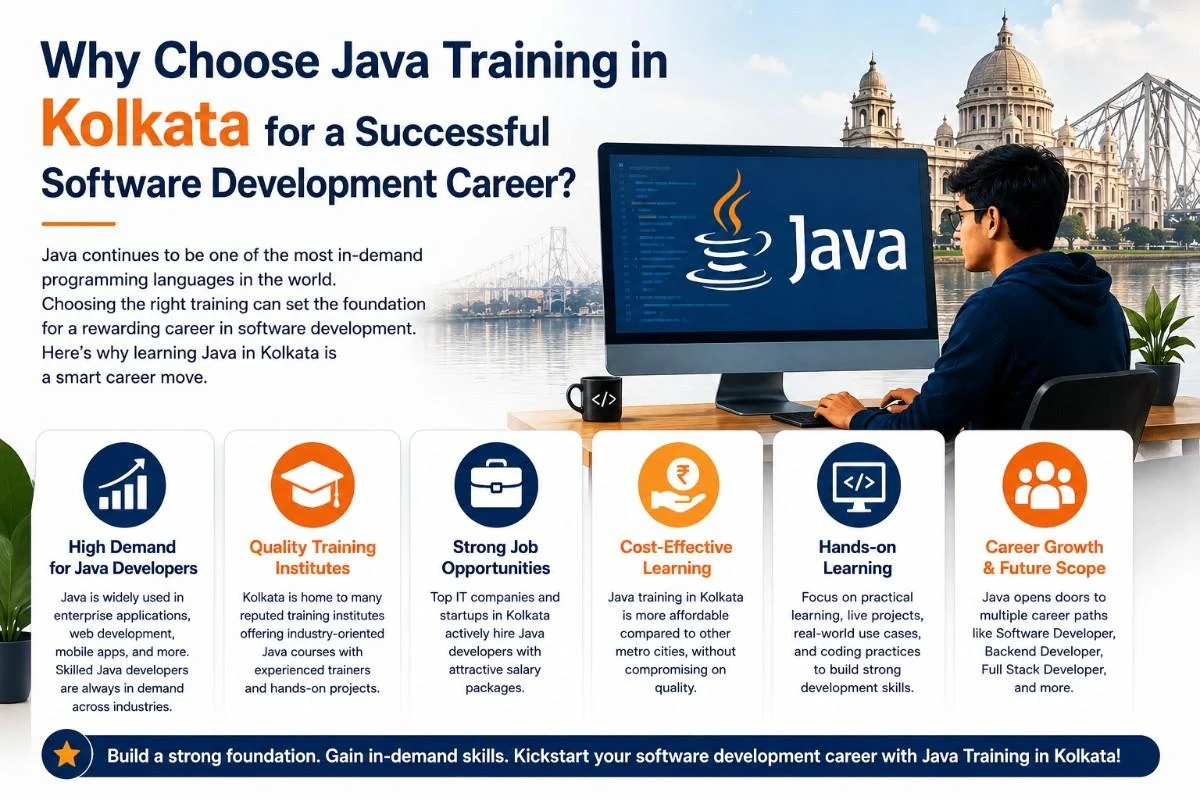
Java is one of the most versatile and widely used programming languages in the world. It shows up everywhere — powering websites, mobile apps, enterprise software, and the backend systems that run behind the scenes at most large companies. If you’re serious about building a career in software development, Java is one of those languages that’s genuinely worth the time to learn properly.
1. Lower cost of learning without lower quality
Compared to Bangalore, Pune, or Hyderabad, the cost of living and course fees in Kolkata are noticeably lower, which means you can invest in a proper Java Course in Kolkata with Live Projects without stretching your budget thin.
2. Local hiring networks
Institutes based in the city often maintain direct relationships with local IT companies, startups, and staffing agencies, which genuinely helps during placement drives.
3. Access to both classroom and online formats
Many learners in Kolkata prefer face-to-face doubt-clearing, especially for a subject like Java where debugging errors in real time makes a huge difference. A well-run Best Java Training Institute in Kolkata usually offers both classroom and online batches so you can choose what fits your schedule.
4. Community and peer learning
Studying in a classroom with 15–20 other learners, all preparing for similar interviews, creates informal peer support that self-paced online learning often lacks.
5. Regional placement targeting
If you want to work locally rather than relocate immediately after your course, a Kolkata-based institute is better positioned to connect you with regional openings, in addition to remote and pan-India roles.
If you’re specifically looking near your locality, options like a Java Course Near Dum Dum, Java Course Near Salt Lake, or Java Classes Near Howrah can save significant commute time, which matters if you’re balancing a job or college alongside your training.
Why Is Java Still One of the Most In-Demand Programming Languages in 2026?
A common question learners ask before enrolling in any Java Classes in Kolkata is simple: is Java still relevant? The honest answer, backed by how enterprise hiring actually works, is yes — and here’s why.
Enterprise systems run on Java
Most large banks, insurance firms, telecom companies, and government IT systems were built on Java over the past two decades, and rewriting that codebase in a different language isn’t practical. This means ongoing demand for developers who can maintain, extend, and modernise these systems.
Android development still leans on Java fundamentals
While Kotlin is now the preferred language for new Android apps, Java remains foundational to understanding the Android ecosystem, and many existing apps still run on Java-based codebases.
Spring Boot dominates backend microservices
The Spring ecosystem, built on Java, is one of the most widely adopted frameworks for building scalable backend APIs and microservices — a skill set that’s directly tied to current job postings.
Stability and long-term support
Java’s LTS (Long-Term Support) release model gives companies confidence to build on it for years without worrying about the language becoming obsolete, unlike some newer, faster-changing frameworks.
A mature hiring ecosystem
Because Java has been an industry staple for so long, the interview processes, certification paths, and career ladders (Java Developer → Senior Developer → Tech Lead → Architect) are extremely well established, giving learners a clear, predictable growth path.
This is precisely why Advanced Java Training Kolkata programs continue to see steady enrollment — the language isn’t trending; it’s structurally embedded in enterprise software.
Java vs Python: Which Language Should You Learn First in 2026?
If your goal is a stable, well-paying career in software development or backend engineering, Java is usually the smarter place to start — especially since IT services companies, which make up a huge chunk of Kolkata’s job market, hire heavily for Java skills. That said, you don’t have to pick just one forever. Plenty of learners eventually pick up both Java and Python, starting with whichever one matches the job they’re targeting first.
| Factor |
Java |
Python |
| Best for |
Enterprise backend, Android, large-scale systems |
Data science, AI/ML, scripting, automation |
| Learning curve |
Slightly steeper due to strict syntax and OOP structure |
Easier to start due to simpler syntax |
| Job market (Kolkata & India) |
Strong in IT services, banking, product companies |
Strong in analytics, AI/ML, startups |
| Performance |
Faster execution for large applications |
Slower but faster to prototype with |
| Career stability |
Very mature, structured career paths |
Growing fast, especially in data-heavy roles |
For most beginners enrolling in a Java Course in Kolkata, the language is chosen because it builds extremely strong programming fundamentals — object-oriented thinking, memory management awareness, and disciplined coding habits — that transfer well even if you later pick up Python or another language.
Who Should Join This Java Course in Kolkata?
A well-designed Java training program isn’t only for computer science graduates. Based on typical batch composition at institutes across the city, here’s who benefits most:
- Final-year and recent B.Tech/BCA/MCA graduates who want to become job-ready before campus placements or off-campus drives.
- Non-CS graduates (B.Sc, B.Com, or other streams) looking to switch into software development through a structured Java Programming Course for Beginners in Kolkata.
- Working professionals in QA, support, or non-tech roles who want to move into development.
- Career-switchers from unrelated fields who are starting from zero and need a beginner-friendly pace.
- Freelancers or self-taught coders who know basic syntax but lack the structured, project-based experience employers expect.
- Students preparing for Java certification who want exam-focused guidance alongside practical skills.
If you see yourself in any of these groups, going for a properly sequenced Java Course in Kolkata — something that doesn’t just assume you already know how to code — is really the safer bet. It lets you build both skill and confidence step by step, instead of getting thrown into the deep end and overwhelmed early on.
What Does the Java Course Curriculum Actually Cover — From Core Java to Spring Boot?
If you’re wondering what you’ll actually sit through week by week, here’s the short version: A proper Java course really moves in stages — you start with Core Java to nail down the fundamentals, then move into Advanced Java for web and database skills, and finally get into Spring Boot and Hibernate, which is honestly what most real backend jobs are built on today. Nothing here is optional if you want to walk into an interview and hold your own — each stage builds directly on the last.
Module 1: Core Java Fundamentals
You’ll start right at the basics — Java syntax, data types, variables, operators, and control statements — and get comfortable with loops and arrays so you actually understand how a Java program runs, not just how to copy one. From there, the module moves into Object-Oriented Programming: classes, objects, inheritance, polymorphism, abstraction, and encapsulation — the concepts that shape how you think in Java. You’ll also pick up exception handling, work with Collections like List, Set, and Map, get an early grip on multithreading and concurrency, and learn file handling through Java’s I/O streams.
Module 2: Advanced Java
You’ll see how Servlets and JSP work together behind the scenes of dynamic web pages, learn to connect your Java code to a MySQL or Oracle database using JDBC, and get a clear sense of how session management keeps track of users while they’re actively using an app. Alongside all that, you’ll get introduced to design patterns — the kind of thing that turns code from “it works” into something clean and actually maintainable.
Module 3: Java Frameworks
You’ll get into Spring Core and Dependency Injection, which takes a lot of the manual heavy lifting out of application development, then move into Spring Boot to build genuinely production-ready applications. Hibernate and JPA come in next, making database work far less painful, and you’ll finish this module by actually building, testing, and consuming REST APIs — a skill that shows up in almost every backend job listing out there.
Module 4: Java Full Stack Development
If you want to build a complete application — not just the backend half — this module brings the front end into the picture. You’ll cover HTML, CSS, and JavaScript to build interfaces people can actually use, then get introduced to React or Angular basics and learn how to connect that front end to your Spring Boot APIs. Deployment fundamentals are covered too, along with Git, so you’re ready to work the way real development teams actually collaborate.
Module 5: Development Tools and Industry Practices
The last stretch is all about the tools developers use every single day, not just in theory. You’ll learn to manage code with Git and GitHub, automate builds with Maven or Gradle, write and run tests with JUnit, and get a working understanding of Agile methodology. By the end, you’re not just someone who “knows Java” — you understand how modern development teams actually operate.
This layered structure is exactly why programs branded as Core Java Course Kolkata or Advanced Java Training Kolkata should be treated as two connected phases, not separate courses — skipping Core Java to jump straight into frameworks almost always creates knowledge gaps that show up during technical interviews.
Hands-on Java Projects You’ll Build During the Course
Reading about Java is one thing — actually building with it is what makes the difference in an interview. Here are the kinds of projects a solid course should have you working on
- Student/Employee Management System — practising CRUD operations, JDBC, and basic OOP design.
- E-commerce Mini Application — combining Spring Boot, REST APIs, and a database layer to simulate product listing, cart, and order flow.
- Library Management System — reinforcing collections, file handling, and exception management.
- Banking Application Simulation — focused on multithreading, transaction handling, and security basics.
- REST API-based Task Manager — built with Spring Boot, useful for demonstrating backend API skills.
- Full Stack Capstone Project — for learners on the full stack track, integrating a front-end (React/Angular) with a Spring Boot backend and a live database.
Reading about Java is one thing — actually building with it is what makes the difference in an interview. Here are the kinds of projects a solid course should have you working on.
Java Course Duration, Fees, and Learning Modes in Kolkata
Duration, cost, and format vary depending on depth and specialisation, but here’s a realistic breakdown based on how most reputable programs in the city are structured:
| Course Track |
Duration |
Base Fees |
GST (18%) |
Total Fees |
Mode |
| Advanced Java (Spring Boot & Hibernate) |
2–3 months |
₹22,000 |
₹3,960 |
₹25,960 |
Classroom / Online |
| Full Stack Developer (Java + React) |
4–6 months |
₹25,000 |
₹4,500 |
₹29,500 |
Classroom / Online / Weekend |
Institutes positioning themselves as Affordable Java Classes in Kolkata typically keep Core Java pricing accessible while charging more for advanced, project-heavy, placement-linked tracks — which is a reasonable structure since the latter involves significantly more mentor time.
Placement Assistance and Java Career Opportunities After the Course
A Best Java Training Institute in Kolkata with Placement support should offer more than just resume forwarding. Genuine placement assistance typically includes:
- Resume building tailored to Java developer roles and Applicant Tracking System (ATS) formatting
- Mock technical interviews covering DSA basics, OOP concepts, and project walkthroughs
- HR interview preparation for soft-skill and behavioural rounds
- Direct referrals to partner companies, startups, and IT service firms
- Soft skills and communication training are especially important for candidates from non-English-medium academic backgrounds
Career opportunities after Java training generally include:
- Java Developer / Software Developer
- Backend Developer (Spring Boot specialist)
- Full Stack Developer (Java + React/Angular)
- Android Developer (with Kotlin transition support)
- QA Automation Engineer (using Java-based Selenium)
- Application Support Engineer
- Java Trainee / Associate Software Engineer (entry-level roles at IT service companies)
Placement outcomes depend heavily on how seriously a learner engages with mock interviews and project work — no institute can guarantee a job, but structured Java Developer Training with Placement Assistance significantly improves your interview readiness and confidence.
Java Developer Salary in Kolkata and India: What to Expect in 2026
Salaries really do vary quite a bit depending on your experience level, the type of company you join, and what you’ve specialised in — so instead of throwing out a vague number, here’s a realistic, experience-based picture of what to expect in 2026.
In Kolkata:
- Fresher (0–1 year): Entry-level packages at IT service companies and local startups, generally on the lower end compared to metro hubs like Bangalore or Pune, but a solid starting point.
- 1–3 years experience: Noticeable jump, especially for developers who’ve picked up Spring Boot and REST API skills.
- 3–5 years / Senior Developer: Significant increase, particularly for those who’ve moved into full-stack or backend architecture roles.
Pan-India (for comparison):
Fresher Java Developer roles at larger IT companies or product startups typically offer higher packages than local Kolkata firms, especially in Bangalore, Hyderabad, and Pune.
Java professionals with 5+ years of experience and strong Spring Boot/microservices expertise command some of the highest packages in the backend development space, particularly at product-based companies.
Your starting salary matters less than your growth trajectory. Developers who continuously upskill — adding Spring Boot, microservices, cloud basics (AWS/Azure), and system design knowledge — tend to see the fastest salary growth within the first 3–4 years, regardless of which city they started in.
Why Choose Our Java Training Institute in Kolkata?
At 99Eedu Institute, the way Java training is taught comes straight from 15+ years spent actually working in the industry – not from a syllabus someone put together in a classroom. The institute is founded by Avijit Rath, CEO of 99Graphics Pvt Ltd, who has spent over a decade and a half working on live client projects and understands firsthand what separates a developer who gets hired from one who doesn’t.
Learners who can explain their code and defend their decisions in an interview get shortlisted; learners who only memorised syntax don’t. That real-world observation is exactly why the training here is built around one core idea — employability, not just finishing the course — and it shapes everything from how modules are sequenced to how every project gets reviewed.
- Structured, sequenced curriculum — from Core Java fundamentals to Advanced Java, Spring Boot, and full-stack development, without skipping foundational concepts.
- Live, project-based learning — every module is reinforced with hands-on coding, not just slide-based teaching.
- Experienced trainers — instructors who bring real industry project experience into how concepts are explained and debugged.
- Flexible learning modes — classroom, online, and weekend batches to fit different schedules.
- Placement-oriented mentorship — resume support, mock interviews, and interview readiness are built into the later stages of the course.
- Batch sizes kept manageable — so learners actually get doubt-clearing attention rather than sitting in oversized lecture halls.
- Certification support — guidance on which Java Certification Training Kolkata path (Oracle-recognised or industry-relevant) suits your career goal.
Whether you’re searching for a Java Institute Near Me in North or South Kolkata, or specifically exploring options near Salt Lake, Dum Dum, or Howrah, evaluating an institute on curriculum depth, project exposure, and genuine placement support — rather than just price — will serve your long-term career far better.
Frequently Asked Questions
Q. Which is the best Java training institute in Kolkata?
The “best” institute depends on your goals, but look for one offering a structured curriculum covering Core Java, Advanced Java, and Spring Boot, along with live projects and placement support — such as the approach followed at 99Eedu Institute. Always check trainer experience, batch size, and project depth before enrolling.
Q. How long does it take to learn Java?
Basic Core Java concepts can be learned in 4–6 weeks. Becoming job-ready with Advanced Java and Spring Boot typically takes 2–4 months, and a full-stack developer track can take 4–6 months, depending on your pace and prior coding background.
Q. Is Java worth learning in 2026?
Yes. Java continues to power enterprise systems, banking software, and backend microservices through the Spring ecosystem, and it remains one of the most consistently in-demand skills in IT hiring, including across Kolkata’s growing IT sector.
Q. Can I learn Java without coding experience?
Yes, a well-designed Java Programming Course for Beginners Kolkata starts from absolute basics — variables, loops, and logic building — before moving into object-oriented programming, so prior coding experience isn’t mandatory.
Q. What are the key differences between Core Java and Advanced Java?
Core Java covers fundamentals like OOP, collections, exception handling, and multithreading. Advanced Java builds on this with web technologies like Servlets, JSP, JDBC, and database connectivity, preparing you for enterprise application development.
Q. What projects are included in Java training?
Typical projects include a student/employee management system, an e-commerce mini application, a library management system, a REST API-based task manager, and, for full-stack learners, a capstone project combining a front-end framework with a Spring Boot backend.
Q. What skills do Java developers need?
Core skills include OOP concepts, data structures and algorithms, Spring Boot, database management (SQL), REST API development, Git version control, and problem-solving ability demonstrated through real projects.
Q. Does Java training include Spring Boot?
A comprehensive Advanced Java Training Kolkata program should include Spring Boot, since it’s the industry-standard framework for building modern Java backend applications and microservices.
Q. Which Java certification is best?
Oracle Certified Professional (OCP) Java certifications are widely respected, but for freshers, a strong project portfolio combined with a recognised Java Certification Training Kolkata course often matters more to recruiters than the certification badge alone.
Q. What are the career opportunities after learning Java?
Career paths include Java Developer, Backend Developer, Full Stack Developer, Android Developer, QA Automation Engineer (Selenium with Java), and Application Support Engineer, with growth into Senior Developer, Tech Lead, and Architect roles over time.
Q. How much does a Java developer earn?
Salaries vary by city, experience, and company type. Freshers in Kolkata typically start on the lower end compared to metro hubs, but salaries grow significantly with 2–5 years of experience, especially for developers skilled in Spring Boot and microservices.
Q. Which course is better: Java or Python?
Neither is universally “better” — Java suits enterprise backend, Android, and large-scale systems, while Python suits data science, AI/ML, and scripting. Choose based on your target job role rather than general popularity.
Conclusion
Picking the right Java program in Kolkata really comes down to three things: a curriculum that actually builds from fundamentals to frameworks, real project-based learning (not slides), and genuine placement support — not just a certificate at the end.
Fresher, career switcher, or someone torn between Core Java and full-stack — the goal doesn’t change. You should walk out able to build something real, explain how it works, and defend your choices in front of any interview panel.

 All Courses

 5.0