
 All Courses


 5.0









The best way to start a career in tech in Kolkata is a full stack developer course in Kolkata that teaches frontend, backend, and databases through real projects. Full Stack Web Development lets one person build a complete website or web app, from the screen users see to the database that stores their data.
Startups and growing businesses need developers who can do exactly that. At 99Eedu Institute, we run a project-based Web developer course in Kolkata for students, graduates, and freshers. You learn HTML, CSS, JavaScript, React, and Node.js, build live projects, and get mentor feedback on your code.
What is Full Stack Web Development?
Full-stack development refers to the combined knowledge of frontend (what users see) and backend (how everything works behind the scenes) technologies. A full-stack web developer is proficient in crafting user interfaces, managing backend databases, executing server-side functions, and integrating all components to create a smooth and functional web application.
A well-designed full-stack web development course in Kolkata equips students with the skills to handle all layers of web application development.
What Does a Full Stack Developer Actually Do?
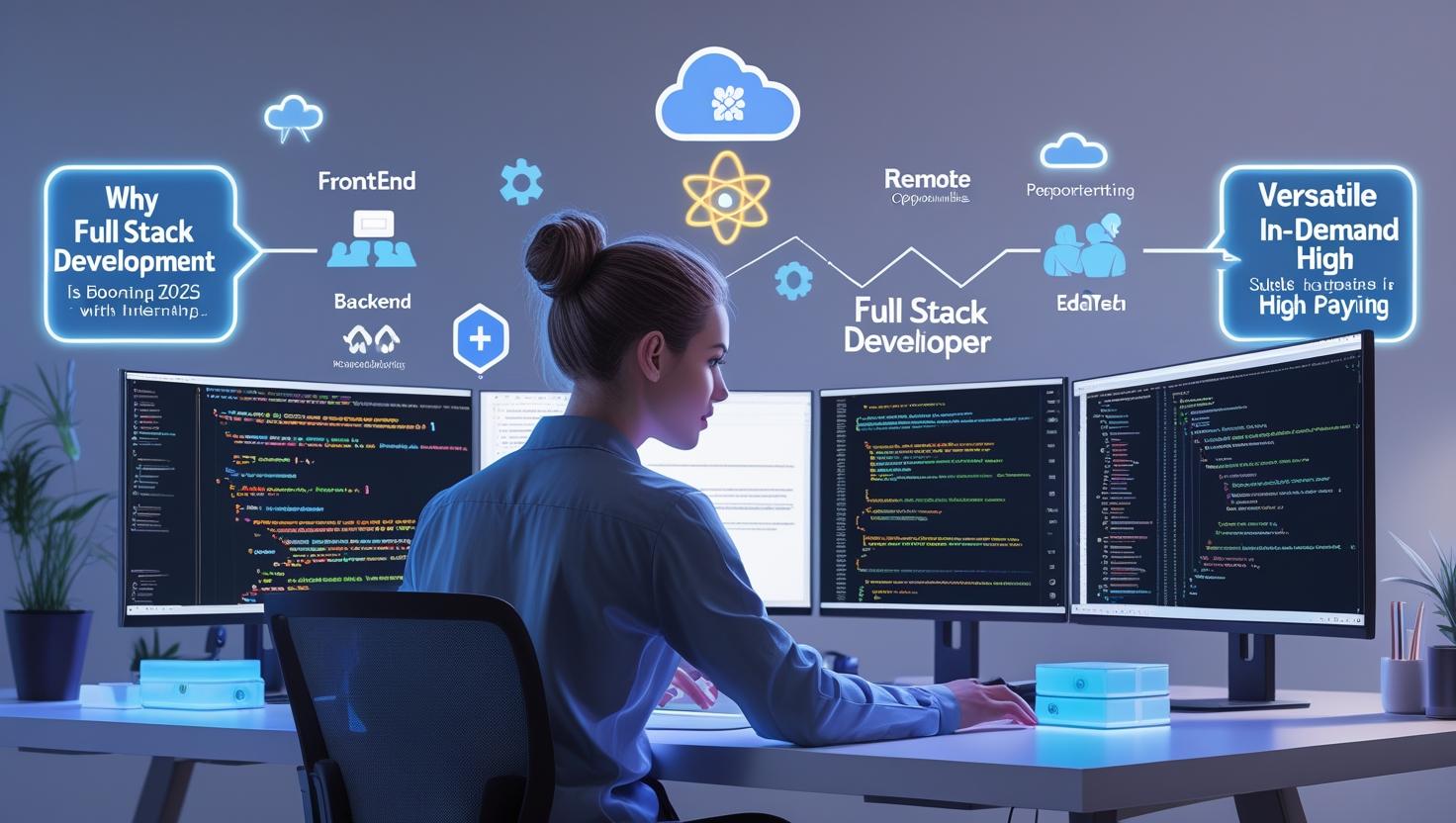
Full stack developers design every aspect of web applications by developing frontend which consists of user interface, backend which consists of server, and databases as well.
Picture a food delivery app. The menu you scroll is one layer. The system that calculates your bill and confirms your order is another. The saved address and past orders sit in a third. A full stack developer can build all three, connect them, and debug them when they break.
Full Stack Web Development is not one skill. It is four or five skills that have to talk to each other. That’s what makes it hard, and it’s exactly why employers pay for it.
| Layer | What it does | Typical tools |
|---|---|---|
| Frontend | What the user sees and touches | HTML, CSS, JavaScript, React |
| Backend | Business logic, security, APIs | Node.js, Express |
| Database | Stores and retrieves data | MongoDB, MySQL, PostgreSQL |
| Version control | Tracks changes, enables teamwork | Git, GitHub |
| Deployment | Puts your app on the internet | Vercel, Render, AWS basics |
Why Is It the Top Skill for Freshers Right Now?
It is the top skill because it makes you useful on day one, in more kinds of companies, with fewer prerequisites than most tech paths. I’ve watched hundreds of students choose between data science, cloud, cybersecurity, and web development. The ones who pick web development tend to get to their first paid work sooner.
Four reasons explain it.
1. Small teams need generalists. A startup with six engineers can’t hire a separate specialist for every layer. They want someone who can fix a broken form in the morning and write an API in the afternoon.
2. The entry barrier is low. You don’t need a specific degree. You need a laptop, patience, and a habit of building things. Graduates from BA, BCom, BSc, and engineering backgrounds all succeed here.
3. You can prove your skill instantly. A recruiter can open your live project in ten seconds. Try doing that with a certificate.
4. Every business needs a website or app. Clinics, coaching centres, retailers, logistics firms, NGOs. Demand doesn’t sit in one industry.
Does this mean other skills are worthless? No. Data science and cloud are great paths. But for a fresher who wants visible, employable output within months, this is the shortest route I know.
How Do Frontend and Backend Development Fit Together?
Frontend and backend development are two halves of one conversation: the browser asks, the server answers.
Here’s the loop, step by step:
- A user clicks “Place order” on a React page.
- The browser sends a request to your Node.js server.
- The server checks the data, applies rules, and talks to the database.
- The database saves the order and returns a result.
- The server replies, and the page updates.
That’s it. Every app you use follows this pattern. Learn it once and you can read any codebase with less fear.
What should you learn on the frontend?
Learn HTML, CSS, and modern JavaScript first, then React. In that order. Students who jump straight to React without solid JavaScript struggle for months. I’ve seen it repeatedly.
Focus on:
- Semantic HTML and accessible forms
- Flexbox and Grid for layout
- Responsive design (most of your users are on phones)
- JavaScript fundamentals: functions, arrays, objects, async/await, fetch
- React components, props, state, and hooks
What should you learn on the backend?
Learn how servers receive requests, validate data, and send responses. The language matters less than the ideas.
Focus on:
- REST API design
- Authentication (login, sessions, JWT)
- Input validation and error handling
- Environment variables and basic security
- Reading logs when something breaks
That last point sounds boring. It isn’t. Debugging from logs is what separates hobbyists from working developers.
Why Do React and Node.js Development Work So Well Together?
React and Node.js development share one language, JavaScript, so you learn one syntax instead of two.
That shared language cuts your learning load nearly in half. You write your interface in JavaScript. You write your server in JavaScript. Even write your database queries in something that feels like JavaScript when you use MongoDB.
Here’s what that looks like in practice:
- One mental model. Data is objects and arrays on both sides.
- Shared tooling. npm, VS Code, and the same debugging habits.
- Easier full projects. You don’t switch languages mid-feature.
- Huge community. Any error you hit has been solved on the internet already.
I’m not saying other stacks are bad. Java with Spring and Python with Django power huge systems. But for a fresher, the JavaScript route gets you to a working, deployed project fastest. You can always add a second language later, and it’ll be easier because you understand the concepts.
A tip from my classroom: build the same small app twice. First with plain JavaScript and no framework. Then with React. You’ll finally understand what React solves instead of memorising its syntax.
How Much Database Management for Web Development Do You Need?
You need enough database knowledge to design tables or collections, write basic queries, and avoid data-loss mistakes. You don’t need to become a database administrator.
Most freshers skip this topic or rush it. Then they freeze in interviews when asked “why did you choose this database?” Don’t be that person.
SQL or NoSQL?
Learn one of each at a basic level. Start with the one your projects need.
| Type | Example | Best for | Watch out for |
|---|---|---|---|
| Relational (SQL) | MySQL, PostgreSQL | Structured data with clear relationships: orders, users, payments | Rigid structure needs planning |
| Document (NoSQL) | MongoDB | Flexible data that changes shape: profiles, content, logs | Easy to create messy data |
The database skills interviewers actually test
- Writing SELECT, INSERT, UPDATE, DELETE
- Using JOINs to combine tables
- Understanding primary keys and foreign keys
- Knowing what an index does
- Explaining one-to-many relationships in plain words
- Never storing plain-text passwords
Database management for web development is the layer that separates a demo from a real product. A demo forgets everything when you refresh.
How Has AI Changed What Employers Expect?
AI coding assistants have made writing code faster, so employers now hire for judgment: can you tell whether the generated code is correct, secure, and maintainable?
Let me be honest about something. Many students ask me, “Will AI take this job?” My answer is that AI takes the typing, not the thinking. A tool can produce a login form in seconds. It cannot decide how your whole system should be structured, spot a security hole it created itself, or explain to a client why a feature will take three days.
What changed in hiring:
Interviews test understanding. “Explain what this function does and why it breaks on empty input.”
Live coding is shorter, debugging is longer. You’re handed broken code and asked to fix it.
Portfolios get scrutinised harder. Interviewers ask about your decisions, because anyone can generate a project.
How I tell my students to use AI while learning:
- Write the first attempt yourself. Always.
- Use AI to explain errors, not to skip them.
- Ask it to review your code, then decide whether you agree.
- Never paste code you can’t explain line by line.
If you use AI as a tutor, you grow faster. If you use it as a shortcut, you build a skill gap that shows up in your first interview.
What Is a Realistic Six-Month Learning Roadmap?
A focused beginner can become job-ready in about six months by following a fixed order: fundamentals, JavaScript, React, Node.js, databases, then projects. This is the roadmap I recommend to freshers. Adjust the pace to your schedule, but keep the order.
| Month | Focus | Outcome |
|---|---|---|
| 1 | HTML, CSS, responsive design, Git | Build and host 2 static pages |
| 2 | JavaScript core, DOM, async code | Build a to-do app and a weather app |
| 3 | React: components, state, hooks, routing | Build a multi-page interface |
| 4 | Node.js, Express, REST APIs, authentication | Build a working login system |
| 5 | Databases, connecting backend to data | Build a complete app with saved data |
| 6 | Capstone project, deployment, interview prep | One deployed, polished project |
What does daily practice look like?
Two to three hours of daily building beats eight hours once a week. The brain retains skills through repetition.
A simple routine:
- 30 minutes: review yesterday’s notes
- 90 minutes: build something new
- 30 minutes: fix bugs or read someone else’s code
- 10 minutes: write down what you learned
Keep a learning log. When interview season arrives, that log becomes your revision material.
What Projects Should Go in Your Portfolio?
Three deployed projects with clean code and a clear README will do more for you than ten half-finished ones. Recruiters spend less than a minute on your portfolio at first.
Project 1: A personal expense tracker. Covers forms, state, CRUD operations, and a database. Everyone understands the idea instantly.
Project 2: A job or event board with login. Adds authentication, protected routes, and role differences (admin vs user).
Project 3: A capstone that solves a real local problem. Build a booking system for a neighbourhood clinic, a fee tracker for a coaching centre, or an inventory tool for a small shop. Real users give you real feedback, and that story shines in interviews.
For every project, include:
- A live link (not just a GitHub repo)
- A short README: what it does, tech used, how to run it
- Two or three screenshots
- One paragraph on a problem you hit and how you solved it
That last item matters most. It proves you thought, not just typed.
What Does a Career in Full Stack Development Look Like?
A career in full stack development starts with junior or trainee developer roles and can branch into specialised engineering, freelancing, product building, or technical leadership.
Here are the common entry points and paths:
| Path | What you do | Who it suits |
|---|---|---|
| Junior full stack developer | Build features across the whole app | Freshers who want product-company experience |
| Frontend developer (React) | Specialise in interfaces and user experience | People who love design and detail |
| Backend developer (Node.js) | Focus on APIs, performance, data | People who love logic and systems |
| Freelancer | Build sites and tools for small businesses | Self-starters who want early income |
| Startup founder or co-founder | Build your own product | People with ideas and grit |
Salaries aren’t mentioned in this post as they keep changing based on location, size of the firm, and level of skills. Just check out the current vacancies and compare a few to get a realistic idea.
All I can say is that the way you grow post the first job won’t depend much on your education, but how often you code and understand others’ codes, and ask questions.
How Do You Choose the Best Full Stack Web Development Course?
The best full stack web development course teaches by building projects, gives you mentor feedback on your code, and ends with a deployed portfolio, not just a certificate.
I’ve seen students burn months and money on courses that only played videos. Use this checklist before you pay anyone, including us.
Ten questions to ask before joining
- Does the syllabus cover React and Node.js development with real depth?
- Is database management for web development included, with hands-on work?
- Will I build at least three projects, not just follow along with one?
- Who reviews my code, and how fast?
- Can I meet current or past students and see their work?
- Is Git and deployment taught, or ignored?
- Are the instructors working developers or full-time lecturers only?
- Does the course include interview preparation and mock rounds?
- Are batch sizes small enough that I get questions answered?
- Is the fee clear, with no hidden add-ons?
Red flags
- Promises of guaranteed jobs
- No visible student projects
- “Learn everything in 30 days”
- Old tools with no mention of current practices
- Refusal to share a full syllabus
A good full stack development training program should feel like an apprenticeship. You write code, someone experienced reads it, and you fix it.
Should You Learn Locally? Full Stack Developer Training in Kolkata
Yes, learning locally helps if you need face-to-face mentoring, a study routine, and peers who solve problems beside you. Online learning works well for disciplined people. Many freshers are not there yet, and that’s normal.
If you’re searching for a full stack web development course in Kolkata, here’s what a local program can give you that a recorded course usually can’t:
- Accountability. A fixed class time gets you out of bed.
- Instant help. A doubt solved in two minutes doesn’t turn into a two-day block.
- Peer learning. You’ll see how classmates approach the same problem differently.
- Local network. Trainers and alumni often know which Kolkata companies and startups are hiring juniors.
- Language comfort. Concepts click faster when you can ask in Bengali, Hindi, or English.
For full stack developer training in Kolkata, visit the institute before enrolling. Sit in a demo class. Ask to see student projects. Talk to someone who finished the course six months ago. If they can’t show you real work, walk away.
At 99Eedu Institute, we push our students to show their code early and often. I’d rather see a messy project on day 20 than a perfect plan on day 2.
What Mistakes Do Freshers Make Most Often?
The most common mistake is tutorial hopping: watching endless videos without building anything alone. I see the same errors every batch. Here they are, with fixes.
| Mistake | Why it hurts | Fix |
|---|---|---|
| Watching without coding | You feel productive but retain little | Pause the video and type it yourself |
| Learning five frameworks at once | Shallow knowledge everywhere | Master one stack first |
| Skipping JavaScript basics | React feels like magic, then breaks | Spend a full month on core JS |
| Copying projects exactly | You can’t explain your own work | Change features, break it, repair it |
| Ignoring Git | Teams will not tolerate this | Commit daily from week one |
| Never deploying | Your work stays invisible | Host every project, however small |
| Comparing yourself to others | Kills motivation | Compare your work to last month’s work |
One more, and it’s a quiet killer: waiting until you feel “ready” to apply. You won’t feel ready. Apply when you have three solid projects and can explain them clearly.
How Should You Prepare for Interviews?
Prepare by practising three things: explaining your projects out loud, solving small coding problems, and answering concept questions in plain language.
Typical interview rounds for junior developers:
- Screening call. Who are you, what have you built?
- Technical round. JavaScript questions, React concepts, a small coding task.
- Project discussion. Why did you choose this database? How did you handle login?
- Culture and communication round. Can you work with a team?
Questions worth rehearsing:
- What’s the difference between let, const, and var?
- What happens when you call an API and it fails?
- How does React decide when to re-render?
- What is middleware in Express?
- How would you store passwords safely?
Practise answering each in three sentences or less. If you can’t explain it simply, you don’t understand it yet.
Why Learn Full Stack Web Development at 99Eedu Institute?
99Eedu Institute offers a project-based full stack web development course in Kolkata built for students, graduates, and freshers who want job-ready skills, not just a certificate. We teach you to build real applications, and mentors review your code along the way.
Here is what you get when you train with us:
- Complete stack coverage. You learn HTML, CSS, JavaScript, React, Node.js, and database management for web development in a clear, fixed order.
- Project-first learning. You build and deploy live projects for your portfolio instead of copying along with videos.
Mentor code reviews. An experienced trainer reads your code, points out mistakes, and helps you fix them. - Beginner-friendly classes. No coding background needed. Ask your doubts in English, Hindi, or Bengali.
- Interview preparation. You practise explaining your projects, solving small coding tasks, and answering concept questions in plain language.
- Local, face-to-face support. Our full stack developer training in Kolkata gives you a study routine, peers to learn with, and quick answers when you get stuck.
We make no guaranteed-job promises. What we promise is a clear roadmap, regular feedback, and a portfolio you can proudly show to recruiters.
Not sure yet? Visit 99Eedu Institute, sit in a demo class, and ask to see our students’ projects.
About the Author
Year Ali(Yeash) is a Senior SEO & PPC Specialist and Digital Marketing Trainer at 99Eedu Institute, and he wrote this guide to help students, graduates, and freshers start a career in Full Stack Web Development. With over 10 years of hands-on experience in organic search strategy, paid media, and hiring for digital roles, he knows what recruiters look for in a fresher’s portfolio and what makes a candidate stand out.
Yeash has trained hundreds of 12th-pass students, graduates, and freshers, taking them from zero experience to job-ready with real projects. His approach is simple: theory without practice doesn’t get anyone hired. At 99Eedu Institute, every course is built around live projects, mentor feedback, and portfolio-first learning, because that is what gets candidates shortlisted in interviews.
Source: Year Ali(Linkedin Profile).
Frequently Asked Questions
Q1. What is a full-stack developer course?
A full-stack developer course teaches you to build complete web applications: frontend (HTML, CSS, JavaScript, React), backend (Node.js, Express), and databases (MongoDB or SQL). Good courses add Git, deployment, and three or more real projects for your portfolio.
Q2. Will AI replace full stack developers?
No. AI automates routine coding, but it cannot replace human judgment. Developers still design systems, review generated code, fix security gaps, and make decisions. Developers who use AI well become faster. Those who cannot explain their code fall behind.
Q3. Can I learn MERN stack in 2 months?
You can learn the basics in 2 months, but not job-ready depth. With 4 to 5 hours of daily practice, you can build a simple MERN app. Employers expect stronger JavaScript, debugging skills, and multiple projects, which usually takes 5 to 6 months.
Q4. Is full stack in demand?
Yes. Startups and small companies hire full stack developers because one person can handle several layers of a product. Competition for entry-level roles is high, so a deployed portfolio and clear project explanations matter more than certificates.
Q5. Can I learn full stack in 3 months?
You can learn the fundamentals in 3 months, but most beginners need 5 to 6 months to become job-ready. Three months works only with full-time study, prior coding exposure, and daily project building. Rushing usually leaves gaps in JavaScript and databases.
Q6. Which is better, full-stack or Python?
Neither is better overall; it depends on your goal. Choose full stack for web apps and quick portfolio output. Choose Python for data science, automation, or AI. Python can also power web backends, but full stack covers the complete web product.
Q7. Does full-stack pay more than backend?
Not automatically. Pay depends on skill depth, company, city, and experience, not the title alone. Full stack developers may earn more at startups by covering multiple roles, while specialist backend engineers often earn more in complex, high-scale systems.
Final Thoughts
The demand for full-stack developers will only continue to grow in 2025 and beyond. Choosing the right full-stack development course in Kolkata can be a life-changing decision. It not only equips you with technical knowledge but also prepares you for high-paying and stable job roles in the tech world.
If you’re serious about your future in tech, it’s time to enrol in a full-stack web development course with placement in Kolkata that gives you both skills and career support.
Ready to Become a Full Stack Developer?
Ready to launch your full-stack development journey? Join the best full-stack course in Kolkata today and transform your future. If you want to take the Web Development Course in Kolkata, then visit us at 99EEdu Institute.
Follow Us on Facebook / Instagram
Share on:

Quick Enquiry
Please fill up the form and we will get back to you in next 12 hours!
