
 All Courses


 5.0



Google showed it at the top of the page. Nobody clicked. That is the new deal. Zero-click traffic is the visibility, trust and sign-ups you earn from searches that never send a visit, and heading into 2027, it matters as much as raw rankings. At 99Eedu Institute, we teach students, freshers and fresh graduates how to write answers that AI engines quote, win featured snippets, and turn an unclicked impression into a real result. Every section ends with something you can do today.
Why Zero-Click Traffic Matters in 2027
Zero-click traffic matters in 2027 because more searches are answered on the results page, so being seen and quoted now counts as much as being clicked. If your content only wins when someone visits, you lose a growing share of your audience.
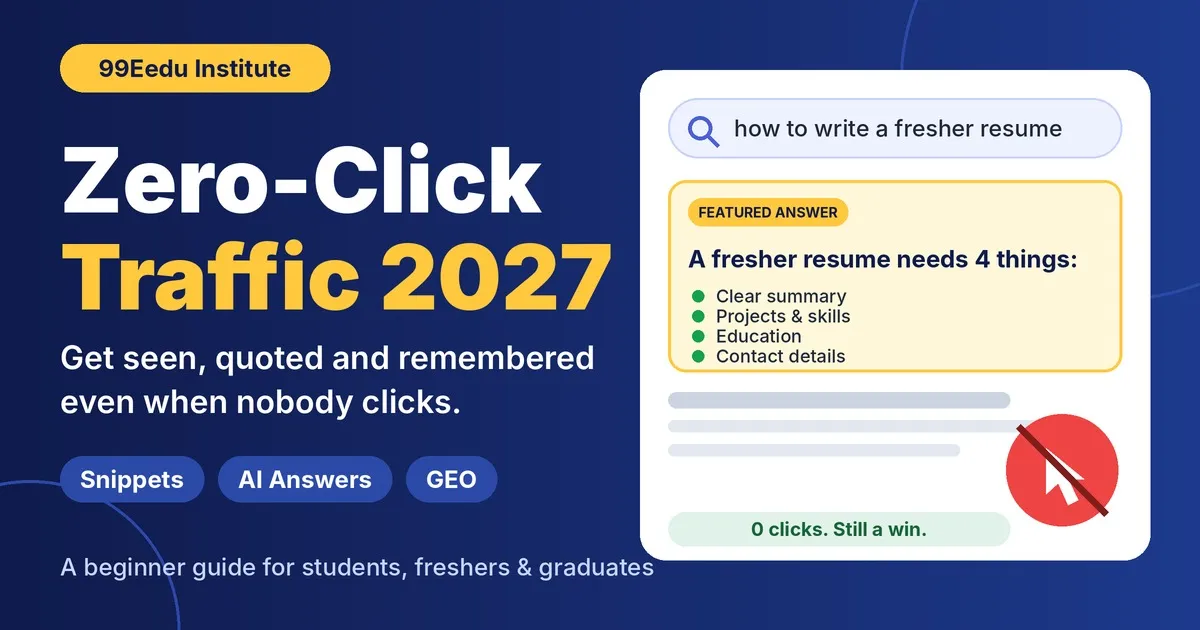
Here is why it matters for you:
- Fewer clicks, same searches. Studies from SparkToro, Similarweb and Pew Research show that AI summaries and snippets are keeping more people on the results page.
- AI engines quote sources. Being cited in an AI answer puts your name in front of readers who never open a link.
- Brand searches grow from it. People who see you often later search your name directly.
- New sites can compete. A clear answer can earn a snippet even if your website is small.
For students and freshers, the benefit is practical. You can build a name, a portfolio and a job-ready skill set without waiting for huge traffic.
Google has not announced a specific “2027 update,” so I’m describing a trend in how a Google zero-click search works, not a rule change. Check the latest figures before you publish.
Snippet Meaning in SEO
A snippet is the short piece of text Google shows under a page’s title in search results, so you can judge whether the page answers your question before you click. Google usually picks this text from the page itself and may change it to match what you searched.
There are two kinds you should know:
- Standard snippet: the two-line description under a blue link.
- Featured snippet: a highlighted box at the top of the results that answers the question directly, with a link to the source.
For students, the second kind is the best place to start, because a featured snippet is the fastest way to be seen without a click.
Why Searches Keep Ending Without a Click
Searches end without clicks because Google and AI engines now answer most questions before you leave the results page. The numbers back this up, though you should always check the latest versions.
- A 2024 study by SparkToro and Datos estimated that roughly 58 to 60 per cent of Google searches in the US and EU ended with no click to the open web.
- Similarweb reported that zero-click news searches rose from about 56 per cent to about 69 per cent between May 2024 and May 2025.
- Pew Research found in 2025 that people who saw an AI summary clicked a traditional result in about 8 per cent of visits, compared with about 15 per cent when no summary appeared.
I am quoting these as direction, not gospel. Methods differ, and numbers shift. The pattern does not shift. More answers live on the results page, and fewer people leave it.
Why Google Searches End Without a Click: 3 Reasons
Zero-click searches keep growing because answers are now faster to read than pages are to open. Three habits drive it:
- AI summaries cover simple questions. For a definition, a date or a quick comparison, you rarely need a full article.
- Phones push people to stay on the results page. Tapping into a slow site costs time and data, and reading the answer in the results is easier. This is common for students on patchy connections in India.
- Voice and chat search give one answer. An assistant speaks a reply. It does not show you ten links.
Your takeaway: don’t fight the trend. Write clear answers that fit it.
What Is Changing Going Into 2027?
Google has not published anything officially called a “2027 algorithm update,” so the honest answer is that we are working from visible direction, not a release note. I would rather say that plainly than invent a fake update name and sell you a fantasy.
What we can see is consistent across 2025 and 2026:
| Signal | What it looks like | What it means for you |
|---|---|---|
| AI answers on the results page | AI Overviews and AI Mode summarise and cite sources | Being cited matters more than being ranked tenth |
| Helpful content systems | Pages written for people outrank pages written for crawlers | Original, experience-based writing wins |
| Experience and trust signals | Real authors, real examples, clear sourcing | Put a human name and first-hand detail in every post |
| Structured, extractable answers | Short, clear blocks of text get pulled into answers | Write answer-first paragraphs |
| Brand strength | Searches for a name are a strong trust signal | Build recognition outside Google too |
Update it whenever Google’s Search Central blog or its core update announcements say something new.
The one-line summary of the shift
The goal moves from “rank a page” to “become the source an engine trusts enough to quote.” Ranking still helps. Citation is the new prize.
GEO Explained: Optimising for AI Answers
GEO, or Generative Engine Optimisation, is the practice of shaping your content so AI systems can find it, understand it and cite it in generated answers. It sits beside classic SEO, not instead of it.
Think of classic SEO as getting into the library. GEO is getting the librarian to recommend your book by name.
AI engines tend to cite content that has these traits:
- A clear, direct answer in the first sentence of a section
- Specific facts, numbers and named sources
- A consistent topic focus across the site
- Clean headings that match real questions
- An identifiable author or organisation with some reputation
None of this is exotic. A good teacher already explains things this way. State the answer. Give the reason. Show an example.
What I do differently for GEO
I write each section as if someone will copy only its first two sentences into a chat window. If those two sentences make sense alone, the section is ready. If they depend on the paragraph before, I rewrite them.
Your takeaway: reread your last blog post. Pick any heading. Do the first two sentences answer the heading’s question on their own? If not, fix them.
How to Write Zero-Click Content That Gets Quoted
Zero-click content is writing built so its core answer can be lifted and displayed without the rest of the page. It is not thin content. The short answer is the front door, and the depth sits behind it for readers who want more.
Use this pattern for every section:
- Heading as a question or clear topic. Match the way people actually search.
- Bold answer in sentence one. Plain words, under 40 words if you can.
- Reason or proof in sentences two and three. A number, a source, a short example.
- Depth below. Steps, a table, an exception, a personal note.
Here is a before and after.
Before: “There are many things to think about when students consider building a portfolio, and the process can feel confusing at first.”
After: “A student portfolio needs three things: two real projects, a short bio and a way to contact you. Everything else is decoration.”
Formats AI engines extract most easily
| Format | Best for | Example query |
|---|---|---|
| Short paragraph (40 to 60 words) | Definitions | “what is zero-click search” |
| Numbered list | Processes | “how to optimise for featured snippets” |
| Bulleted list | Options and features | “types of snippets in Google” |
| Simple table | Comparisons | “AI Overview vs featured snippet” |
| Short Q&A block | Specific doubts | “Does Google penalise AI content” |
Your takeaway: for your next post, plan one paragraph, one list and one table. Then write the content around them.
Keep the human part
Extractable does not mean robotic. Engines also reward original perspective, because generic summaries are everywhere. Add what only you can add: a mistake you made, a tool you tried, a result from your own project. First-hand detail is hard to copy and easy to trust.
Featured Snippets SEO: A Step-by-Step Method
To win a featured snippet, answer one specific question in a short, clean block directly under a matching heading, on a page that already ranks on page one. That last part matters. Google rarely pulls snippets from pages ranking far down.
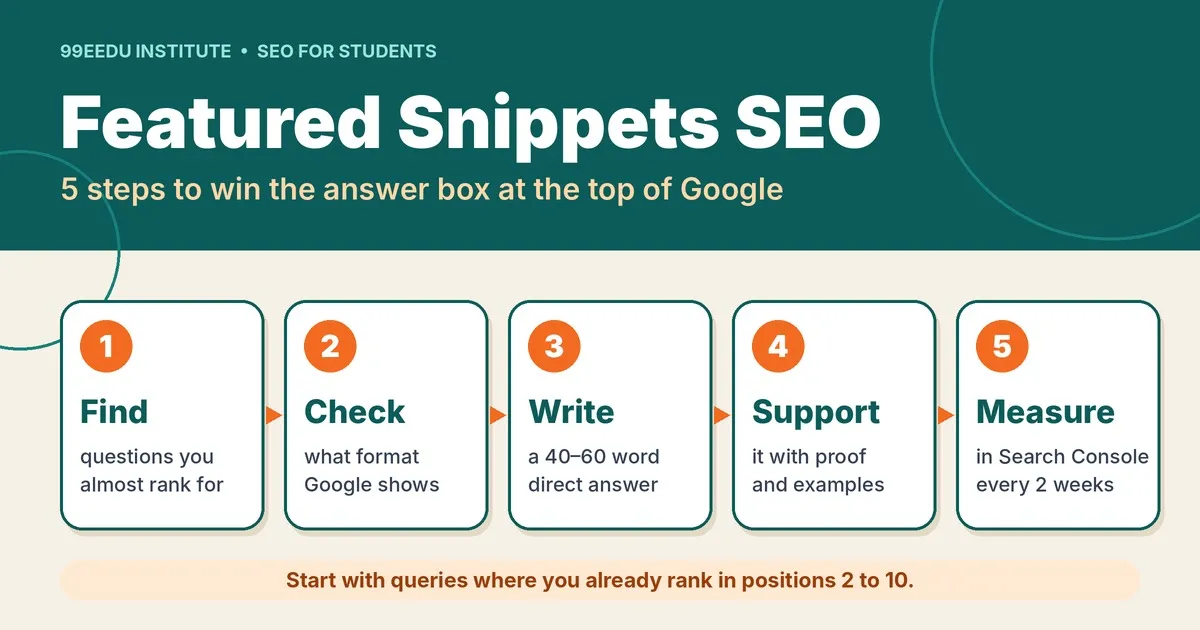
This is the core of featured snippets SEO, and it is more learnable than people think.
Step 1: Find questions you can win
Start with queries where you already rank between positions 2 and 10. Open Google Search Console, go to the Performance report, and filter queries that start with “what”, “how”, “why” or “can”. Sort by impressions. Those are your targets.
Step 2: Check what Google currently shows
Search the question yourself and note the format. Is the current snippet a table, a list, or a paragraph? Match the format, then improve the clarity. Do not copy the wording.
Step 3: Write the answer block
Place a direct answer of 40 to 60 words right below a heading that repeats the question. For process queries, use a numbered list with five to eight short steps. For comparison queries, use a table.
Step 4: Add support below it
Back the answer with depth so the page deserves its position. Add examples, edge cases and a source or two. A snippet-only page with nothing behind it tends to fade.
Step 5: Measure and adjust
Check Search Console every two weeks and compare impressions, clicks and position for the targeted query. If you hold position but lose the box, test a tighter answer or a different format.
Snippet types at a glance
| Snippet type | Looks like | Best answer length |
|---|---|---|
| Paragraph | A short text box | 40 to 60 words |
| List | Numbered or bulleted steps | 5 to 8 items |
| Table | Rows and columns | 3 to 5 rows |
| Video | A clip with a timestamp | Clear chapters |
One more thing. Featured snippets in Google search can change or vanish without warning, so never build your whole plan on one box. Treat it as a bonus on top of a strong page.
Tools to Check and Control Your Snippets
The most useful free tool for snippets is Google Search Console, and it needs no payment. Beginners often search for a separate snippets tool, but the free option covers most needs.
Here is how I use each piece.
- Google Search Console snippet data: the Performance report shows which queries bring impressions, how often people click, and your average position. Pair it with the URL Inspection tool to see how Google reads a page.
- An SEO snippet tool: paid and free options exist that preview how your title and description will look in results and show which of your keywords trigger featured boxes. Use one for checking, not for guessing.
- Manual search in a private window: it still beats any dashboard for seeing what real users see. Do it weekly.
- Structured data testing: if you add FAQ or how-to markup, test it before publishing. Google now limits where some of these rich results appear, so expect markup to help understanding more than it helps display.
Controlling your own snippet text
You can influence your snippet, but you cannot force it. Write a clear meta description of about 150 characters that answers the main question. Google may still rewrite it. If you need to stop text from being shown, the “nosnippet” and “max-snippet” directives exist for that purpose. Most student bloggers should leave them alone.
Your takeaway: open Search Console today and export your top 50 queries by impressions. That sheet is your content plan for the next month.
Where Zero-Click Traffic Actually Comes From
Zero-click traffic turns into real results through four paths: brand searches, return visits, citations and off-Google channels. If you track only direct clicks, you miss all four.
1. Brand searches
When people see your name repeatedly in answers, some of them search for you directly. Watch the branded queries in Search Console. A rise there, even when clicks stay flat, tells you that unclicked impressions are working.
2. Return visits
Many users read a snippet today and open the full page days later. The click is delayed, not lost. Check assisted conversions in your analytics if you run any.
3. Citations in AI answers
A citation inside an AI answer is a trust vote. Some people click the source link when they want more. Others simply remember the name. Both outcomes help you.
4. Off-Google channels
Someone who meets you on Google can follow you on LinkedIn, YouTube or Instagram. That is where zero-click traffic becomes a relationship. Put a short, natural line in your content that points to one other place where you share more.
I stopped treating these as soft metrics. For a new blog, they are often the only early signals you will have.
Zero-Click Marketing for Students and Freshers
Zero-click marketing is the practice of building recognition and trust on the surfaces where people read, so the click is a bonus and not the goal. You do not need a big budget. You need consistency.
A practical version for a student or a fresher looks like this:
- Answer questions where they are asked. Reddit threads, Quora answers, college forums and LinkedIn comments all carry your name and expertise.
- Publish short, useful posts. A 150-word LinkedIn post that explains one concept does more for your reputation than a silent portfolio.
- Use one name everywhere. Same photo, same headline, same handle. Engines and humans both connect the dots.
- Create one proof asset. A small project, a case study or a free template that people can use.
What About Zero-Click Ads?
Zero-click ads are paid placements that deliver their message or even complete the action inside the ad or the results page, without sending the person to a landing page. Think of call buttons, lead forms inside the ad, product listings with all details visible, or ads inside AI answers where those exist.
For most beginners, paid is not the starting point. Organic work costs time, not cash. But understanding the format helps you in interviews and in client projects. Three quick notes:
- Measure differently. Track leads, calls and form fills, not only website sessions.
- Keep the message complete. The ad must make sense without a click.
- Test small. A tiny budget and a clear goal teach more than a large one with no plan.
If you are learning marketing, run one small experiment and write about it. That story is useful content on its own.
Zero Click SEO: A Practical Checklist
Zero-click SEO means optimising pages so they earn value on the results page, through snippets, AI citations and brand recall, as well as through visits. Use this checklist before you publish any post.
- Each H2 and H3 starts with a direct, bolded answer
- The main answer is quotable in under 60 words
- One table or list sits on the page for easy extraction
- Facts have a named source or a date
- The author name and short bio are visible
- The page has at least one original example or personal note
- Headings match real queries from Search Console
- The meta description answers the main question
- Internal links connect related posts
- A soft next step exists for readers who want more
Print it. Tape it above your desk. Use it for ten posts, and it becomes a habit.
Common Mistakes That Kill Zero-Click Visibility
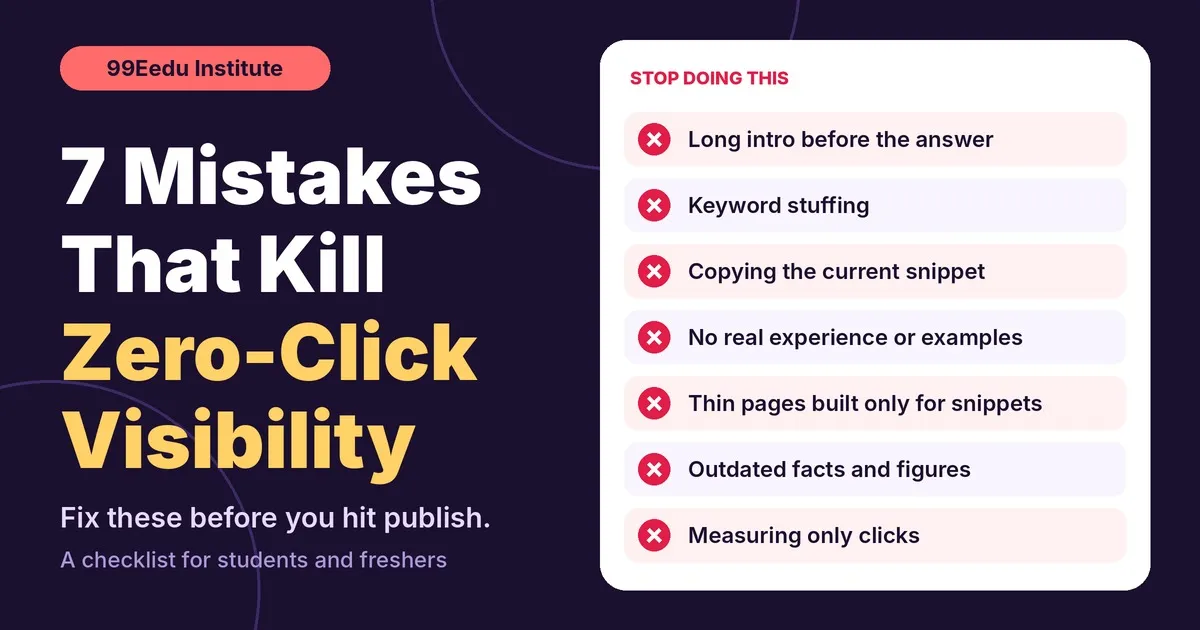
The most common mistake is burying your answer under a long introduction. Readers want the answer in the first line, and so do search engines. If your answer starts in paragraph three, a snippet or AI summary will quote someone else’s page instead.
Here are the others I see most often from students and beginners:
- Stuffing keywords. Repeating a phrase ten times makes writing worse and gains nothing. Use it where it fits.
- Copying the current snippet. Duplicate wording gives Google no reason to choose you. Write your own answer.
- Ignoring experience. Pages without a human voice or a real example feel interchangeable.
- Publishing thin snippet bait. A page that exists only to grab a box rarely holds it.
- Skipping updates. Dates, figures and tools age fast. Review your top posts every quarter.
- Measuring only clicks. You will think everything is failing when it is not.
- Using AI text unedited. Generic drafts blur together. Use AI for outlines if you want, then add your own facts and voice.
I made the first, third and sixth mistakes myself. They cost me months.
How to Measure Success When Clicks Are Not the Metric
Measure zero-click success with impressions, branded search growth, snippet ownership, citations and assisted conversions. Clicks stay on the list, just lower on it.
| Metric | Where to find it | What a good sign looks like |
|---|---|---|
| Impressions | Search Console | Rising while position holds |
| Branded queries | Search Console | Steady monthly growth |
| Snippet ownership | Manual search or an SEO snippet tool | More queries where you hold the box |
| AI citations | Manual checks in AI search tools | Your name or URL appears in answers |
| Assisted conversions | Analytics | Visits that follow earlier exposure |
| Social follows and mentions | Platform analytics | New followers after content posts |
Set a baseline now. Write down your current numbers for each row. Check again in 30, 60 and 90 days. Without a starting point, you cannot see progress.
A 30-Day Zero-Click Traffic Plan
You can build a working zero-click traffic system in 30 days with four focused weeks of work. Here is the plan I would follow if I were starting today with one blog and a free Search Console account.
| Week | Focus | Tasks |
|---|---|---|
| 1 | Research | Export top 50 queries. Pick 10 question-style targets. Note the current snippet format for each. |
| 2 | Rewrite | Update 3 existing posts with answer-first sections, one table and a clean list each. |
| 3 | Publish | Write 2 new posts around narrow questions. Add an author bio and a personal example. |
| 4 | Distribute and measure | Share key answers on LinkedIn. Record baseline metrics. Check manual search results. |
If thirty days sounds like a lot, cut it down. Do week 1 and week 2 only. Even that is a meaningful start.
Why Students Trust 99Eedu Institute for Practical SEO Learning
At 99Eedu Institute, you learn SEO by working on real pages, not by memorising slides. Our trainers guide you, and our CEO, Avijit Rath, brings 15 years of experience to everything we teach. You get honest feedback on your work, and you watch your progress in Google Search Console as it happens.
Here is what you get:
- Hands-on practice: rewrite real posts and track the results in Google Search Console.
- Up-to-date lessons: learn what Google currently says about snippets, AI answers and GEO.
- Honest guidance: we tell you what SEO can and cannot do. We never promise rankings.
- A portfolio you can show: finish with real work to share in interviews.
Meet Your Trainers
- Jaya Roy has 8 years of hands-on experience. She helps you plan, write and improve content that both people and AI tools can understand and trust. (LinkedIn Profile).
- Year Ali (Yeash) has 5 years of experience in SEO, Meta Ads and Google Ads. He shows you how organic search and paid ads work together, including how zero-click ads and snippets fit into a real marketing plan.
Both trainers teach from real projects, so you learn what works in practice.
About the Author
Year Ali (Yeash) is an SEO specialist and trainer at 99Eedu Institute with 5 years of experience in SEO, Meta Ads and Google Ads. He teaches students how organic search and paid campaigns work together, so they learn to build visibility from both sides.
In his classes, Yeash focuses on practical skills: finding what people actually search for, writing answers that earn snippets, and tracking results in Zero-click traffic and Google Search Console. He believes students learn best by working on real pages and checking real numbers.
Connect: (LinkedIn Profile).
People Also Ask
Q1. Is SEO still worth learning if Google answers questions directly?
Yes, SEO is still worth learning because AI answers draw from content that search systems can find and trust. Skills in research, clear writing and structure carry over directly into snippets, citations and brand building.
Q2. How long does it take to win a featured snippet?
Most pages need a few weeks to a few months after publishing or updating. The page should already rank on page one, and the answer should be short, direct and clearer than the current result.
Q3. Can a new blog get zero-click traffic without backlinks?
It can, but progress is slower. Target narrow, low-competition questions, write original answers and build presence on LinkedIn or forums. Backlinks help trust, yet early wins usually come from specificity and clarity.
Q4. How does zero-click search affect your traffic?
Zero-click search lowers direct visits for simple questions because people get the answer on Google. It does not have to lower your visibility. Your brand can still gain impressions, branded searches and later visits.
Q5. What are 7 ways to get traffic anyway?
Write answer-first sections, target featured snippets, add tables and lists, cite named sources, build your name on LinkedIn or YouTube, update old posts, and track results in Search Console.
Q6. How do you measure zero-click impact?
Track impressions, branded searches, snippet ownership and assisted conversions in Google Search Console and your analytics. Note your numbers today, then compare after 30, 60 and 90 days.
Final Thoughts
Zero-click traffic rewards students who explain things clearly and show up consistently, no matter how small their website is. Your first post doesn’t need to be perfect. It needs to answer one question better than the page above it.
Start small. Rewrite the first two sentences under each heading of one published post (about an hour). Then note your Search Console numbers and check again in 30 days for impressions, branded searches and snippets.
Your First Ranking Starts at 99Eedu Institute
Build real SEO skills while you are still a student, and graduate with a portfolio that proves it. Join the digital marketing and SEO learning path at 99Eedu Institute and practise snippets, zero-click content and GEO on live projects with mentor feedback.
Share on:

Quick Enquiry
Please fill up the form and we will get back to you in next 12 hours!
