
 All Courses


 5.0










Most freshers run Facebook lead generation ads the same way: boost a post, spend a ₹2,000 Daily budget, get three likes and zero leads. That pattern is painfully common. The fix isn’t a bigger budget. It’s a proper setup: one clear offer, the right campaign objective, a short form and a fast reply. 99Eedu Institute wrote this guide to walk students and graduates through every step, from your first Page to your first qualified lead. Read it once, then run your first test this week.
How to Get Leads From Facebook Ads
To get leads from Facebook Ads, pick one clear offer, run a Leads campaign with an Instant Form, target a focused audience, and call every lead within five minutes. The rest of this guide sharpens each part.
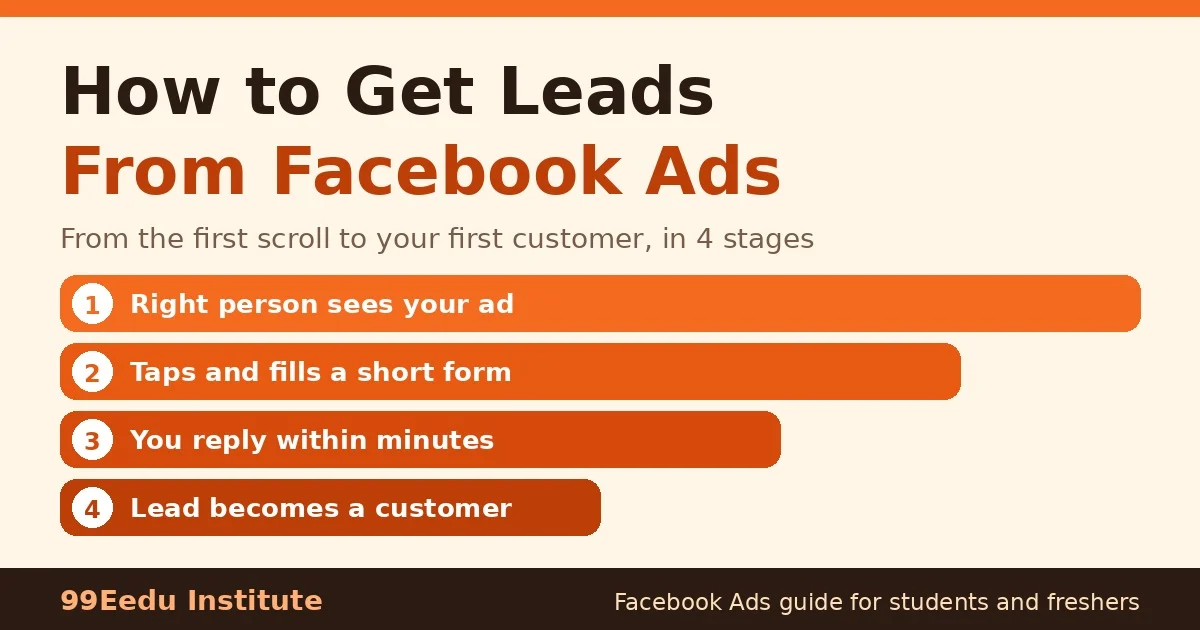
- Offer: something a student or fresher wants this week, like a free resume review or a demo class.
- Campaign: Leads objective, Instant Form, “Higher intent” form type.
- Budget: a small daily test, for example ₹500 a day for 5 to 7 days.
- Follow-up: call or WhatsApp within five minutes.
- Scorecard: cost per qualified lead, not cost per lead.
Anyone can launch Facebook lead generation ads in an afternoon. They require a system to run well, and that’s what you are about to learn.
What the 2027 Google and GEO Shift Means for Lead Generation
Google’s 2027 direction rewards pages that answer fast, show first-hand experience and stay consistent across the web, and AI answer engines pull from those same pages. Google does not release one named “2027 algorithm.” It ships updates all year. What we see, and what we build for, is a steady direction: helpful, experience-led, easy-to-extract content.
GEO (Generative Engine Optimisation) means writing so that AI tools such as Google’s AI Overviews, ChatGPT and Perplexity can lift your answer cleanly and name you as the source.
Why should an ads guide care?
Because paid and organic now work as one trust loop. Someone sees your ad. Then they search your brand name. Then an AI summary tells them whether you look real. If that summary comes back empty, many people close the tab and never fill out your form.
Here is what we do about it:
| Signal | What we do on our pages | Why it helps your ads |
|---|---|---|
| Answer-first writing | Bold direct answer under every heading | AI tools quote it, visitors skim it |
| First-hand experience | Share what we tested and what failed | Builds trust before the form fill |
| Consistent entity | Same brand name, offer and contact details everywhere | AI engines connect the dots |
| Structured content | Tables, short FAQs, FAQ schema | Easier for engines to extract |
| Freshness | Date stamps and yearly updates | Shows the advice still holds |
Build one simple proof page for your offer. Say what you do, who it helps, what people got from it, and how to reach you. Link it from your Facebook Page, your Instagram bio and your ad profile.
What Facebook Lead Generation Ads Are, and When They Beat Landing Pages
Facebook lead ads are ads that open a pre-filled form inside Facebook or Instagram, so people share their details without leaving the app. Name, email and phone number are often filled in automatically from the person’s profile. One tap. One submit.
That speed is why Facebook lead generation ads suit students and freshers. Your audience scrolls on a phone, often on mobile data, and will not wait for a slow website to load.
Here is how the three main options compare:
| Option | Speed to submit | Lead quality | Best for | Watch out for |
|---|---|---|---|---|
| Instant Form | Very fast | Medium (higher with “Higher intent”) | Webinars, demos, free sessions | Wrong or fake phone numbers |
| Website landing page | Slower | Often higher | Paid courses, higher-priced offers | Needs a fast, clear page |
| Messenger or WhatsApp chat | Fast, conversational | High if you reply quickly | Counselling, quick questions | Needs a person online to reply |
Start with an Instant Form. Move to a landing page once you know which offer works. That is the heart of Meta Ads lead generation for beginners: low setup, fast feedback, small risk. It is also the easiest way into fb lead generation without a developer or a big budget.
Before You Spend a Rupee: Four Things to Prepare
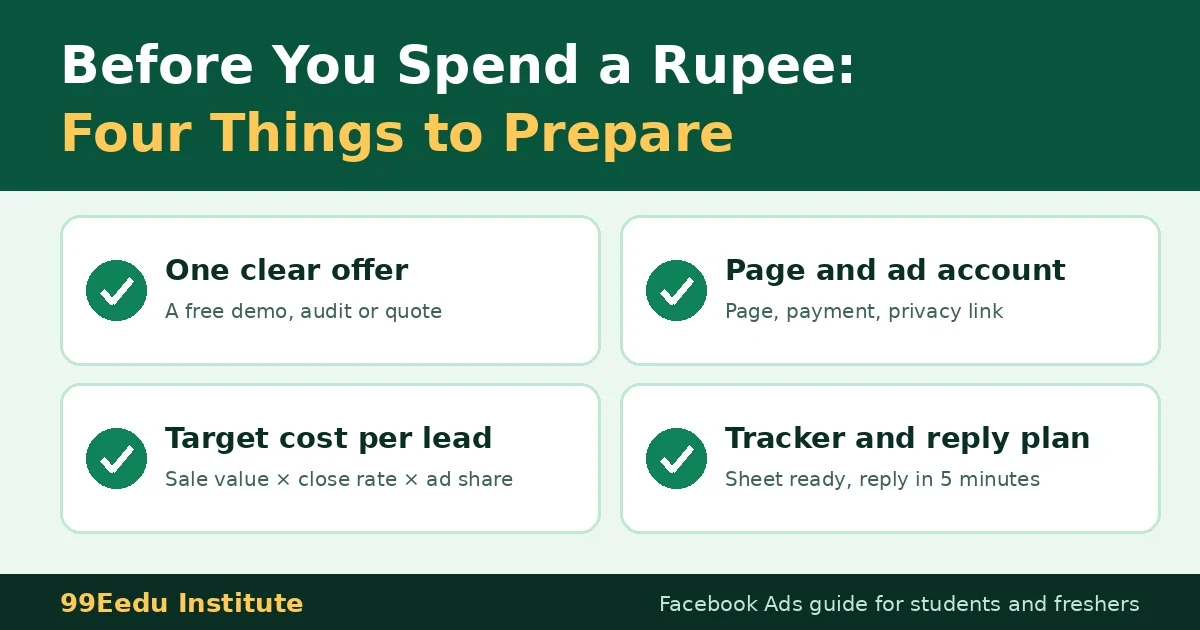
Prepare four things first: an offer, a promise, a place to store leads and a follow-up plan. Skipping this prep causes most of the wasted ad money we see.
1. Choose an Offer People Will Trade a Phone Number For
A strong lead offer solves one small, urgent problem in under a day. “Join our course” asks for commitment. “Get a free 30-minute resume check” asks for almost nothing.
| Your audience | Offer ideas |
|---|---|
| Students | Free career roadmap call, mock aptitude test |
| Graduates | Resume teardown, LinkedIn profile audit |
| Freshers | Interview prep session, free skills assessment |
| College groups | Campus workshop registration |
In our experience, a small free offer beats a big paid pitch on a cold audience almost every time.
2. Write One Clear Promise
Your promise should name who it is for, what they get and how fast they get it. Example: “Final-year students: get your resume reviewed in 30 minutes, free.”
Never promise guaranteed jobs or guaranteed income. Meta’s ad policies reject misleading claims, and trust collapses the second someone senses hype.
3. Decide Where Leads Will Live
Send every lead to a Google Sheet or CRM automatically, because Meta keeps lead data for a limited time (currently around 90 days). Connect storage on day one. Do not rely on downloading files by hand.
4. Plan Your Follow-Up Before Launch
Decide who calls, when, and with what script before the first lead arrives. Leads go cold in hours. Even if you are a one-person team, block the first 30 minutes after your ad goes live and keep your phone close.
Step-by-Step: How to Run Meta Ads for Leads
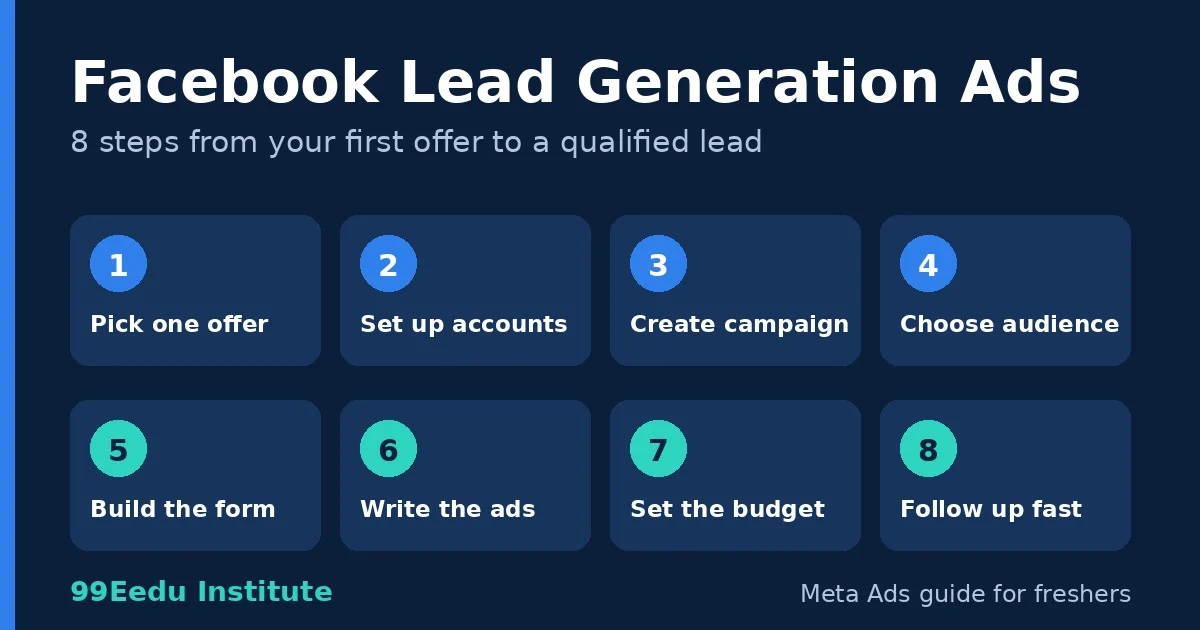
Follow eight steps in order: account setup, Leads objective, audience, budget, creative, form, automation and launch. Meta moves buttons around often, so menu names may look slightly different on your screen. The logic stays the same. This is the full Facebook Ads lead generation strategy in one pass.
Step 1: Pick one offer and decide what a “lead” means
Pick one specific offer people want this week, then write down exactly what counts as a lead before you spend a rupee.
Vague offers kill campaigns. “Contact us for details” gives nobody a reason to tap. “Free 15-minute Instagram audit for your shop” does.
| You are | Your offer | A lead means |
|---|---|---|
| Freelance designer | Free logo concept review | Phone number plus business type |
| Home tutor or coach | Free demo class | Parent’s phone plus class level |
| Fresher running ads for a local salon | First-visit discount coupon | Phone number plus preferred day |
| Student building a skill business | Free 20-minute career call | Name, phone and qualification |
Set your price ceiling first: decide the highest amount you can spend to get one lead. Multiply your average sale value by your close rate, then by the share of that sale you’ll spend on ads. Example: ₹5,000 × 10% × 30% = ₹150 target cost per lead.
Your close rate is a guess today. That’s fine. If you’re spending money on leads, real data will rectify it within 30 leads. 99Eedu Institute’s advice to every learner: choose an offer you can deliver on day one, because a promise you can’t keep burns your first leads.
Step 2: Set Up Your Accounts
Before your first lead ad can run, you need a Facebook Page, an Instagram professional account, a Meta ad account, a payment method and a privacy policy link.
Do these in order:
- Create a Facebook Page for the business, or for your own freelance brand. Add a clear name, logo and contact details.
- Switch your Instagram account to professional and link it to the Page in Meta Business Suite.
- Open Ads Manager, create your ad account and add a payment method.
- Publish a privacy policy on a simple web page. Lead forms require the link. A free page builder plus a policy generator does the job.
- Build a lead tracker in Google Sheets with columns for name, phone, source, date, first reply time, status and sale value.
Do you need the Meta Pixel? Only if people convert on your website. Instant forms work without it. If you send traffic to a landing page instead, install the Pixel and the Conversions API so Meta can see each lead.
Where do leads land? Meta lets you download them as a CSV from Ads Manager, from the Instant Forms page, or from Leads Centre in Business Suite. That’s fine for week one. By week two, connect a CRM, an email tool or a free automation so leads reach you in seconds, not whenever you remember to check.
Step 3: Create the Leads campaign in Ads Manager
Open Ads Manager, click Create, pick the Leads objective, and choose where people will convert. That’s the core of how to run Meta Ads for leads.
Follow this sequence:
- Click Create and choose Leads. Meta may push you into an Advantage+ leads flow. For your first test, I’d pick the manual setup, so you see every setting.
- Name the campaign something you’ll recognise in three months, such as “Nov 2026 | Free career call | Leads.”
- Switch on the Advantage+ campaign budget. Older guides call it CBO. It lets Meta move money to the ad set that works.
- At the ad set level, choose your conversion location.
| Conversion location | Pick it when | Watch out for |
|---|---|---|
| Instant forms | You want fast, cheap volume on mobile | Quality varies, because the form pre-fills |
| Website | You own a landing page and the Pixel | Fewer leads, usually higher intent |
| Website and instant forms | You want Meta to choose the path each person finishes | Less control over where each lead comes from |
| Calls | Someone can answer the phone quickly | Missed calls waste your spend |
| Messenger, Instagram, WhatsApp | Your sales happen in chat | You must reply fast |
For a first test of Facebook lead generation ads, choose Instant Forms. It needs no website, no developer and no Pixel, which makes it the simplest way to get leads from Facebook Ads on day one. You can add a landing page later, once you know the offer works.
Step 4: Build your audience without overthinking it
Start broad: set your location and age range, keep Advantage+ audience on, and let your creative do the targeting.
This is the Facebook Ads lead generation strategy that surprises most beginners. Stacking twelve interests feels smart. It usually backfires. Meta’s system finds buyers faster when you give it room, and your ad copy already filters people. A student who sees “Final-year? Get a free resume review” knows the ad is for them.
Here’s what to set:
- Location. Use your city or a 10 to 15 km radius for local services. Use a country or state for online offers.
- Age. Match your buyer. For student and fresher offers, 18 to 28 works as a start.
- Exclusions. Exclude past leads and customers so you don’t pay twice for the same person.
- Placements. Keep automatic placements on. They include Instagram feed, Stories and Reels, so your Instagram lead generation ads run without extra setup.
- Narrow offers need more help. If you sell to a specific job role, add audience suggestions such as relevant interests and upload a customer list so Meta can find similar people.
That’s the whole audience setup for Facebook lead generation ads at the testing stage. Retargeting comes later, once you have video viewers, form openers and website visitors to bring back.
Step 5: Design an instant form that filters for quality
Use a short form with two or three qualifying questions, and switch to the higher-intent form type when you want fewer but better leads.
The form decides your lead quality more than any other setting. Fewer fields bring more leads. More friction brings more serious leads.
| Form type | What happens | Use it when |
|---|---|---|
| More volume | Pre-filled details, one tap to submit | You want cheap leads fast |
| Higher intent | Adds a review step so people confirm details | Your team calls every lead |
Here’s a sample form for a free career counselling call:
- Intro screen: “Free 20-minute career call. A counsellor phones you within one hour.”
- Fields: full name, phone number (email is optional).
- Question 1: “Where are you now?” Options: final-year student, graduate, working fresher.
- Question 2: “When do you want to start?” Options: this month, within three months, just exploring.
- Thank-you screen: “Done. Save our number and watch for our WhatsApp message.” Add a button that opens a WhatsApp chat.
Use multiple-choice questions, not typed answers. People finish them faster, and you can sort the answers in your sheet.
Preview the form on your own phone before you publish. Submit a test lead. Check that it reaches your sheet. One broken field can waste your entire first week.
Step 6: Write ads that stop the scroll
Open with the result your reader wants in the first line, then give one offer and one action.
With broad targeting, your creative does the targeting. People who relate to the words step forward. Everyone else scrolls past, which saves your budget.
Use this copy order: problem, offer, proof, action. Here’s an example for a resume offer:
Final-year and still no interview calls?
- Get a free 15-minute resume review from a working recruiter. We’ll mark exactly what to fix.
- Tap “Get offer,” fill in two answers, and we’ll message you on WhatsApp today.
Then build the visuals:
- Format. Test one vertical video of 15 to 30 seconds with captions, one single image and one carousel. Three to five ads is plenty.
- First three seconds. Display the person or the result, not your brand.
- Real photos. Use your own photos, student results and screenshots. People ignore stock photos because they appear to be advertisements.
- Matching promise. The ad headline, form intro and thank-you screen must all say the same thing. A mismatch tanks form completion.
- Policy check. Offers on credit, jobs, housing and similar topics carry targeting limits on Meta. Read the rules before you launch.
Write three different hooks for the same offer and test them against each other. The hook usually moves results more than the budget does.
Step 7: Set a small budget and run a clean test
Plan for roughly 50 leads a week per ad set: multiply your target cost per lead by 50, then divide by 7 to get your ideal daily budget.
A lead generation campaign on Facebook needs about 50 results in around a week before Meta’s delivery system settles down. With a ₹150 target, the math gives ₹150 × 50 ÷ 7, which is about ₹1,070 a day.
That’s more than most students have. So here’s the honest plan for a ₹300 to ₹500 daily budget: run one ad set with two or three ads, accept slower learning, and judge the test over two weeks, not two days. Facebook lead generation ads reward patience far more than they reward big spending. At 99Eedu Institute, we tell learners to treat their first ₹3,000 to ₹5,000 as tuition, not profit.
| Week | What you do | What you don’t do |
|---|---|---|
| 1 | Launch one ad set, three ads. Check the form works. | Edit anything for the first 3 to 4 days |
| 2 | Pause the weakest ad. Read lead quality, not just cost. | Add new audiences |
| 3 | Add two new hooks against your best ad. | Raise the budget by more than 20% |
| 4 | Scale the winner by about 20% every few days. | Judge by cost per lead alone |
Keep the structure simple. One campaign, one or two ad sets, three to five ads. Meta learns faster when each ad set gets plenty of data.
Refresh your creative every two to four weeks. When your click rate drops and the same people keep seeing the ad, the audience is tired of it. New hook, same offer.
Step 8: Follow up fast and track lead quality
Reply to every lead within minutes, because speed is the cheapest way to raise your close rate.
This is also how to generate quality leads online. Ads bring names. Follow-up turns names into customers. A lead that waits a day has already forgotten your ad.
Here’s a routine you can run from your phone:
- Send leads straight to your sheet or CRM in real time.
- Send a WhatsApp or SMS within five minutes: “Hi Riya, this is Aman from [your brand]. Thanks for requesting the free resume review. Does 6 pm today work for a quick call?”
- Call within the hour. Two attempts, at different times.
- Update the status column the same day: new, contacted, qualified, sold, dead.
Meta optimises for form completions. That’s not the same as qualified leads. So judge the campaign by what happens after the form.
| Metric | What it tells you | If it’s weak |
|---|---|---|
| Cost per lead | How cheaply you buy form fills | Test new hooks, shorten the form |
| Qualified lead rate | Whether leads fit your offer | Add a question or use Higher intent |
| Cost per qualified lead | The number to optimise | Tighten the offer and ad promise |
| Cost per customer | Whether the channel pays back | Fix follow-up speed and your pitch |
| Click-through rate | Whether the ad earns attention | Rewrite the first line and visual |
Once you have a steady flow, send your qualified-lead data back to Meta through the Conversions API. The system then learns what a good lead looks like for you. Keep your lead sheet for every campaign you run. It becomes proof of work you can show in interviews or to freelance clients, and 99Eedu Institute encourages every learner to build that portfolio.
Instagram Lead Generation Ads: What to Change
Instagram lead generation advertisements use the same Instant Form, but they need faster hooks, vertical video and a more native, less polished look. Students decide in about a second on Reels.
- Put your hook as text on the very first frame.
- Shoot in a creator style: real voice, real desk, no heavy studio feel.
- Check placement results. Reels, Stories, and Feed often perform differently.
- Polish your profile first: clear bio, highlights, a pinned proof post.
Expect casual intent. Add a qualifying question to the form.
Budget and Testing Plan for Your First 30 Days
Test one variable at a time across four weeks: offer first, creative second, audience third, form fourth. Changing everything at once teaches you nothing.
| Week | What you test | Example daily budget | Decision rule |
|---|---|---|---|
| 1 | Three creatives, one offer | ₹500 | Keep the one with the lowest cost per qualified lead |
| 2 | Winning creative with a second offer | ₹500 | Keep the offer that books more calls |
| 3 | Broad audience vs. interest suggestions | ₹500 each | Keep the audience with better lead-to-call rate |
| 4 | Short form vs. higher-intent form | ₹500 each | Scale the winner by 20% |
These budgets are examples. Pick numbers that match your own situation, and never borrow money for ads.
How to Generate Quality Leads Online
Quality leads come from adding smart friction, not from chasing the lowest cost per lead. Facebook lead generation ads reward volume by default. If you change nothing, you collect many weak leads.
| Lever | Effect on volume | Effect on quality |
|---|---|---|
| Higher intent review step | Lower | Higher |
| One qualifying question | Slightly lower | Higher |
| Price or eligibility stated in the ad | Lower | Much higher |
| Phone verification through your CRM | Lower | Higher |
| Conversion-leads optimisation | Neutral | Higher |
| Real trainer or founder on video | Neutral | Higher |
Sort leads into three buckets, so your team knows who to call first:
- Hot: right profile, right year, wants to attend this week.
- Warm: right profile, unsure about timing.
- Cold: doubtful answers, wrong location, or no clear need.
Call hot leads first. Nurture warm leads with a helpful message. Review cold leads weekly to learn what to fix in the ad.
Follow-Up: Where Most Leads Are Won or Lost
Contact every lead within five minutes, because interest fades fast and other advertisers reply quickly. I have watched good ads fail only because nobody picked up the phone.
Use a three-touch rhythm:
- Minute 5: call. If they do not answer, move to step two.
- Minute 6: send a short WhatsApp message with your name and why you called.
- Next day: call once more, then send one useful tip or free resource.
A simple call script:
“Hi Riya, this is Aman from 99Eedu Institute. You just asked for a free resume review on Facebook. Is now a good time for two quick questions?”
Keep it friendly. Ask, listen, then offer the next step. Never read a script word for word.
Five mistakes freshers make with Meta Ads lead generation
The five costliest beginner mistakes are boosting posts, chasing the cheapest leads, replying late, making vague offers and editing the campaign constantly.
- Boosting posts instead of using the Leads objective. Fix: build the campaign in Ads Manager and pick Leads.
- Chasing the lowest cost per lead. Cheap leads often never answer the phone. Fix: track cost per qualified lead.
- Replying tomorrow. Fix: message within five minutes and call within the hour.
- Offering “free consultation” with no detail. Fix: name the outcome, the time and the person who will deliver it.
- Editing every day. Every big change can restart learning. Fix: wait three to four days, then change one thing at a time.
Your 2027-Ready Launch Checklist
Run through this list before you press Publish.
- One offer, one promise, written in one sentence.
- Facebook Page and Instagram profile look real and complete.
- Proof page exists, with a bold, direct answer at the top, a short FAQ and consistent brand details.
- Leads objective, Instant Form, Higher intent turned on.
- Three to five form questions, with one qualifying question.
- Privacy policy link added.
- Leads flow into a Sheet or CRM automatically.
- Auto-reply message and call script ready.
- Someone is free to call within five minutes.
- Scorecard ready: cost per qualified lead, lead-to-call rate, show-up rate.
How 99Eedu Institute Helps You Learn Meta Ads
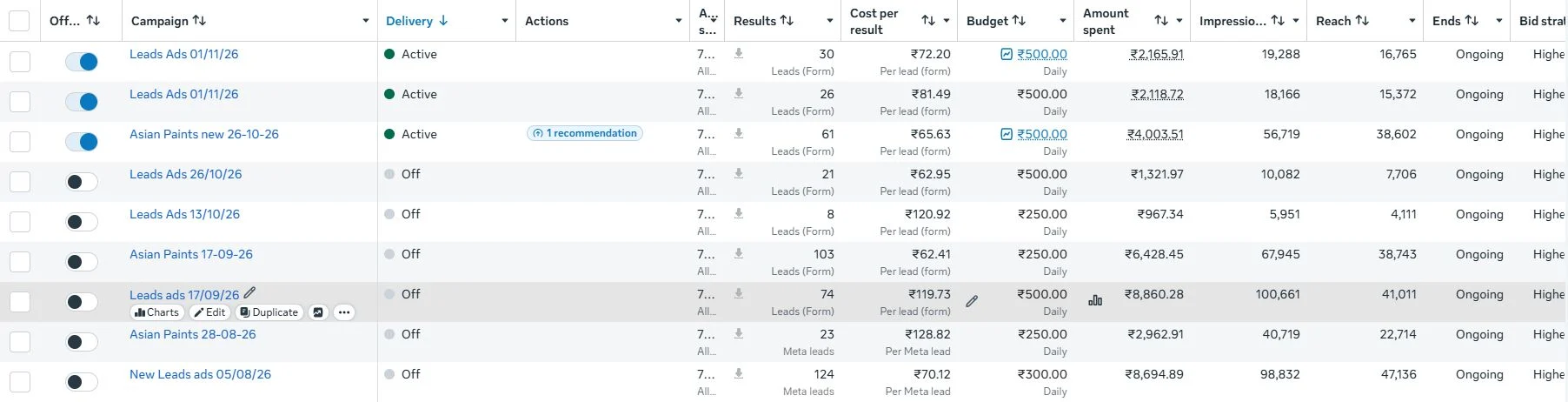
99Eedu Institute teaches a practical social media marketing course through step-by-step lessons, live campaign practice and one-on-one mentor feedback, so you learn by doing instead of only watching. You don’t need a marketing background. We start from zero and build up to running real campaigns on your own.
What You Learn in the Course
- Social media basics: how Facebook, Instagram and other platforms work, and how people find businesses there.
- Content and creative: writing hooks, scripts, captions and ad copy that students and freshers actually stop for.
- Meta Ads: setting up accounts, choosing objectives, building audiences and creating lead forms.
- Lead generation: getting quality leads, not just clicks, and following up fast.
- Tracking and reports: reading cost per lead, cost per qualified lead and lead-to-call rate to judge what works.
How You Learn It, Step by Step
| Stage | What you do | What you gain |
|---|---|---|
| 1. Understand | Learn the concepts in simple language | Clear basics, no confusion |
| 2. Practice | Build pages, posts and campaigns on real accounts | Hands-on confidence |
| 3. Create | Write and design your own ads and content | A portfolio you can show |
| 4. Measure | Study your results and find what to fix | Skill to improve campaigns |
| 5. Improve | Get mentor feedback and try again | Faster progress, fewer mistakes |
How to Get the Most From the Course
- Practice every day. Even 30 minutes of hands-on work beats a long weekend of passive watching.
- Build your own project. Promote a freelancing service, a campus event, or a modest concept. Real goals teach faster.
- Ask questions early. Mentors can fix a small confusion before it becomes a big mistake.
- Save your work. Keep your ads, forms and reports in one folder. That becomes your portfolio.
- Review your numbers weekly. Learn to judge by results, not feelings.
Who this course is for: students, graduates and freshers who want a skill before graduation, a first digital marketing job, freelance clients, or help promoting their own project.
About the Author
Written by Year Ali (Yeash), Senior SEO & PPC Specialist and Trainer at 99Eedu Institute, Kolkata.
Yeash has 5 years of hands-on experience in SEO, Google Ads and Meta Ads. He teaches students to run campaigns that bring real leads, not just clicks, starting with tracking and lead quality. In this guide, he shares the exact steps he uses to set up Facebook lead generation ads, filter weak leads and follow up fast.
Connect: (LinkedIn Profile).
People Also Ask
Q1. How much money do I need to start Facebook lead generation?
Start with ₹300 to ₹500 a day for 7 to 10 days, roughly ₹3,000 to ₹5,000 in total. That’s enough for a first signal. Your real cost per lead depends on your city, offer and form type, so measure it yourself.
Q2. Can a fresher run Meta Ads without experience?
Yes, if you start with one offer, one campaign and a small budget. Follow the eight steps above, use an Instant Form, and learn from real data
Q3. Do I need a website to get leads from Facebook Ads?
No. Instant forms collect contact details inside Facebook and Instagram, with no website or Pixel required. Add a landing page later if your offer needs explaining or you want higher-intent leads.
Q4. How long do Facebook lead ads take to work?
Expect about one week for Meta’s learning phase and two to four weeks to compare ads fairly. Judge results by cost per qualified lead, not first-day numbers.
Learn Meta Ads With 99Eedu Institute
Pick one offer today. Build your form tomorrow. Launch your first Facebook lead generation ads campaign this weekend. At 99Eedu Institute, you learn it hands-on with a mentor beside you, so you can run campaigns on your own.
Ready to run your first campaign with a mentor beside you? Message the 99Eedu Institute team through our official channels and ask about our Meta Ads training.
Share on:

Quick Enquiry
Please fill up the form and we will get back to you in next 12 hours!
